
The question I hear most often from men considering a facelift is not "Will it work?" It is "Will people be able to tell?"
That single concern — the fear of looking operated on, pulled, or simply different — stops more men from seeking treatment than almost anything else. And it is a completely valid concern. We have all seen results that look wrong: skin stretched too tight, a face that no longer moves naturally, features that have been softened into something unfamiliar. For men, the stakes feel even higher because masculine facial characteristics are less forgiving of surgical error.
But here is what I tell every male patient who sits in front of me: a bad facelift result is almost never accidental. It is the consequence of specific, identifiable planning mistakes. Understanding what those mistakes are — and how a skilled surgeon avoids them — is the most important thing you can do before choosing to have surgery.
This post covers the real anatomy behind natural-looking male facelift results, including details that most surgeons rarely discuss openly: the tragus incision decision, what happens to your beard after surgery, and why your sideburn is one of the most important factors in the entire operation.
What Actually Makes a Male Facelift Look Unnatural?
Before we talk about solutions, it helps to understand the problem. There are three root causes of an unnatural facelift result in men:
1. Skin tension that is too high. When a facelift relies primarily on pulling the skin — rather than repositioning the deeper tissue layers (the SMAS) — the result looks stretched. The face appears flat, the corners of the mouth pull sideways, and expressions become stiff. This is what creates the classic "windswept" look.
2. Disruption of male facial landmarks. Men have specific features — a defined jawline, a strong chin angle, a squared lower face — that define masculine appearance. Surgery that shifts or softens these landmarks, even unintentionally, produces a feminised result that men find deeply unsettling.
3. Visible scarring or displaced hair-bearing skin. This is the most male-specific problem, and it deserves far more attention than it typically receives. Beard skin, sideburns, and the temporal hairline are all involved in a facelift. If incision placement and skin movement are not planned with these structures in mind, the results can include beard hair growing on the ear, a sideburn that has been lifted away from its natural position, or scars sitting in exposed, shave-prone skin. These are the signs that tell the world — and your barber — exactly what you have had done.
The Most Important Decision in Male Facelift Surgery: Pre-Tragal vs. Retro-Tragal Incision
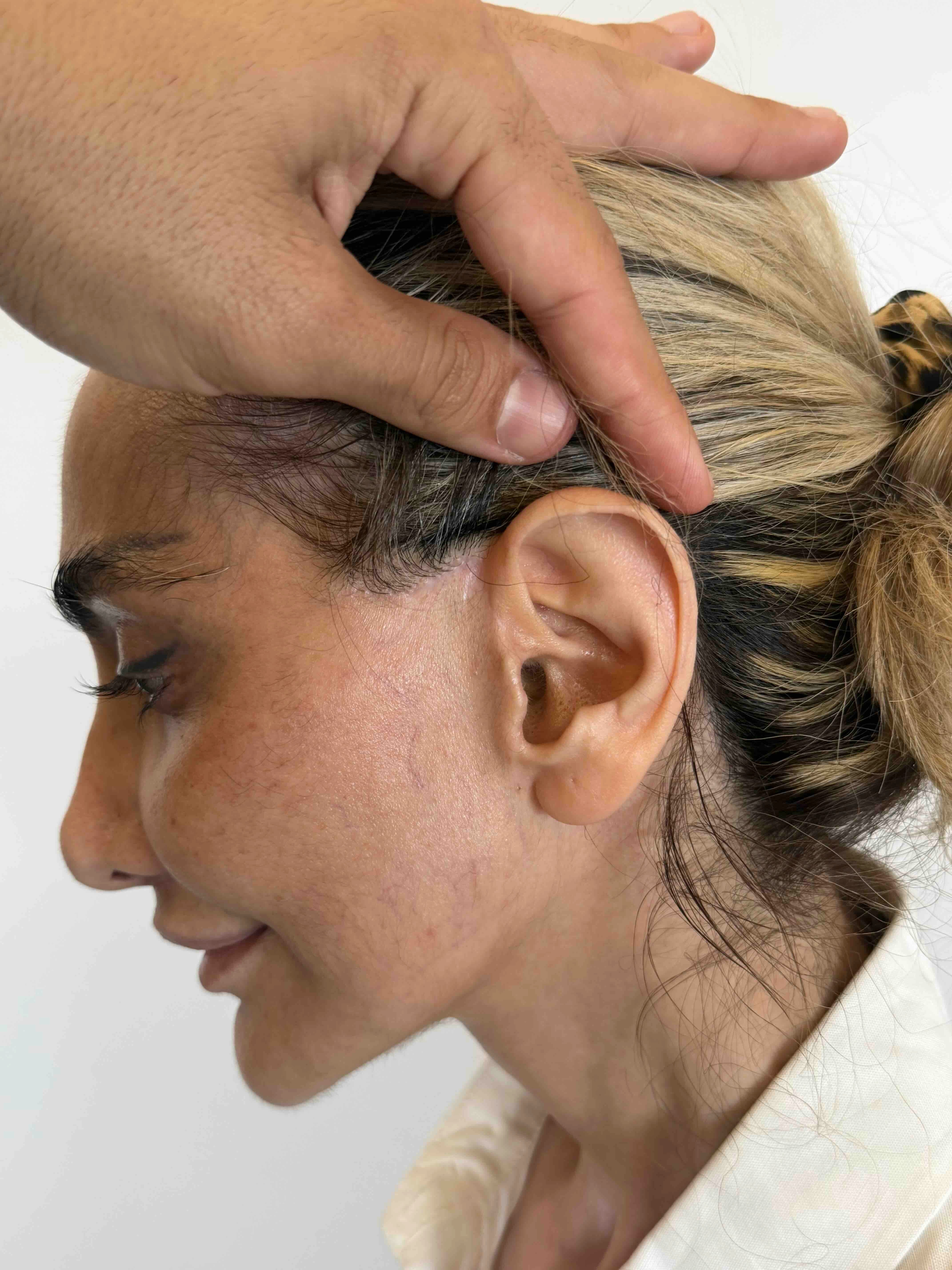
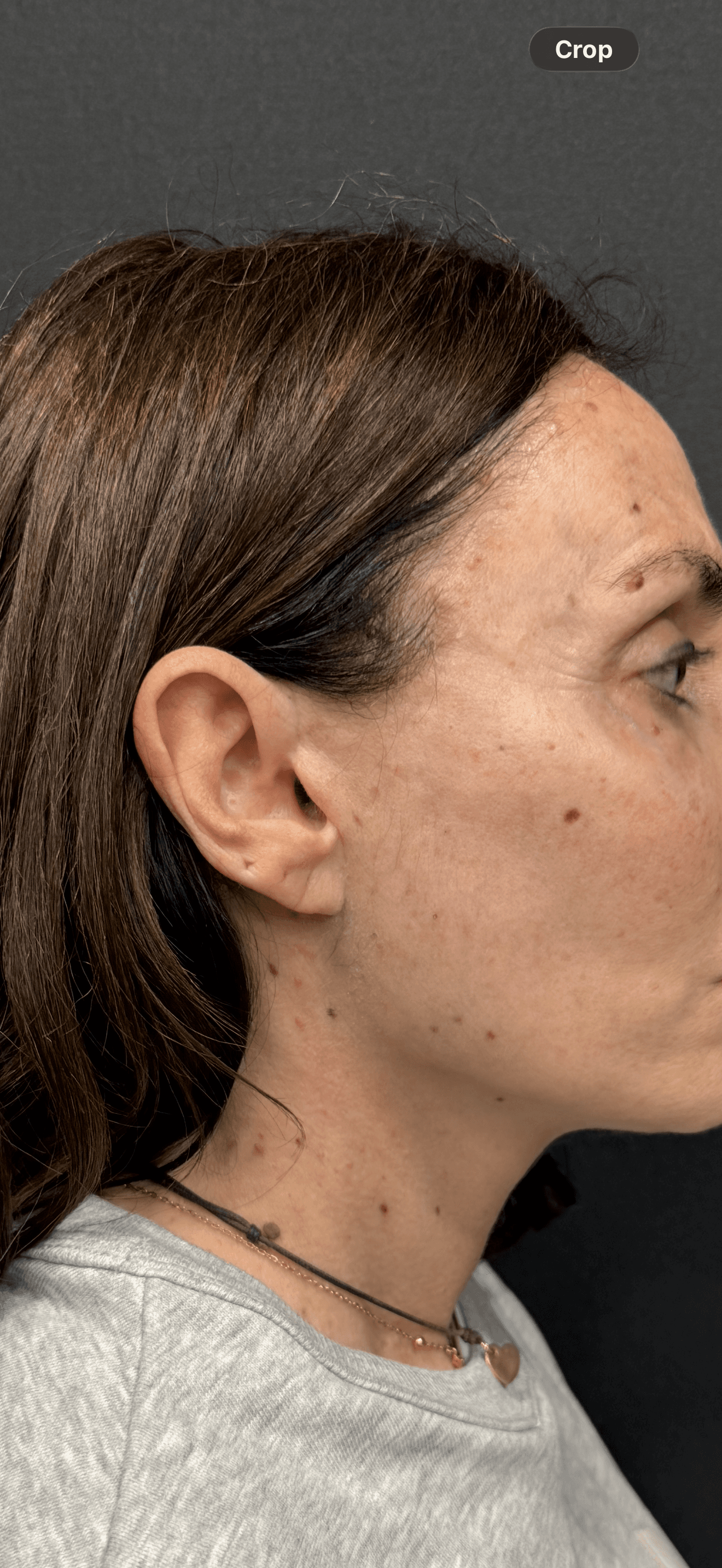
The tragus is the small cartilage projection that sits just in front of your ear canal. How we position the facelift incision around it is one of the most consequential decisions in male facelift surgery — and it is a decision that does not exist in quite the same way for female patients.
The Retro-Tragal Incision (Behind the Tragus)
In most female facelifts, the incision runs behind the tragus — tucked into the natural fold between the tragus and the face. This keeps the scar almost completely hidden, and because women do not have beard hair in this area, there is no concern about hair displacement.
For men, this incision is still possible and can produce the most invisible scar of the two options. However, it introduces a specific risk: when the facial skin is lifted and repositioned upward and backward during surgery, beard-bearing skin can migrate toward the tragus. This means that after surgery, a man may find that he has hair growing on or very near the tragus — an area that previously had none.
This is not a catastrophic complication, and it is very manageable. A few sessions of laser hair removal in that area, several months after surgery, resolves it completely. But patients must be aware of this possibility before committing to the retro-tragal approach.
There is one more technical point that matters enormously with this incision: the soft tissue layer covering the tragus must be kept very thin during surgery. If the skin flap is too thick when it is redraped over the tragus, the natural definition and projection of the cartilage is lost. The ear starts to look flat and unnatural. Precise tissue handling in this area is not optional — it is essential.
The Pre-Tragal Incision (In Front of the Tragus)
The alternative is to place the incision just in front of the tragus, running along the border where the face meets the ear. This scar sits in a slightly more visible position than the retro-tragal approach, but it completely eliminates the risk of beard hair migrating onto the tragus.
For many male patients — particularly those who have a naturally deep skin crease or fold just in front of the tragus — this is an excellent choice. The fold camouflages the incision effectively, and the scar often becomes nearly invisible once fully healed.
The right choice between these two approaches depends on the individual patient: the amount of skin to be removed, beard density and distribution, skin quality, and the anatomical structure around the ear. There is no universal answer. Both options require experience with male facial anatomy specifically — not just facelift technique in general.
What Happens to Your Beard After a Facelift?
This is something many patients do not think about, and many surgeons do not explain clearly enough.
During a facelift, the skin of the face, jaw, and neck is lifted and repositioned upward and posteriorly — toward the ear and behind it. The beard does not disappear. It moves with the skin.
What this means in practice is that the beard-bearing skin under the jaw migrates upward and backward toward the earlobe. In most cases, this shift is modest and the resulting hair pattern remains natural-looking. But in cases where a significant amount of skin is being removed — particularly in men with heavier jowling or significant neck laxity — the beard hair can travel further than expected. The hairline along the lower jaw rises. In some cases, beard hair can appear behind the earlobe, in an area that was previously clean-shaven skin.
As with the tragus situation, this is manageable. Laser hair removal several months post-operatively resolves it easily. But it must be anticipated and discussed during the planning stage. Surgeons who are not accustomed to operating on male patients sometimes overlook this entirely, which leads to a result the patient was not prepared for.
Understanding the extent of skin movement — and therefore the expected beard shift — is part of what separates surgeons experienced in male facelift surgery from those who are not.
Protecting the Sideburn: The Detail That Defines Masculine Appearance
Of all the anatomical landmarks in male facelift surgery, the sideburn may be the one that most clearly separates a natural result from an obvious one.
Men's sideburns are a defining feature of masculine facial structure. They frame the face, anchor the hairline, and are immediately noticeable when they are wrong. A facelift that pulls the sideburn upward, thins it out, or distorts its shape leaves a visible and permanent signal that something has been done — one that no amount of styling can hide.
The challenge is that the facelift incision must travel around the temporal region, in the area where the sideburn meets the temple. How we handle this part of the incision depends on how much skin needs to be removed.
When skin removal in the temporal region is significant, the correct approach is to place the incision along the hairline itself — just at the border of the sideburn. This allows the excess skin to be removed while keeping the sideburn exactly where it belongs. The scar sits at the hairline edge, which for most men is well-concealed by natural hair styling.
When skin removal in this area is minimal — less than one to two centimetres around the sideburn — we can instead direct the incision into the hair, running it inside the hairline and leaving the sideburn completely untouched. The scar hides within the hair, and the sideburn remains entirely natural.
The decision between these two approaches cannot be made by formula. Every male facelift patient must be assessed individually. The amount of skin laxity, the density and shape of the sideburn, and the overall hairline pattern all influence the correct choice. Getting it wrong in either direction creates a result that is difficult or impossible to reverse.
Why Skin Tension Is Not the Answer
Natural male facelift results are not achieved by pulling the skin harder or tighter. They are achieved by repositioning the deeper structural layers of the face — the SMAS (superficial musculoaponeurotic system) and the platysma muscle in the neck.
When these deeper layers are properly lifted and secured, the overlying skin can be redraped with minimal tension. This produces a result that looks refreshed and natural rather than stretched or pulled. Facial expressions remain fluid. The jawline is defined without appearing carved. The neck is smooth without looking rigid.
This approach also produces longer-lasting results, because the structural changes are supported by tissue that holds sutures well — unlike skin, which stretches over time and cannot maintain surgical improvement on its own.
For male patients with significant neck laxity or platysmal banding — the vertical cords that appear in the neck with age — a platysmaplasty is frequently performed alongside the facelift to address these structures directly. You can read more about how this combines with neck lift surgery on the neck lift procedure page.
Why Consultation Matters So Much
Everything described above — incision placement, beard migration, sideburn preservation, tissue handling around the tragus — must be discussed and decided before surgery, not during it.
A proper male facelift consultation is a detailed conversation about your specific anatomy, your goals, your beard pattern, your hairline, and the realistic trade-offs involved in different surgical approaches.
Questions worth asking in that conversation include:
Where exactly will my incisions be placed, and why?
What will happen to my beard hair after surgery?
How will my sideburn be affected, and how will you protect it?
How much skin do you anticipate removing, and how does that influence the plan?
What is your specific experience with male facelift patients?
If a surgeon cannot answer those questions clearly — based on your anatomy — that tells you something important.
See a Real Male Facelift Result
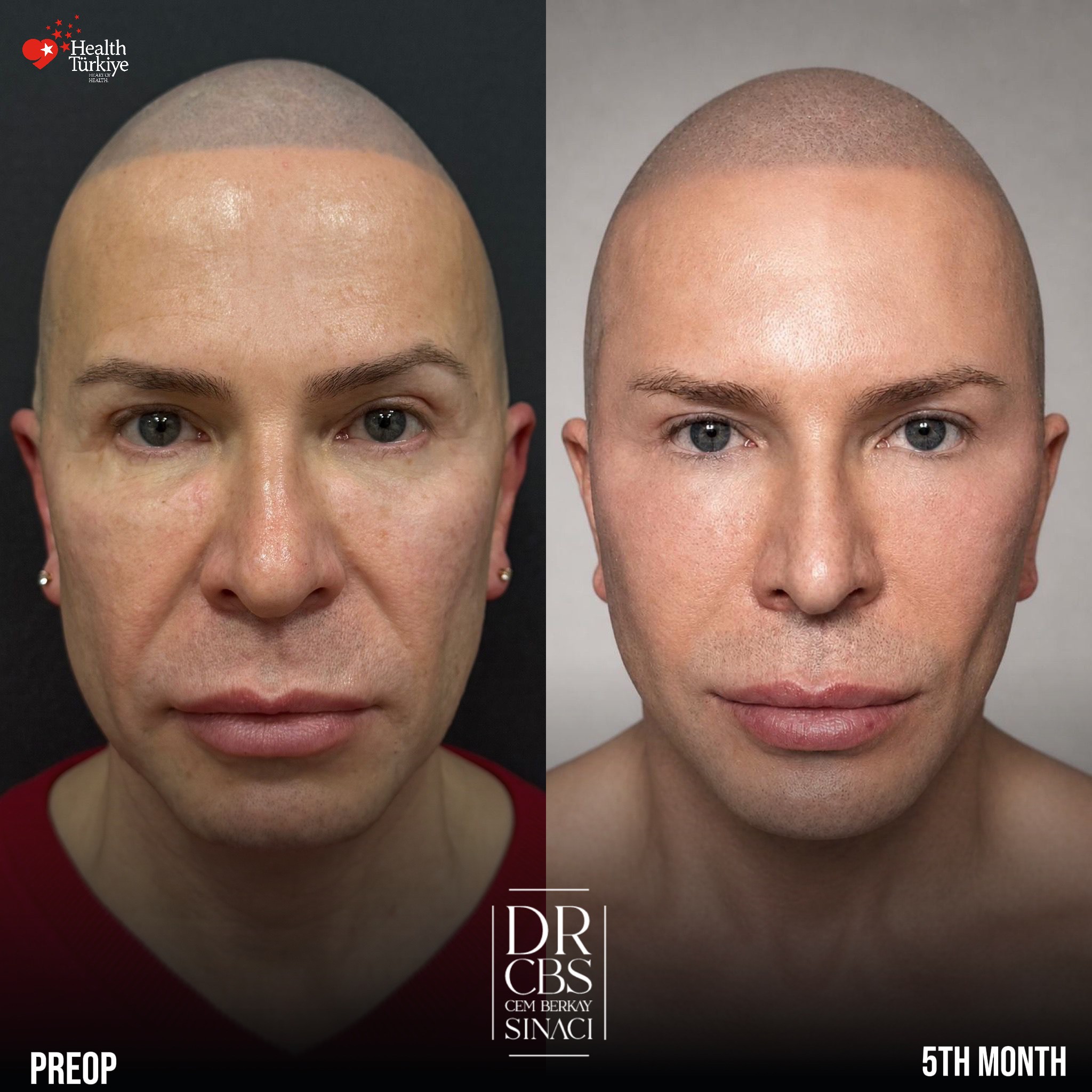
Michael, a 67-year-old patient who traveled from the United States, underwent a combined deep plane facelift and neck lift to address significant jowling and turkey neck banding. His case illustrates the combination of techniques — including careful incision planning around the ear and platysmal work — that produces a natural, masculine result.
You can read his full story here: Michael's Facelift and Turkey Neck Surgery, and view his before and after photos in the gallery.
Frequently Asked Questions
Will people be able to tell I had a facelift?
A well-planned facelift by a surgeon experienced with male patients should produce results that read as "refreshed" rather than "operated on." The goal is for people to notice you look well — not to notice that you had surgery.
Can beard growth really end up on my ear?
Yes, this is a real phenomenon that occurs when beard-bearing skin migrates toward the ear during tissue repositioning. It is manageable with laser hair removal and must be discussed as part of pre-surgical planning.
Will my sideburn move after a facelift?
It can, if incision planning does not account for it. A surgeon experienced in male facelift surgery will evaluate your specific anatomy and choose the approach that protects your sideburn appropriately.
How long until final results are visible?
Most patients see the majority of their result within three to four months. Full tissue settling and scar maturation can take up to twelve months. Beard regrowth patterns in repositioned areas typically normalise within a few months, and any laser hair removal can begin once the tissue has fully healed.
Is a facelift the only option?
For significant jowling, neck laxity, and skin excess, a surgical facelift remains the only treatment that produces lasting structural change. You can learn more about the full range of options on the facelift information page.
Conclusion
The fear of looking "done" is exactly the right thing to think about before choosing a surgeon. Natural male facelift results are not the product of luck — they are the product of precise anatomical planning: knowing where to place every incision to protect the beard, the tragus, and the sideburn; knowing how to move deeper tissues so that skin does not carry the tension; and knowing that every patient's anatomy requires an individual approach.
If you are considering a male facelift and want to understand what the right approach would be for your specific anatomy, I am happy to review your case.
You may also find these resources useful:
Dr. Cem Berkay Sınacı is a European and Turkish board-certified plastic surgeon based in Istanbul, Turkey. He is a Fellow of the European Board of Plastic, Reconstructive and Aesthetic Surgery and a member of ISAPS and ASPS. His practice focuses on facial rejuvenation surgery, with a particular emphasis on natural-looking results for both male and female patients.