
Author: Dr. Cem Berkay Sinaci, M.D. — European and Turkish Board-Certified Plastic Surgeon Published: August 2026 Category: Face & Neck Aesthetics Estimated Reading Time: 10 minutes
Quick Tip: A facelift lifts and repositions the deeper structures of the face. It does not change the quality of the skin itself. Fractional CO2 laser skin resurfacing does the opposite — it resurfaces the skin, softens wrinkles and tightens pores, but it lifts nothing. That is exactly why I perform fractional CO2 laser skin resurfacing on most of my facelift patients as the final step of the surgery, while they are still asleep in the operating room. One anaesthetic, one recovery, and a result that is lifted and resurfaced.
In this article I explain how ablative and fractional CO2 laser resurfacing work, how I choose the laser dose for each patient, what recovery actually looks like at high and low doses, why sun protection is non-negotiable afterwards, and when CO2 laser can replace a small operation such as a skin pinch lower blepharoplasty.
What Is CO2 Laser Skin Resurfacing?
CO2 laser skin resurfacing is an ablative laser treatment. The carbon dioxide laser beam is absorbed by the water inside the skin cells and vaporises a controlled depth of the surface — the epidermis and, depending on the dose, part of the upper dermis. As the skin heals, it produces new collagen and a new, smoother surface layer.
There are two ways to deliver that energy, and the difference matters enormously for recovery:
Fully ablative CO2 laser resurfacing removes the entire surface of the treated area in one pass. It is powerful, but the healing is long and the risk of prolonged redness and pigment change is higher.
Fractional CO2 laser resurfacing delivers the energy in thousands of microscopic columns, leaving healthy untreated skin in between each column. Those untreated bridges of skin act as reservoirs of healing cells, so the skin repairs itself far faster while still getting a strong collagen response.
I use fractional CO2 laser skin resurfacing. It gives me the collagen stimulation and wrinkle reduction of an ablative laser with a recovery that fits inside the facelift recovery period rather than extending it.
Facelift vs Laser: Two Different Problems, Two Different Solutions
This is the single most useful thing a patient can understand before consultation.
When I perform a deep plane facelift, I release all of the facial retaining ligaments — zygomatic, masseteric cutaneous and mandibular — and reposition the SMAS and the skin together as a single composite flap. The skin and the SMAS are never separated from each other. In the face the vector is vertical; in the neck it becomes more horizontal, toward and behind the ear. That surgery corrects descent: jowls, a heavy midface, a lost jawline, a blunted neck angle.
What that surgery does not correct is the condition of the skin envelope itself. Fine perioral lines, crepey lower eyelid skin, enlarged pores, sun damage, uneven pigment and dull texture are surface problems. You can lift sun-damaged skin, and it will still be sun-damaged skin — only tighter.
That is why the phrase “laser facelift” is misleading. No laser lifts the SMAS, and no laser releases a retaining ligament. A laser resurfaces. A facelift lifts. Combining them in one operation is not marketing — it is treating two independent layers of ageing at the same time. The same logic drives my use of combined microfat and nanofat SVF fat injection: microfat restores lost volume, nanofat with stromal vascular fraction improves the skin from beneath, and CO2 laser improves it from above.
Why I Perform Fractional CO2 Laser Resurfacing During Facelift Surgery
For most of my full face rejuvenation patients, CO2 laser skin resurfacing is the last step of the operation — performed after the lift is complete, the incisions are closed and the fat grafting is done, while the patient is still under general anaesthesia.
There are real advantages to doing it this way rather than booking laser resurfacing as a separate treatment months later:
One anaesthetic, one recovery. The skin heals during the same downtime the facelift already requires. My international patients do not need a second trip to Istanbul.
No pain and no compliance problem. A full-face fractional CO2 session performed awake is uncomfortable and usually needs topical anaesthetic and nerve blocks. Asleep, it is nothing.
Better access to the skin. The face is prepped, draped and sterile, and I can treat right up to the eyelid margins and the vermilion border with precision.
The results mature together. Facelift swelling settles and laser-stimulated collagen builds over the same three to six months, so the patient sees one single, coherent improvement rather than two separate events.
Is It Safe to Combine Ablative CO2 Laser With a Facelift?
This is a fair question, and the answer depends on the facelift technique.
The concern with simultaneous laser resurfacing is blood supply. If the facelift has been performed by widely undermining the skin and separating it from the deeper layers, the skin flap survives on a reduced blood supply — and adding an ablative laser injury on top of that thin flap is not wise.
In a deep plane facelift the anatomy is different. Because the skin and the SMAS stay attached and move as one composite flap, the skin keeps its own perfusion from the deeper tissue. That preserved blood supply is what makes same-session fractional CO2 laser skin resurfacing safe in my hands, and it is one of the practical arguments for the deep plane technique that patients rarely hear about.
I also insist on FDA-approved CO2 laser devices. Laser resurfacing is safe when the energy delivery is predictable and reproducible; with uncertified equipment it is not. Device quality is a safety issue, not a luxury.
How I Choose the CO2 Laser Dose for Each Patient
There is no standard setting. The dose — energy, density and depth — is adjustable, and I adjust it individually for every patient. The variables I weigh are:
Age — older skin with deeper static wrinkles usually tolerates and needs more energy.
Skin type and Fitzpatrick phototype — darker phototypes (Fitzpatrick IV–VI) carry a higher risk of post-inflammatory hyperpigmentation, so I deliberately reduce the dose.
Skin thickness — thick sebaceous skin behaves very differently from thin, crepey eyelid or perioral skin.
Gender — male skin is typically thicker, with denser hair follicles and different healing.
Season and sun exposure — a patient going home to a New Zealand or Gulf summer is treated more conservatively than one recovering through a European winter.
The patient’s expectations and downtime tolerance — someone who can hide for two weeks is a different candidate from someone with a wedding in three.
That last point is not a compromise of quality. It is the honest reality that a laser dose the patient cannot look after properly is the wrong dose.
High Dose vs Low Dose: What Recovery Actually Looks Like
Patients want specifics, so here they are.
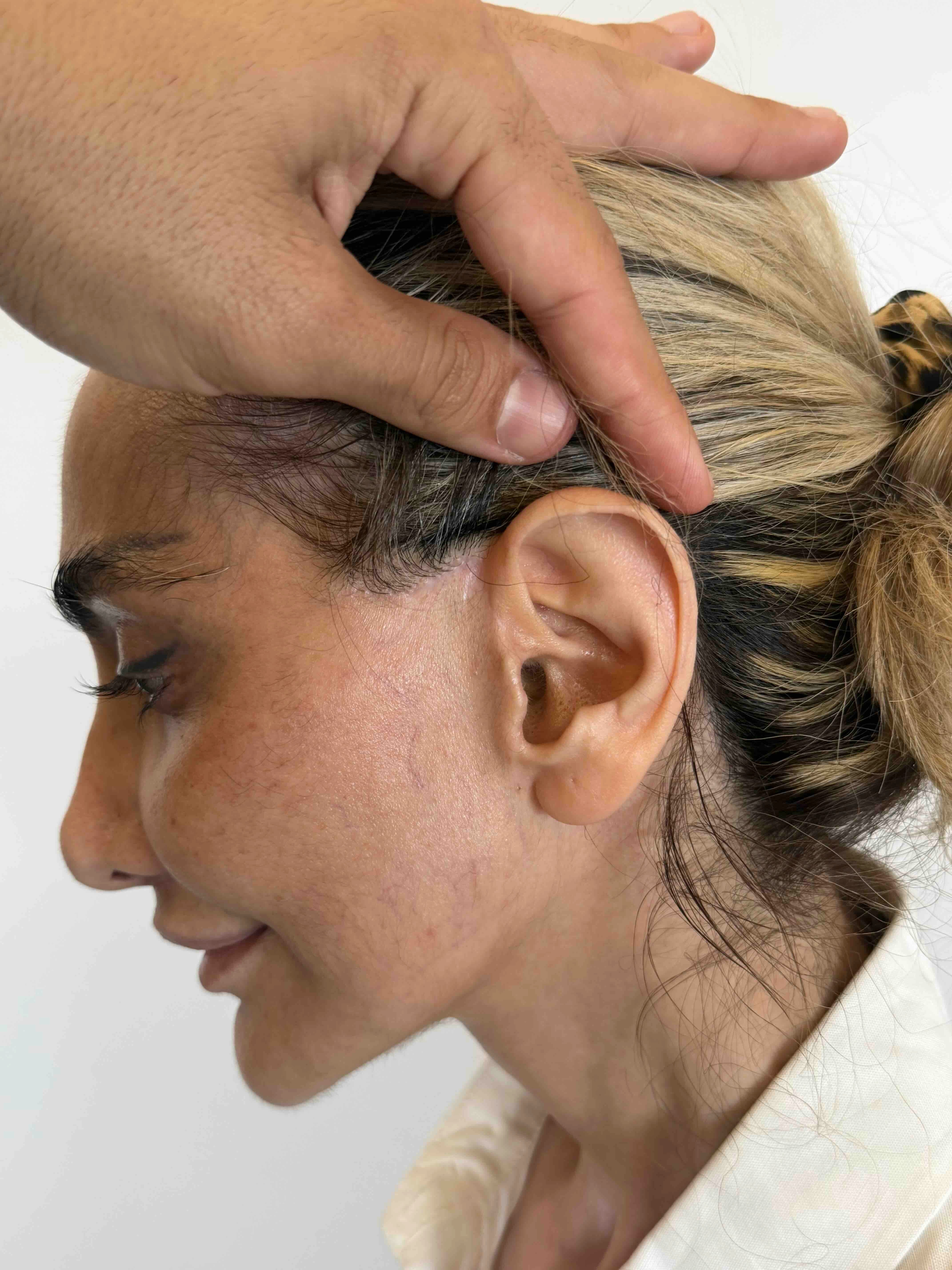
Higher-dose fractional CO2 laser resurfacing. Expect fine scabbing — a sandpaper-like crusting over the treated areas — for a couple of days. The scabs are small, superficial and part of normal healing. They are not to be picked. Once they separate, the new skin underneath is pink.
Lower-dose fractional CO2 laser resurfacing. Scabbing is not expected at all. Instead, the treated skin stays reddish, and that redness typically takes a couple of weeks to fade. It responds well to camouflage make-up once the skin is intact.
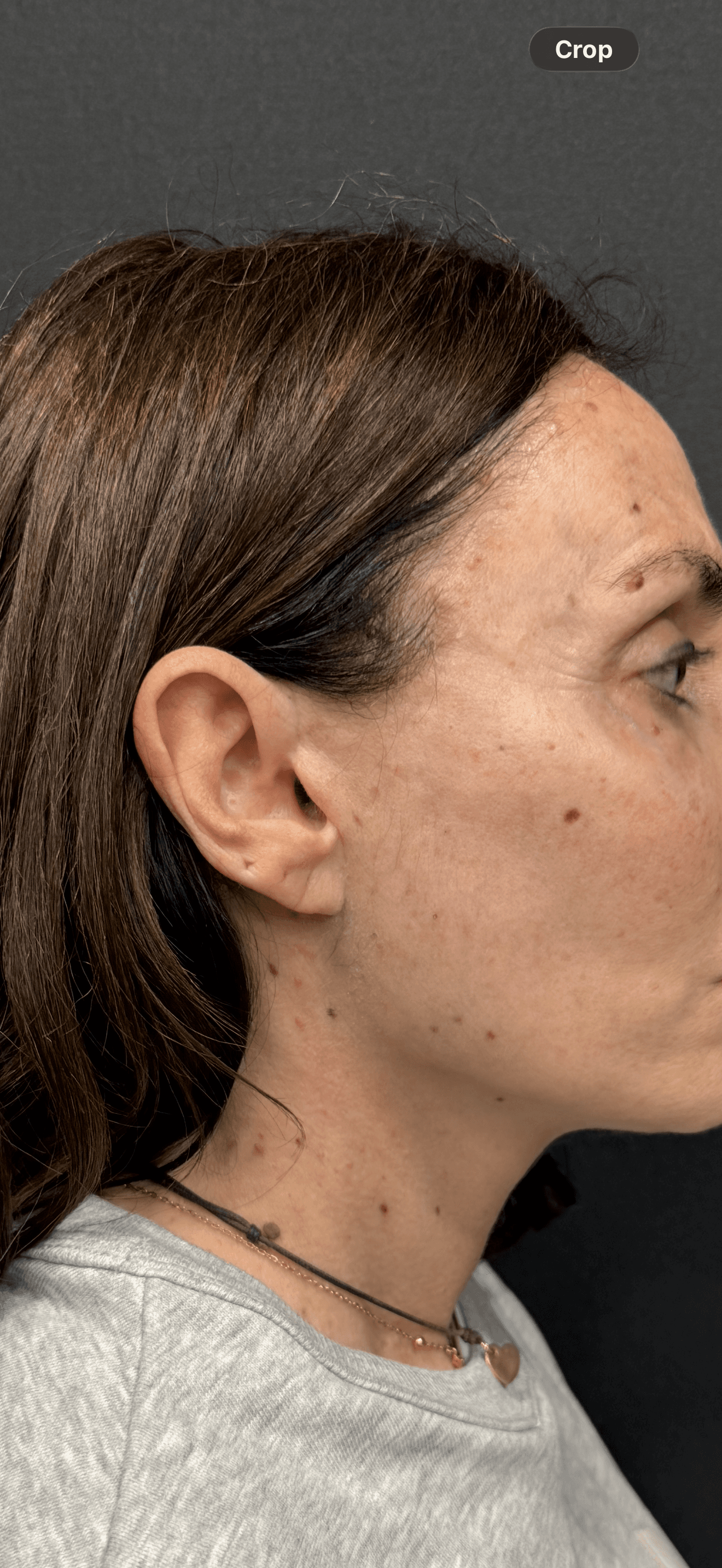
In both cases the redness is a sign of active collagen remodelling, not of damage. The final texture improvement continues to develop for months after the colour has normalised. You can see the combined outcome of surgery plus resurfacing across my before and after gallery.
Does CO2 Laser Make Facelift Recovery Longer?
No. In my experience, adding fractional CO2 laser skin resurfacing does not prolong the overall facelift recovery period.
What it can do is add a little swelling, particularly around the eyes, in the first days. That extra puffiness is expected and typically settles within a couple of days — well inside the timeline the facelift itself already requires. Patients who have had CO2 laser to the eyelid skin should be prepared for that appearance on day two or three and not be alarmed by it.
Which Areas Benefit Most from CO2 Laser Skin Resurfacing?
Fractional CO2 laser is at its best where wrinkles are fine, static and etched into the skin surface, and where pores are deep:
Around the mouth (perioral) — vertical lip lines are one of the areas that surgery alone can never fix, and where CO2 laser is most impressive. It pairs particularly well with a lip lift.
Around the eyes (periorbital) — crow’s feet and crepey lower eyelid skin, treated in continuity with blepharoplasty.
Cheeks — texture, sun damage and enlarged pores.
Chin and forehead — fine lines and pore size, complementing an endoscopic brow lift above.
Neck and chest are a different matter. I do treat them in selected cases, but always more conservatively and with lower energy. The skin there is thinner, has fewer hair follicles and sweat glands to drive healing, and is considerably more prone to pigmentation problems. A cautious approach on the neck and décolleté is not timidity — it is how complications are avoided. The neck’s contour is corrected surgically, with a deep neck lift, not with a laser.
Is CO2 Laser Painful? Cooling Before You Wake Up
No. My patients do not wake up with burning or stinging from the laser.
Immediately after the resurfacing pass, and before the patient is woken, I perform acute cooling of the treated skin in the operating room. Cooling the skin at that moment removes the residual thermal sensation, so the patient wakes up without the burning feeling that people associate with ablative laser treatment.
Once cooling is complete, I apply antibacterial and moisturising creams to the treated skin before the patient leaves the operating room. For higher-dose cases I sometimes prescribe a topical steroid cream for a maximum of five days to control inflammation and swelling. Short courses only — steroid creams are a tool for the first few days, not part of long-term aftercare.
Aftercare: Sun Protection Is the Whole Game
If you take one instruction away from this article, take this one.
Freshly resurfaced skin has lost its surface barrier and its melanocytes are activated. Ultraviolet exposure during the healing phase is the single biggest cause of post-inflammatory hyperpigmentation — patchy brown discolouration that is far harder to treat than the wrinkles the laser was correcting.
My rules after CO2 laser skin resurfacing:
Strict sun avoidance while the skin is scabbing or pink.
Broad-spectrum SPF 50+ every day, reapplied, once the skin is intact enough to tolerate it.
Physical protection — a wide-brimmed hat and sunglasses, which my facelift patients should be wearing anyway.
Consistent moisturising, so the healing surface never dries and cracks.
No active acids or retinoids until I clear you.
This is also why I plan the laser dose around the patient’s season and travel. Someone flying home to strong sun gets a gentler treatment.
When CO2 Laser Can Replace Surgery
In selected patients, fractional CO2 laser skin resurfacing is a genuine alternative to a small operation rather than an addition to a big one.
The clearest examples are the eyelids. A skin pinch lower blepharoplasty — removing a thin strip of excess lower eyelid skin — can sometimes be replaced by tightening that same skin with CO2 laser, with no incision and no risk of lower lid retraction. In some patients with mild upper eyelid skin laxity and good brow position, laser resurfacing can also delay or replace an upper blepharoplasty.
This is a case-by-case decision that depends on how much skin excess there is, the tone of the lower lid, and the patient’s phototype. Where there is true fat herniation or significant skin excess, surgery remains the correct answer — a laser cannot reposition orbital fat over the rim. I explain that distinction at consultation rather than defaulting to whichever option is easier to sell.
Watch: CO2 Laser Skin Resurfacing During a Facelift
Fractional CO2 laser skin resurfacing performed as the final step of a deep plane facelift, before the patient is woken.
Frequently Asked Questions About CO2 Laser and Facelift Surgery
Can CO2 laser resurfacing be done at the same time as a facelift?
Yes. I perform fractional CO2 laser skin resurfacing as the final step of most of my facelift operations, while the patient is still under anaesthesia. It is safe when the facelift is performed in the deep plane, because the skin and SMAS move as one composite flap and the skin keeps its blood supply.
How long does redness last after fractional CO2 laser resurfacing?
At lower doses, expect reddish skin for a couple of weeks with no scabbing. At higher doses, expect fine scabbing for a couple of days followed by pinkness that fades gradually over several weeks.
Is CO2 laser painful after facelift surgery?
No. I cool the treated skin acutely in the operating room before the patient wakes up, so there is no pain or burning sensation attributable to the laser afterwards.
Does CO2 laser make facelift swelling worse?
It can add a little swelling, especially around the eyes, but it usually resolves within a couple of days and does not extend the overall facelift recovery.
Can CO2 laser be used on the neck and chest?
Yes, but conservatively. Those areas heal more slowly and are more prone to pigmentation problems, so I use lower energy and select patients carefully.
Can CO2 laser replace lower or upper blepharoplasty?
Sometimes. In patients with mild eyelid skin laxity and no significant fat herniation, CO2 laser tightening can substitute for a skin pinch lower blepharoplasty and occasionally for an upper blepharoplasty.
Is CO2 laser safe for darker skin types?
It can be, with a reduced dose and careful aftercare. Fitzpatrick IV–VI skin carries a higher risk of post-inflammatory hyperpigmentation, so the settings are lowered and sun protection is enforced strictly.
What device do you use?
Only FDA-approved CO2 laser systems. Predictable, reproducible energy delivery is the foundation of laser safety.
The Bottom Line
A facelift and a CO2 laser are not competitors. A facelift restores the architecture of the face; fractional CO2 laser skin resurfacing restores the quality of the skin covering it. Performed together, in one operation, by a surgeon using a deep plane technique and an FDA-approved device, they produce the result most patients are actually asking for when they say they want to look rested rather than operated on.
If you are considering facial rejuvenation, you can read how these procedures come together in real cases in my patient stories, see outcomes in the before and after gallery, read patient reviews, or learn about the process for out-of-town and international patients.
Request a consultation with Dr. CBS in Istanbul
Plan Your Facelift with CO2 Laser Skin Resurfacing in Istanbul
Dr. Cem Berkay Sinaci is a European and Turkish board-certified plastic surgeon in Istanbul specialising in deep plane facelift, neck lift and full face rejuvenation. Request an online consultation or learn more about Dr. CBS.