
Male Upper Eyelid Surgery Before and After at Day 6
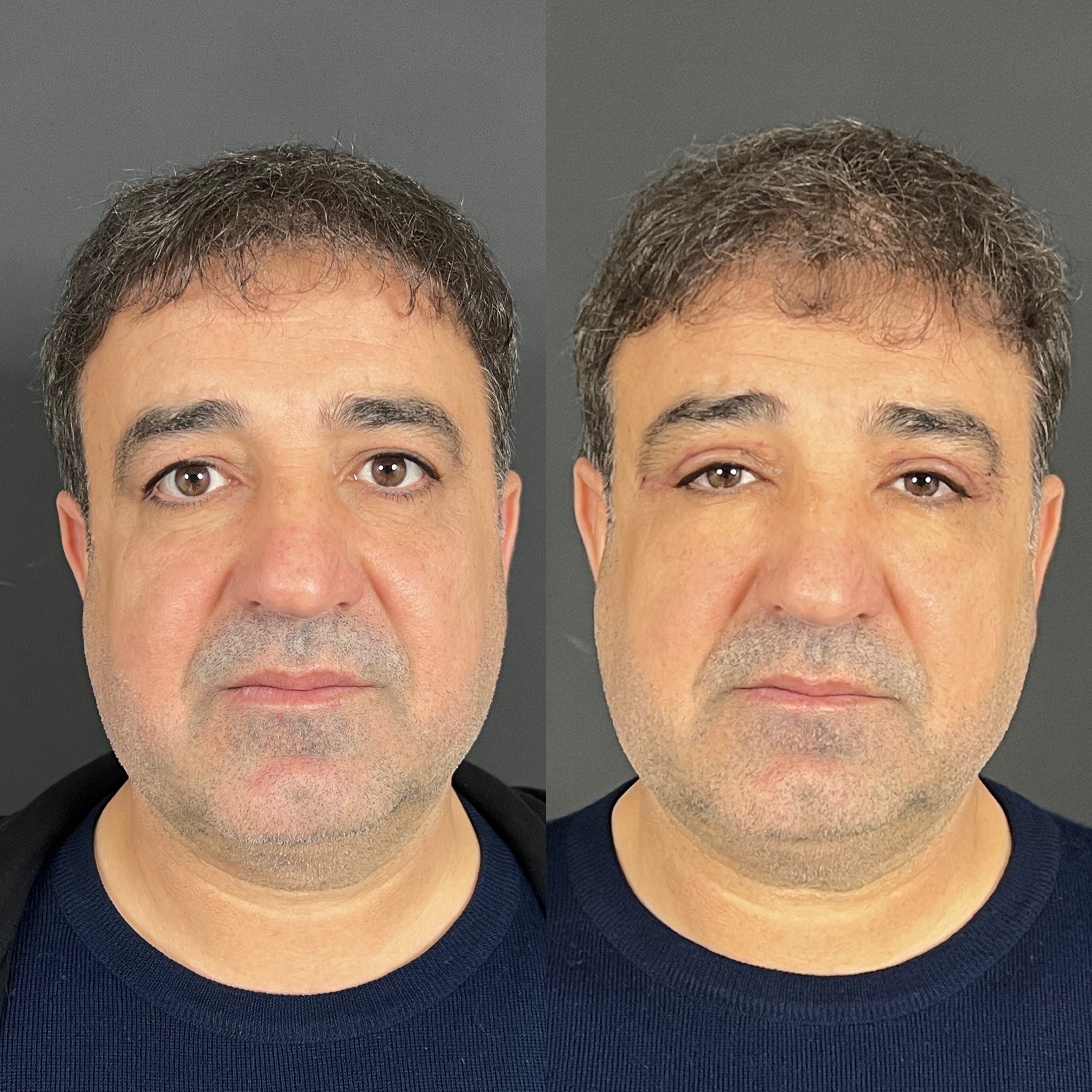
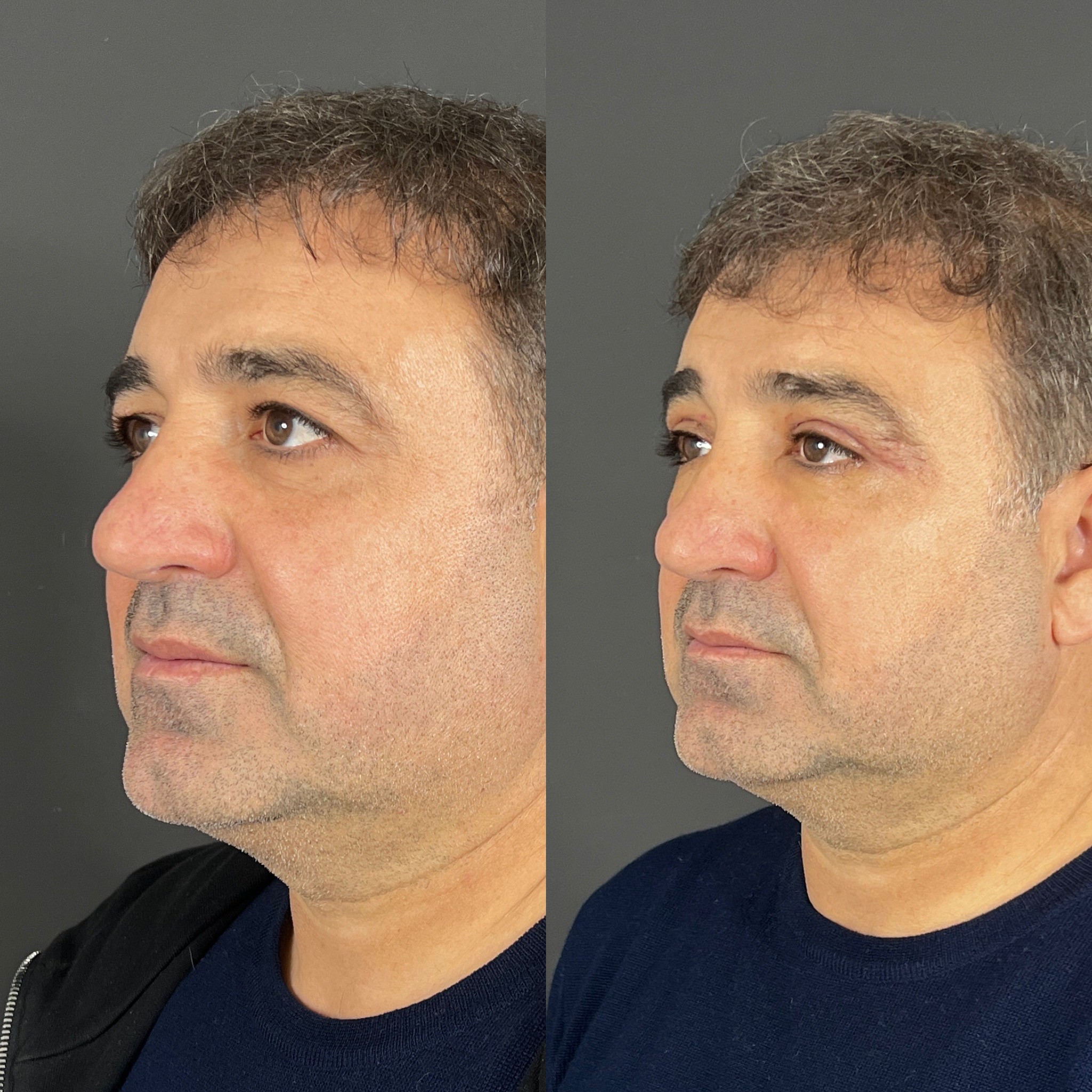
Before and after male upper blepharoplasty eye lift at six days with sutures removed. Dr. CBS performs natural male eyelid surgery in Istanbul, Turkey.

Patient Overview
Patient: Yavuz
Age: 48 years old
Gender: Male
Procedures: Upper eyelid surgery (upper blepharoplasty / eye lift)
After photos taken at: 6 days post-surgery
Location: Istanbul, Turkey
Male Blepharoplasty: Different Eyes, Different Rules
Upper eyelid surgery is the same procedure on a male patient and a female patient — the same incision, the same excision, the same crease placement. But the aesthetic target is fundamentally different. A beautiful female blepharoplasty result opens the eye, reveals the eyelid platform, and creates a bright, lifted appearance. Apply that exact result to a male face and it looks wrong. Male eyes operate under different aesthetic rules, and the surgeon who does not respect these rules produces a result that feminises rather than rejuvenates.
Yavuz, a forty-eight-year-old male patient of Dr. Cem Berkay Sinaci, underwent upper eyelid surgery designed specifically for masculine aesthetics. Dr. Sinaci, a European board-certified plastic surgeon (FEBOPRAS) and member of ISAPS and ASPS, approaches male blepharoplasty with a conservative philosophy that preserves the heavier, more hooded quality that defines masculine eyes while removing only the excess that crosses from characterful into tired.
The Male Eyelid Aesthetic
The male eye sits differently within the facial architecture than the female eye. The male brow is lower and flatter, positioned closer to the orbital rim. The upper eyelid crease is typically lower, and the eyelid platform — the visible skin between lash line and crease — is narrower. A degree of upper eyelid fullness that would be considered hooding on a female face is part of normal masculine eye anatomy.
This means the surgeon must calibrate the skin excision differently for male patients. Removing the amount of skin that would produce an ideal result on a female eyelid would over-expose the male eyelid platform, creating a wide-eyed, startled appearance that contradicts masculine facial structure. The goal in male blepharoplasty is to remove the excess that produces a tired or aged look while preserving enough fullness to maintain the naturally heavier male eyelid character.
For Yavuz at forty-eight, this calibration meant a more conservative excision than a female patient of the same age with similar skin redundancy would receive. The result is eyes that look rested and alert — not wide open and lifted. The distinction is subtle but critical to a natural male outcome.
Why Non-Dissolvable Sutures Make Better Scars
Dr. Sinaci uses non-dissolvable suture material for every upper blepharoplasty, removing the stitches between days four and six. This is a deliberate clinical decision that directly affects the quality of the scar the patient will carry permanently.
Dissolvable sutures are designed to break down within the body through an inflammatory process. The tissue surrounding the suture must mount an immune response to degrade the material, and this prolonged inflammation radiates into the wound margins. The result is more collagen deposition, more tissue reaction, and ultimately a thicker, more visible scar than the same incision would produce with an inert suture material.
Non-dissolvable sutures sit within the tissue without provoking this degradation response. They hold the wound edges in precise alignment during the critical first days of healing, and when they are removed at days four to six, they leave behind tissue that has bonded under minimal inflammatory stimulation. The resulting scar is thinner, flatter, and fades faster than a scar produced by dissolvable material.
In the upper eyelid — where the scar sits within the crease and must become invisible to fulfil the procedure's promise of undetectable surgery — this difference in scar quality matters. The choice of suture material is invisible to the patient during the procedure but visible in the scar for years afterward. Dr. Sinaci's preference for non-dissolvable sutures with early removal reflects a prioritisation of long-term scar quality over the minor convenience of avoiding a suture removal appointment.
Day Six: Sutures Out, Result Emerging
Yavuz's six-day photographs capture a specific milestone in blepharoplasty recovery: the sutures have just been removed. The fine stitches that held his eyelid incision together during the critical early healing days are gone, and the wound is now self-supporting — held together by the collagen crosslinks that formed during the first days of healing.
At six days, the incision line appears as a fine pink mark within the eyelid crease. Without the suture material drawing attention to it, the line is already less conspicuous than it was a day earlier. Over the next weeks and months, this line will fade progressively — from pink to pale, from slightly raised to flat, from detectable to invisible within the natural crease fold.
The residual swelling at day six has decreased substantially from the peak that occurred around days two to four. The upper eyelid contour is becoming visible through the diminishing oedema, and the improvement in eye opening is apparent. Yavuz's eyes look measurably less heavy and more alert than his preoperative photographs, even with healing still underway.
Bruising at day six, if present, is in its resolution phase — yellow-green tones replacing the darker colours of the first days. In male patients, this bruising cannot be concealed with makeup as easily as in female patients (though some men choose to use concealer). Sunglasses remain the most practical social camouflage during this brief transitional phase.
Male Recovery Considerations
Male blepharoplasty recovery follows the same biological timeline as female recovery, but the social context differs. Men are statistically less likely to use cosmetic concealment during the healing phase, which means the window of visible recovery signs — bruising, mild swelling, the fading incision line — is more socially exposed.
The practical solution is timing. Many male patients schedule their eye lift to coincide with a period when social or professional visibility is naturally reduced — a holiday period, a work-from-home week, or a long weekend extended by a few days. Yavuz's six-day result shows that by this point, the most conspicuous healing signs have already resolved or faded to a level that is manageable in most social settings.
By ten to fourteen days, male blepharoplasty patients are fully socially presentable. The bruising has cleared, the incision is hidden in the crease, and any residual swelling is too subtle for colleagues or acquaintances to detect. The transformation reads as looking "well-rested" rather than "post-surgical" — exactly the perception that male patients want.
Why Men Wait Longer Than Women to Seek Eyelid Surgery
Male patients consistently present for blepharoplasty later than female patients with comparable degrees of hooding. The average age of male blepharoplasty patients runs several years older than the female average, not because men's eyelids age differently but because the cultural threshold for men to seek aesthetic surgery is higher.
Yavuz at forty-eight represents a common male presentation: significant upper eyelid excess that has been bothering him for years, initially dismissed as an inevitable part of ageing, and finally addressed when the functional and aesthetic impact became impossible to ignore. The tired appearance in photographs, the heavy sensation over the eyes, the compensatory brow-raising that produces forehead fatigue — these accumulating daily frustrations eventually overcome the cultural hesitation.
The irony is that male blepharoplasty is one of the most discreet procedures available. The scar is hidden. The change is natural. The recovery is brief. And the result — more alert, more rested, more energetic eyes — is attributed by observers to a good holiday or better sleep, not to surgery. Men who delay the procedure out of concern about it being noticeable consistently report afterward that no one detected the change.
The Male Eye Lift Result Over Time
Yavuz's six-day appearance will refine steadily over the coming weeks. By two weeks, the healing is essentially invisible. By three weeks, the eyes have settled into their corrected contour with the masculine eyelid character fully preserved. By three months, the non-dissolvable suture scar has matured to a fine pale line hidden within the crease — the long-term scar benefit of Dr. Sinaci's suture material choice now visible in its superior quality.
The result is permanent. The excess skin that was excised will not regenerate. The more open, alert male eye that emerges from the healing process is the eye Yavuz will carry forward — naturally masculine, appropriately rested, and free of the excess that made him look older and more tired than he is.
Male Upper Eyelid Surgery in Istanbul
Yavuz's six-day before and after demonstrates that male upper blepharoplasty, performed with gender-appropriate aesthetic calibration and non-dissolvable sutures for optimal scar quality, produces a result that refreshes without feminising. For men considering an eye lift in Istanbul, his case confirms that the procedure is brief, the recovery is discreet, and the result preserves the natural masculine eye character while eliminating the excess that ageing has deposited — a correction that colleagues will perceive as renewed energy rather than surgical intervention.