
Upper Eyelid Surgery at 62: Day Four Eye Lift Result
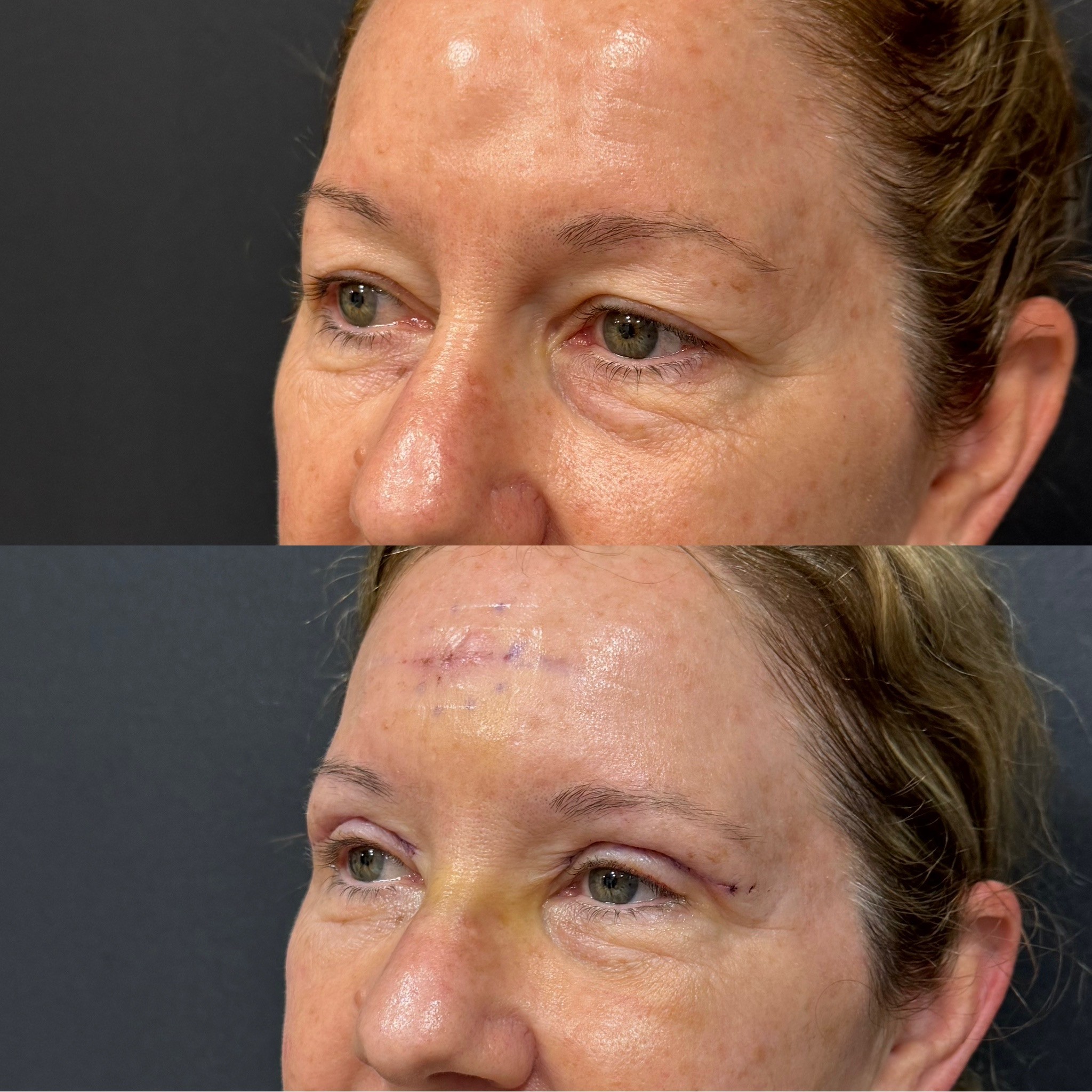
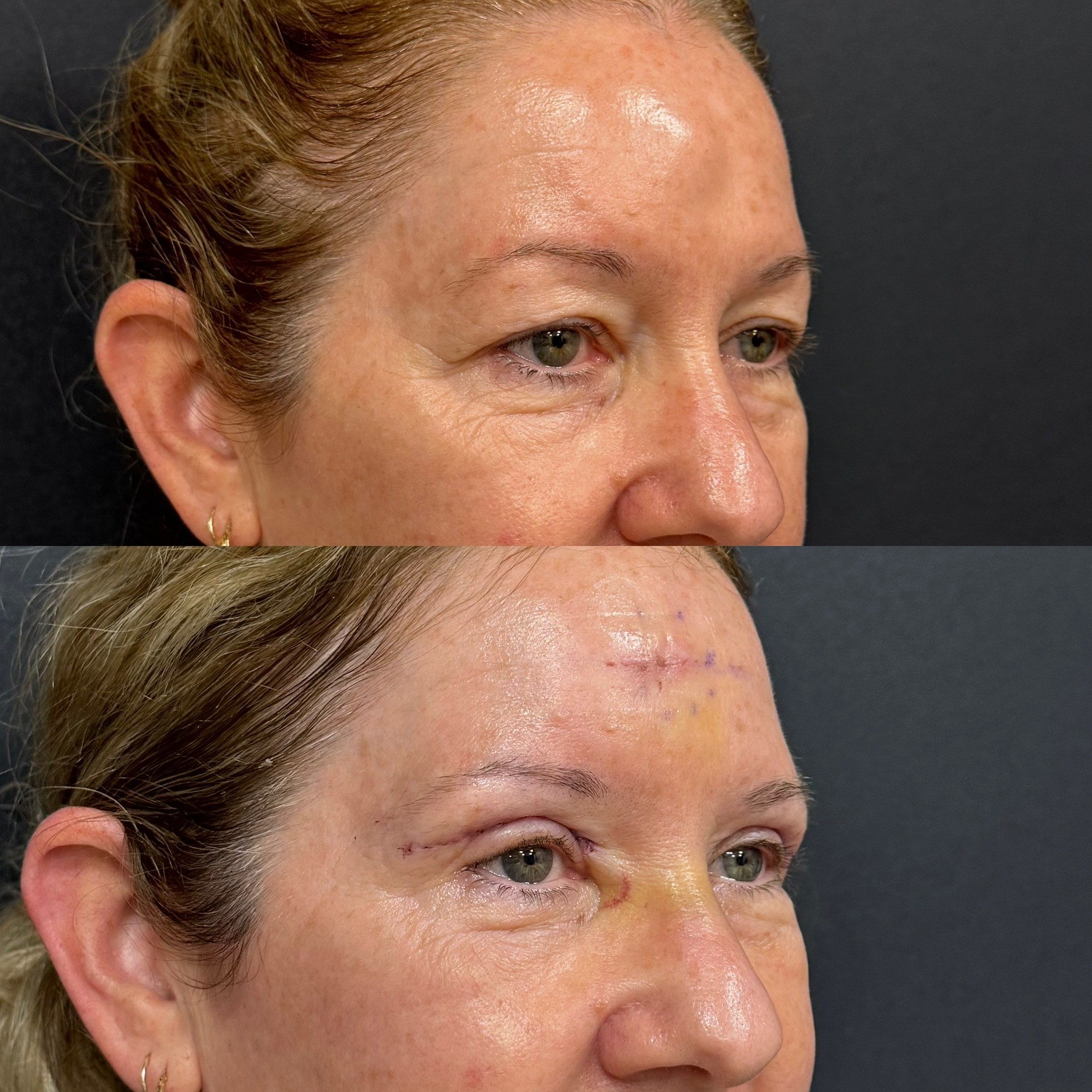
Before and after upper eyelid blepharoplasty eye lift at 62 years old showing four-day early result. Dr. CBS performs eyelid rejuvenation in Istanbul, Turkey.

Patient Overview
Patient: Chrissy
Age: 62 years old
Gender: Female
Procedures: Upper eyelid surgery (upper blepharoplasty / eye lift)
After photos taken at: 4 days post-surgery
Location: Istanbul, Turkey
Upper Blepharoplasty in the Sixties: When Function Meets Aesthetics
At sixty-two, upper eyelid surgery occupies a different clinical space than it does at forty. The hooding is no longer subtle. The excess skin has had two additional decades to accumulate beyond what younger patients present with, and the redundancy has often progressed past a purely cosmetic concern into functional territory. The excess skin drapes over the lash line, encroaching on the upper visual field and creating a measurable obstruction that affects reading, driving, and navigating stairs. The eye lift at this stage is simultaneously a rejuvenation procedure and a functional restoration — looking better and seeing better through a single correction.
Chrissy, a sixty-two-year-old patient of Dr. Cem Berkay Sinaci, a European board-certified plastic surgeon (FEBOPRAS) and member of ISAPS and ASPS, presented with the significant upper eyelid redundancy that characterises this age group. Her four-day photographs document the very early post-operative appearance — healing still visibly underway, but the fundamental correction already established beneath it.
Why More Skin Removal Does Not Mean More Complexity
A common misconception is that patients with more excess skin require a more complex or risky procedure. In practice, upper blepharoplasty is remarkably consistent in its surgical approach regardless of how much skin needs to be removed. The procedure remains a precisely measured excision of redundant skin from the upper eyelid, performed through the natural crease, under local anaesthesia, in approximately thirty minutes.
What changes with greater skin excess is the amount removed, not the technique used to remove it. Chrissy's excision was calculated using the same pinch-test methodology applied to every patient — the excess is grasped with forceps, the maximum safe removal is determined by the point at which the eyelid begins to separate from the underlying tissue, and the excision is marked accordingly. The wider the excess, the more skin is excised — but the surgical principles, incision placement, and closure technique remain identical.
This consistency is what makes upper blepharoplasty one of the most reliable procedures in facial surgery. Whether the patient is thirty-six with genetic hooding or sixty-two with decades of accumulated redundancy, the operation follows the same precise methodology with predictable, reproducible results.
Reading Day Four in a Sixty-Two-Year-Old Patient
Chrissy's four-day photographs require interpretation through the lens of early healing. The signs of surgery are present and expected — this is not the final result but a snapshot of the body's acute response to the procedure.
Swelling at day four is still meaningful. The upper eyelids carry residual oedema that partially masks the improvement the surgery achieved. The eyelids appear puffier than they will at ten days, and the full extent of the skin removal is not yet visible because inflammatory fluid temporarily occupies some of the space the excised skin previously held.
Bruising patterns at sixty-two may be slightly more pronounced than in younger patients. The capillary fragility that increases with age means that the small blood vessels disrupted during surgery release more blood into the surrounding tissue, producing more visible periorbital discolouration. This bruising follows the same resolution timeline as in younger patients — transitioning through colour phases over seven to fourteen days before clearing completely — but the initial intensity may be greater.
The incision line is visible within the eyelid crease at day four, held together by its early healing bonds. This line will mature over the coming months into a scar that is hidden within the crease fold, invisible when the eyes are open.
Despite these healing signs, the correction is already evident. The heavy curtain of excess skin that previously draped over Chrissy's eyelids has been removed. The eyes, even through the swelling, appear more open than they did preoperatively. The eyelid platform is beginning to reappear. The fundamental improvement is established — healing simply needs to clear the stage for it to be fully appreciated.
The Functional Improvement Patients Notice First
While cosmetic improvement is the primary motivation for most eye lift patients, those with significant hooding like Chrissy often notice the functional change before they appreciate the aesthetic one. In the first days after surgery — even while swelling is still present — the physical sensation of excess skin resting on the eyelashes disappears. The weight that sat on the upper eyelids, creating a constant low-grade heaviness, is gone.
Peripheral vision improvement becomes apparent as swelling resolves. The upper visual field that was partially obstructed by the overhanging skin opens up, and patients frequently describe the sensation as though a curtain has been pulled back from the top of their sight. Activities that required compensatory head tilting — looking up at shelves, reading overhead signs, driving — become easier without the patient consciously recognising that she was compensating before.
These functional gains are permanent. The skin that was obstructing the visual field has been excised and will not return. The eye lift provides lasting improvement in both the appearance and the practical function of the upper eyelids.
Healing in Mature Skin: What Differs and What Doesn't
Patients in their sixties sometimes worry that their age will compromise healing or produce inferior results. The reality is more nuanced. Certain aspects of healing are slower in mature skin — the inflammatory phase may last slightly longer, bruising may take an extra few days to clear, and scar maturation may follow a longer timeline. These are differences of degree, not of outcome.
The final result of upper blepharoplasty in a sixty-two-year-old patient is not inferior to the result in a forty-year-old patient. The excess skin is removed, the eyelid contour is restored, and the scar matures to a concealed line within the crease. The endpoint is the same — the path to that endpoint simply takes slightly longer in mature tissue.
Dr. Sinaci's technique accounts for these age-related tissue characteristics. The skin closure is performed with meticulous attention to tension distribution, ensuring that the mature skin is not subjected to forces that could widen the scar. Post-operative care instructions include extended cold compress use and elevation protocols that support the slightly longer inflammatory phase that older tissue may experience.
From Day Four to the Final Result
The trajectory from Chrissy's four-day appearance to her final result follows a predictable arc. By ten days, the sutures are out, the bruising has largely cleared, and the improved eyelid contour is becoming visible. By three weeks, the recovery is socially invisible — the eyes look naturally refreshed with no evidence of surgery. By three months, the scar has matured significantly. By six months, the result is final — open, rested, naturally rejuvenated eyes that function better and look better than they have in years.
The four-day appearance that might concern a patient in the moment is simply the earliest point on a curve that leads reliably and predictably to that final result. Every blepharoplasty patient passes through this stage. Every blepharoplasty patient emerges from it into a result that makes the brief healing period worthwhile.
Upper Eyelid Eye Lift in Istanbul
Chrissy's four-day before and after provides an honest early-recovery reference for patients considering upper blepharoplasty at sixty-two or any age. The early healing signs are temporary. The improvement beneath them is permanent. For patients researching eyelid surgery and eye lift procedures in Istanbul, her case confirms that significant upper eyelid excess — even the degree that affects vision as well as appearance — is correctable through a brief procedure under local anaesthesia, with a recovery measured in days and a result that restores both function and aesthetics to the most expressive feature of the face.