
Upper Eyelid Surgery at 66 Under Local Anaesthesia
Before and after upper blepharoplasty eye lift at 66 under local anaesthesia at seven days. Dr. CBS performs safe eyelid surgery for older patients in Istanbul.
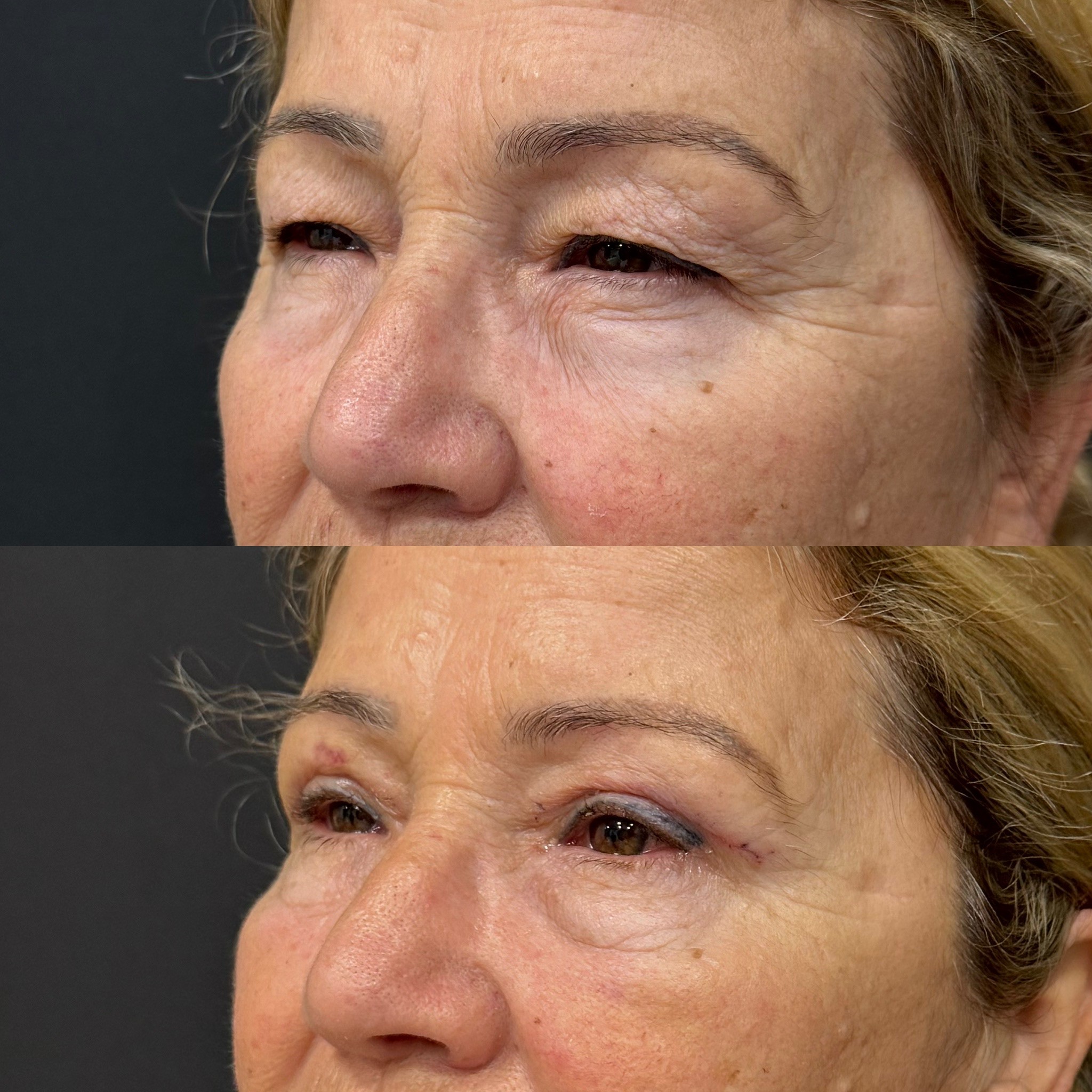


Patient Overview
Patient: Aysin
Age: 66 years old
Gender: Female
Procedures: Upper eyelid surgery (upper blepharoplasty / eye lift) under local anaesthesia
After photos taken at: 7 days post-surgery
Location: Istanbul, Turkey
Why Local Anaesthesia Matters More at Sixty-Six
Every surgical procedure involves a balance between the benefit of the correction and the risk of the anaesthesia required to perform it. For younger patients, this balance is rarely a concern — general anaesthesia is well tolerated and recovers from quickly. At sixty-six, the equation shifts. The cardiovascular system, respiratory function, and metabolic clearance of anaesthetic agents are all less resilient than they were decades earlier. General anaesthesia remains safe for most patients at this age, but it is no longer trivially so. Every unnecessary exposure adds risk without adding benefit.
This is why Dr. Cem Berkay Sinaci performs upper blepharoplasty under local anaesthesia for patients of every age — including Aysin, at sixty-six. Dr. Sinaci, a European board-certified plastic surgeon (FEBOPRAS) and member of ISAPS and ASPS, eliminates the systemic risks of general anaesthesia entirely by numbing only the eyelids, keeping the patient awake, comfortable, and physiologically undisturbed throughout a procedure that takes approximately thirty minutes.
For a sixty-six-year-old patient, this approach is not merely convenient — it is a meaningful safety advantage. No intubation. No pharmacological unconsciousness. No post-anaesthetic confusion, nausea, or cardiovascular stress. Aysin walked into the clinic, had her eyelids corrected, and walked out — alert, oriented, and independent — within an hour.
The Safest Entry Point to Facial Rejuvenation
Patients in their sixties who want to look more rested and refreshed face a spectrum of procedural options ranging from minimal to extensive. At one end sits the full facelift under general anaesthesia — highly effective but involving significant surgery, recovery, and anaesthetic exposure. At the other end sits upper blepharoplasty under local anaesthesia — a targeted correction with minimal risk, brief recovery, and no systemic anaesthesia.
For many patients at sixty-six, upper blepharoplasty is the ideal starting point. The upper eyelids are often the single feature contributing most to a tired, aged facial appearance. The hooding that has accumulated over decades creates a heaviness over the eyes that dominates facial perception — observers see the heavy eyelids before they notice anything else. Correcting this one feature can produce a disproportionate rejuvenation effect, making the entire face appear more alert and energised without touching any other structure.
Aysin's decision to begin with upper blepharoplasty reflects this pragmatic approach. Rather than committing to comprehensive facial surgery, she addressed the feature with the highest impact-to-risk ratio — gaining a significant visible improvement through the least invasive, safest procedure available.
Day Seven: Sutures Removed, Healing Underway
Aysin's seven-day photographs capture the eye lift at a pivotal transition point. The non-dissolvable sutures that Dr. Sinaci uses for all upper blepharoplasty cases have been removed. These sutures — chosen specifically because they produce less tissue reaction and better long-term scar quality than dissolvable alternatives — held the incision in precise alignment during the critical first days of healing. Now removed between days four and six, they leave behind an incision that is self-supporting and progressing through its early maturation phase.
At seven days, the incision line appears as a fine pink mark within the eyelid crease. Without suture material drawing attention to it, the line is already beginning to blend with the surrounding crease anatomy. Over the next three to six months, this mark will fade to a pale, thin line that becomes invisible when the eyes are open and virtually undetectable even on close examination with the eyes closed.
Swelling at day seven has decreased substantially from its peak. The upper eyelid contour is clearly visible, and the improvement in eye opening is unmistakable compared to the preoperative photographs. Some residual puffiness remains — particularly in the medial corner near the nose, where lymphatic drainage is slowest — but this will resolve over the next one to two weeks.
Bruising at seven days varies by individual. In a sixty-six-year-old patient, the capillary fragility associated with mature skin may produce more initial bruising than younger patients experience, but the resolution timeline is similar. Any remaining discolouration at day seven is typically in its yellow-green phase, indicating active reabsorption that will be complete within another week.
The Functional Dividend at Sixty-Six
At sixty-six, Aysin's upper eyelid excess had almost certainly crossed from aesthetic concern into functional territory. The degree of hooding that accumulates over six decades of gravitational influence and elasticity loss typically encroaches on the upper visual field, creating a measurable obstruction that affects daily activities.
The functional improvement after eye lift surgery is immediate and permanent. The skin that was draping over the lash line and intruding into the visual field has been excised. Even at day seven, with residual swelling still present, the upward gaze is less obstructed than it was preoperatively. As the remaining oedema resolves over the next two weeks, the full functional benefit will become apparent — a wider, unobstructed visual field that makes reading, driving, and navigating the physical environment easier and more comfortable.
This functional component is one reason why upper blepharoplasty in older patients carries a particularly high satisfaction rate. The improvement is not only visible in the mirror — it is felt in the practical experience of daily life.
Recovery at Sixty-Six: Realistic Expectations
Aysin's recovery timeline at sixty-six follows the same general pattern as younger patients, with minor adjustments for mature tissue healing. The inflammatory phase may last one to two days longer. Bruising may take an additional three to five days to clear completely. The scar maturation may proceed on a slightly extended timeline.
These are differences of pace, not of outcome. The final result — refreshed eyes with an invisible scar hidden in the natural crease — is the same regardless of age. The path to that result simply requires slightly more patience in a sixty-six-year-old patient than in a forty-year-old one.
Practical recovery at day seven is already well advanced. Aysin can read, watch television, perform gentle household activities, and engage in normal social interaction. The sutures are out, the most visible healing signs are fading, and the eyes are looking progressively more natural with each passing day. Most patients at this stage feel comfortable resuming their regular routine, with the only remaining restriction being avoidance of vigorous physical activity for another one to two weeks.
Why Older Patients Should Not Delay
A common pattern among patients in their sixties is prolonged hesitation — years of considering eyelid surgery while the hooding progresses and the functional impact worsens. The hesitation is often driven by concern about age-related surgical risk, a belief that they are "too old" for cosmetic procedures, or uncertainty about whether the result will be worthwhile.
Aysin's case addresses all three concerns. The risk is minimal — local anaesthesia eliminates the systemic exposure that drives age-related surgical risk. There is no age limit for upper blepharoplasty — the procedure is as safe and effective at sixty-six as at forty-six. And the result is immediately impactful — both aesthetically in the mirror and functionally in daily life.
Every year of delay is a year of living with heavy, hooded eyelids that make the patient look more tired and older than she is, while the procedure that corrects them takes thirty minutes and requires no general anaesthesia.
Upper Eyelid Eye Lift in Istanbul
Aysin's seven-day before and after demonstrates that upper blepharoplasty at sixty-six, performed under local anaesthesia with non-dissolvable sutures removed within the first week, produces a safe, effective eye lift with a recovery that is already well advanced by day seven. For older patients considering eyelid surgery in Istanbul, her case confirms that age is not a barrier to this procedure — it is, if anything, a reason to proceed, as the functional and aesthetic benefits become more significant with each additional year of eyelid skin excess.