
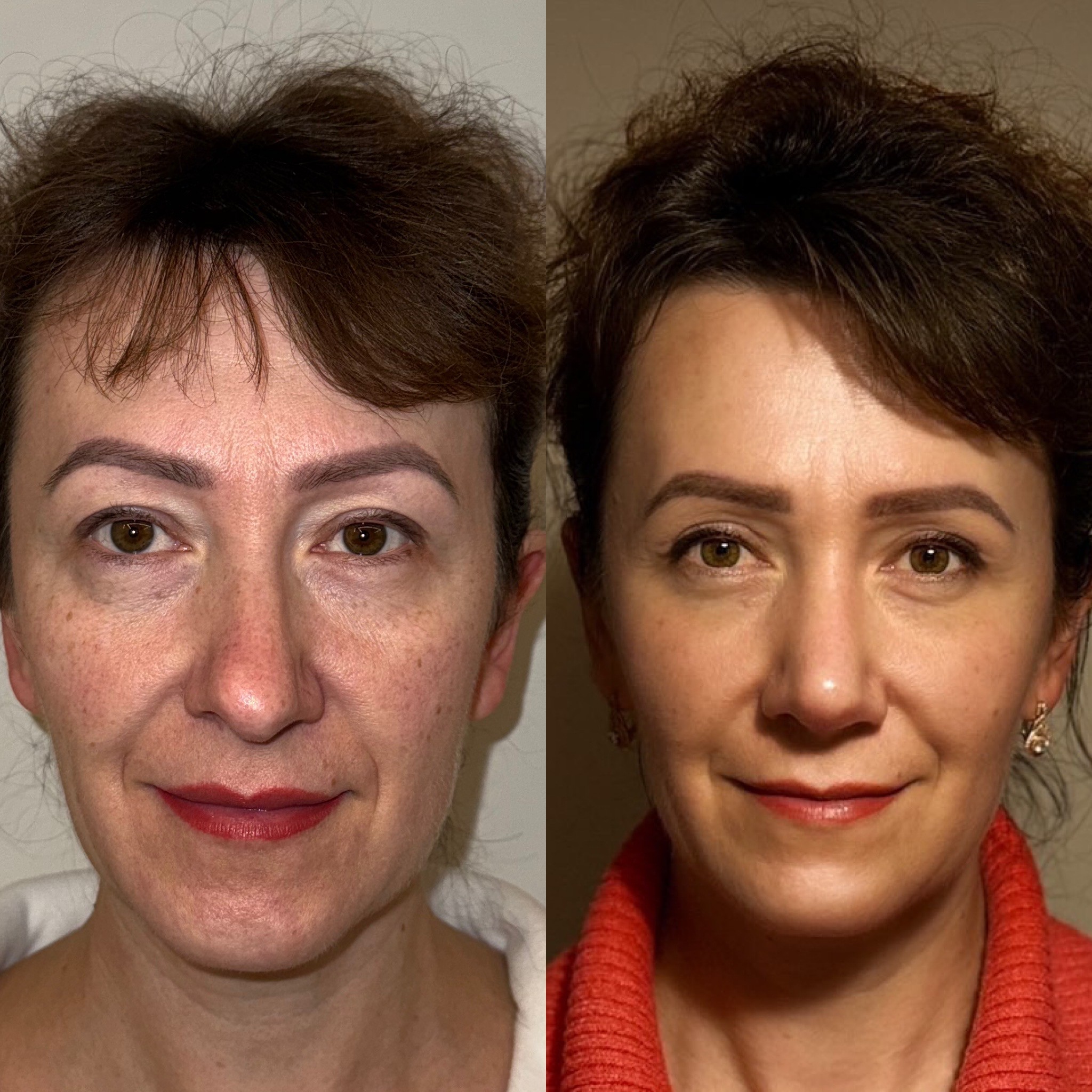
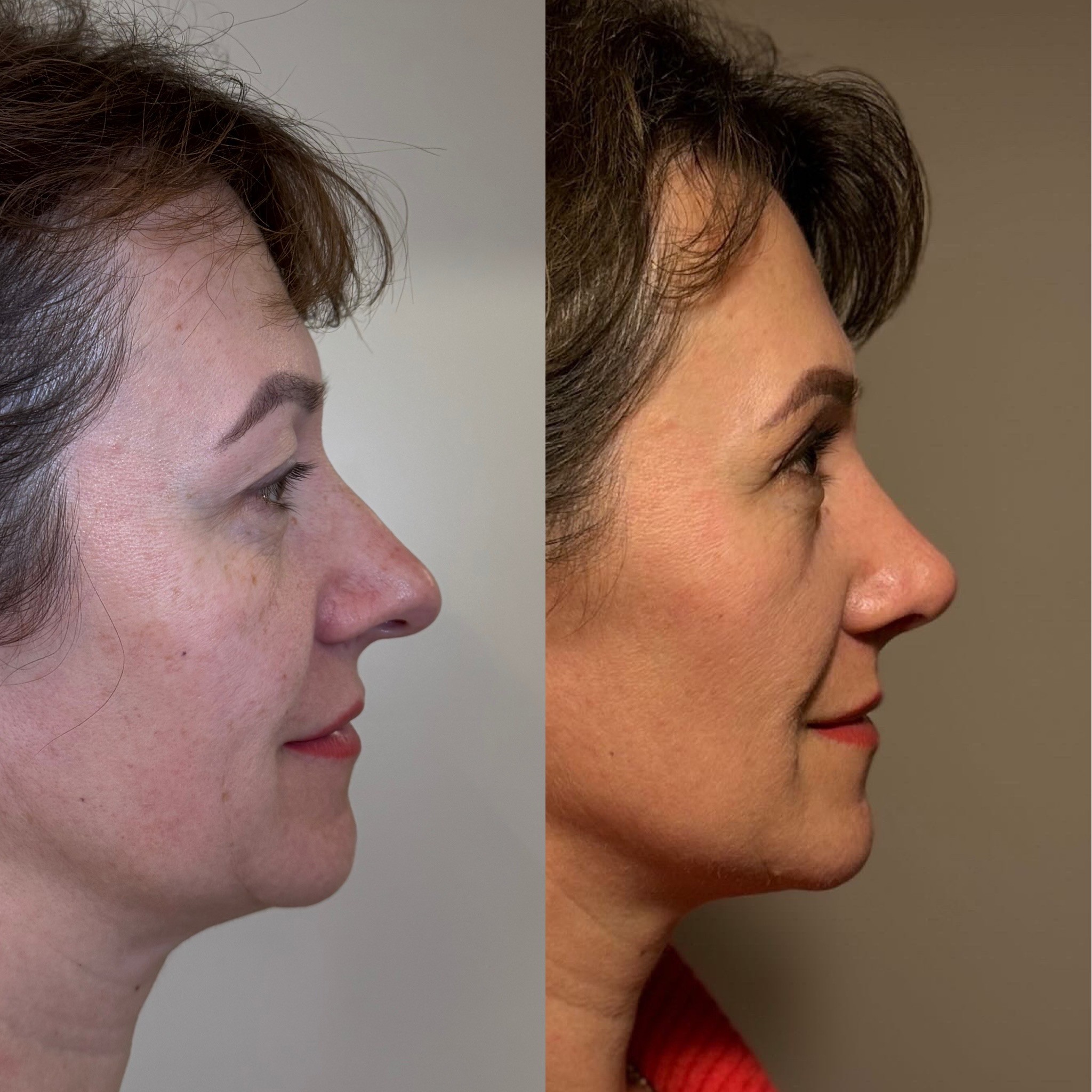
Revision Rhinoplasty Before After 1 Month Post-Surgery
1-month patient-taken before after of revision rhinoplasty for 44-year-old female from USA by board-certified plastic surgeon Dr. Sinaci in Istanbul, Turkey.

Patient Overview
Patient: Vitalia
Age: 44 years old
Gender: Female
Procedures: Revision rhinoplasty
After photos taken at: 1 month post-surgery (patient's own photos)
Origin: United States of America
Location: Istanbul, Turkey
Why Revision Rhinoplasty Is the Most Demanding Procedure in Nasal Surgery
A revision rhinoplasty is not simply a second version of the first operation. It is an entirely different surgical challenge that operates under conditions the primary rhinoplasty never faced. The anatomy has been altered by a previous surgeon. Scar tissue has formed in unpredictable patterns throughout the internal nasal structures. Cartilage may have been removed, weakened, or distorted during the first procedure, leaving the surgeon with a depleted structural inventory. The skin may have thickened from chronic inflammation or thinned from over-resection of the underlying framework. For Vitalia, a 44-year-old woman who travelled from the United States to Istanbul after an unsatisfactory primary rhinoplasty performed elsewhere, the decision to undergo revision surgery required both courage and careful research. Her revision was performed by Dr. Cem Berkay Sinaci, a Fellow of the European Board of Plastic Reconstructive and Aesthetic Surgery (FEBOPRAS) and active member of ISAPS and ASPS, whose training in structural nasal surgery provided the specific expertise that revision cases demand.
What Goes Wrong After a Primary Rhinoplasty and Why Revision Becomes Necessary
Patients seek revision rhinoplasty for a range of reasons, and understanding the common causes helps both prospective patients and those considering their options after an unsatisfactory first surgery. Aesthetic dissatisfaction is the most frequent driver. The nose may still appear too large, too wide, too projected, or asymmetric after the first procedure. The tip may lack definition or appear pinched. The bridge may have developed a visible irregularity, a scooped-out appearance from over-resection, or an inverted-V deformity where the upper lateral cartilages have collapsed inward.
Functional problems are equally common. Aggressive cartilage removal during the first surgery can weaken the internal nasal valve, causing the sidewalls to collapse inward during inhalation and producing significant breathing obstruction. Septal perforation, where a hole develops in the septal cartilage, can cause whistling, crusting, and chronic nasal discomfort. Scar tissue formation within the nasal cavity can narrow the airway passages even if the external shape appears acceptable.
In many revision cases, both aesthetic and functional concerns coexist. The structural damage from the first surgery affects both the appearance and the breathing simultaneously, and correcting one without addressing the other produces an incomplete result.
The Surgical Challenges Unique to Revision Rhinoplasty
Every element of revision rhinoplasty is more complex than its primary counterpart. The tissue planes that were cleanly defined during the first surgery are now obscured by scar tissue. Where a primary rhinoplasty surgeon dissects through natural anatomical layers with predictable landmarks, the revision surgeon navigates through fibrosis, adhesions, and distorted anatomy where the normal roadmap has been rewritten by previous surgical intervention and subsequent healing.
Cartilage availability is often the most significant limitation. If the first surgeon removed substantial amounts of septal cartilage, the revision surgeon may not have enough remaining material to perform the grafting necessary for structural reconstruction. In these cases, cartilage must be harvested from alternative donor sites. Ear cartilage, taken from the conchal bowl behind the ear, provides curved grafts suitable for certain applications. Rib cartilage, harvested from the chest wall, provides the most abundant and strongest grafting material and is often the preferred source for complex revision cases where significant reconstruction is required.
The skin envelope presents its own challenges. Skin that has been elevated from the nasal framework during a previous surgery may have thickened due to chronic low-grade inflammation, making it less responsive to the refined contours beneath. Alternatively, skin that was stretched over an over-reduced framework may have thinned excessively, making every subtle irregularity in the underlying cartilage visible on the surface. The revision surgeon must assess the skin condition and factor it into the surgical plan, sometimes accepting that the skin's limitations will influence what is achievable.
Rebuilding the Nasal Framework in a Revision Case
Dr. Sinaci's approach to Vitalia's revision rhinoplasty centred on structural reconstruction. Rather than attempting to adjust the existing compromised framework through minor modifications, the strategy involved rebuilding the nasal architecture from a stable foundation. This is the principle that distinguishes successful revision rhinoplasty from procedures that produce yet another unsatisfactory result requiring a third operation.
The reconstruction begins with the septum, which serves as the central pillar of the entire nasal structure. If the septum was weakened or deviated during the first surgery, it must be straightened and reinforced before any external reshaping can succeed. Grafts are placed along the dorsum to restore smooth contour where irregularities exist. Spreader grafts re-establish the internal valve angle and middle vault width. Tip grafts reconstruct definition and projection that may have been lost through previous cartilage removal or scar contracture.
Each graft must be precisely shaped, positioned, and secured in an environment where scar tissue makes every step less predictable than in a primary case. The surgeon cannot rely on the natural tissue planes and landmarks that guide primary rhinoplasty. Instead, revision rhinoplasty demands the ability to interpret altered anatomy in real time and adapt the surgical plan as the internal structures are revealed.
Patient-Taken Photos at One Month — An Honest View of Revision Recovery
Vitalia's after photographs were taken by the patient herself at one month following surgery, providing an authentic perspective on what revision rhinoplasty recovery looks like in everyday conditions. Revision cases typically involve more extensive internal work than primary rhinoplasties, which can translate into slightly longer swelling resolution times. At one month, the overall nasal shape is clearly improved and the structural correction is visible, but residual deep swelling, particularly in the tip and supratip region, will continue to resolve over the following months.
Patient-taken photographs carry particular value in revision rhinoplasty cases because they show the result in real-world conditions without the controlled lighting and standardised positioning of clinical images. For prospective revision patients evaluating their options, seeing what a one-month recovery looks like in a home setting, in natural light, and without professional photography equipment provides a level of relatability that clinical images alone cannot offer.
The Timeline for Revision Rhinoplasty to Reach Its Final Result
Revision rhinoplasty healing takes longer than primary rhinoplasty healing. The scar tissue from the first surgery creates a denser tissue environment that is slower to remodel and settle. Where a primary rhinoplasty tip may reach its final definition by 12 to 18 months, a revision rhinoplasty tip can take 18 to 24 months to fully mature. The bridge and middle vault settle somewhat faster but still lag behind primary healing timelines.
For Vitalia, the one-month result is an early chapter in a healing story that will continue to improve well into the second year. The structural framework rebuilt during her revision surgery will progressively reveal itself as the swelling resolves and the scar tissue softens and remodels. Patience during this extended timeline is essential, and it is one of the most important topics discussed during the preoperative consultation so that patients approach their recovery with realistic expectations.
Why Revision Rhinoplasty Patients Travel Internationally for Expertise
The decision to travel from the United States to Istanbul for revision rhinoplasty reflects a reality that many revision patients discover during their research: not every rhinoplasty surgeon is equally equipped to handle revision cases. Revision rhinoplasty represents a subspecialty within a subspecialty, requiring experience with scar tissue management, cartilage grafting from alternative donor sites, structural reconstruction techniques, and the ability to problem-solve in real time when the internal anatomy deviates from preoperative expectations.
Dr. Sinaci's training pathway, including fellowship with world-renowned plastic surgeon Raul Gonzalez in Brazil where complex nasal reconstruction was a core focus, and cadaver-based anatomy training in Bangkok, built the specific skill set that revision cases require. For American patients like Vitalia who have already experienced one unsatisfactory result and cannot afford the physical and emotional cost of another, choosing a surgeon with verified revision experience and international structural rhinoplasty training is not a preference but a necessity.