
Structural Rhinoplasty Three-Week Result With Piezo
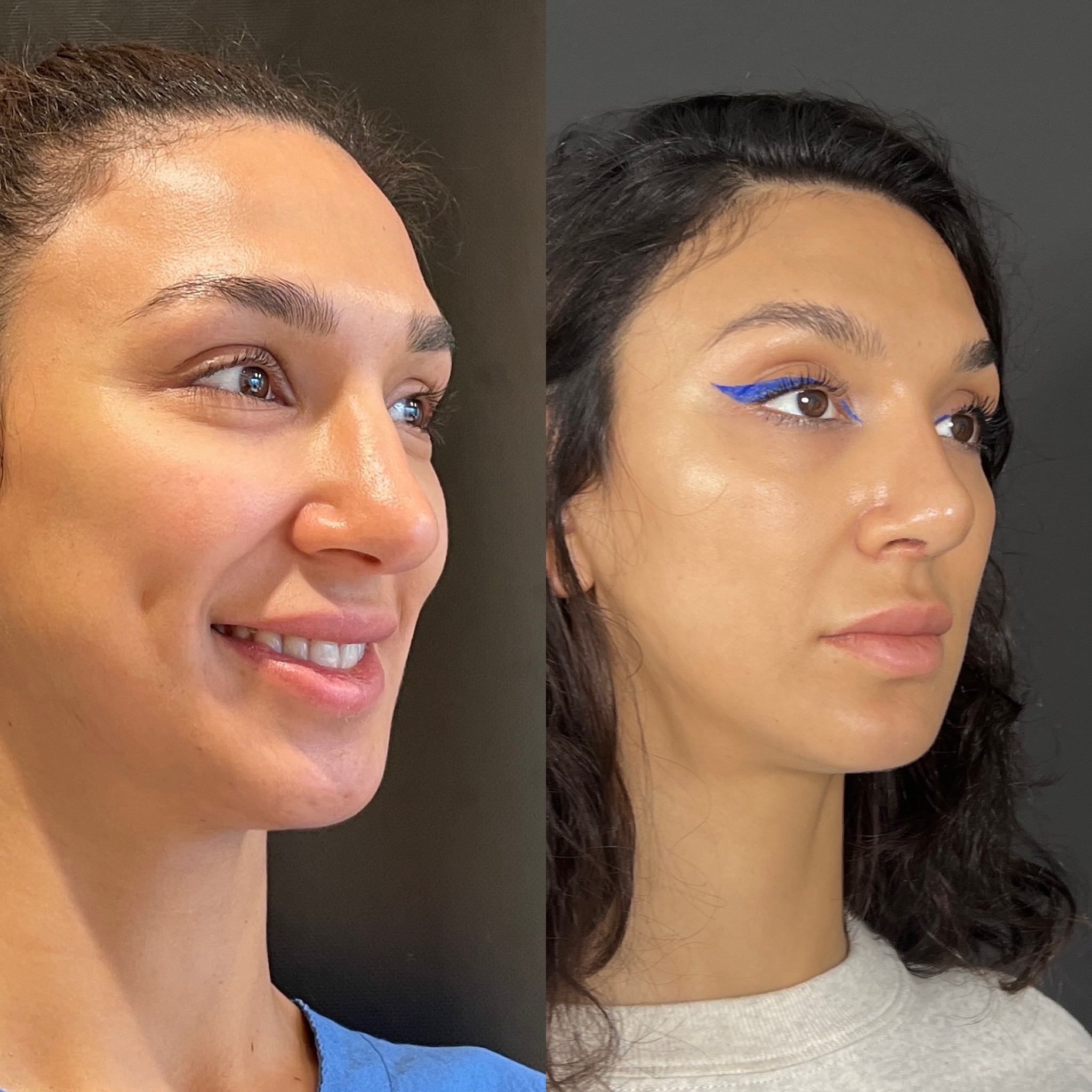
3-week before after of ultrasonic piezo rhinoplasty with minimal swelling and bruising for 28-year-old female by board-certified surgeon Dr. Sinaci in Istanbul.


Patient Overview
Patient: Lada
Age: 28 years old
Gender: Female
Procedures: Ultrasonic piezo rhinoplasty
After photos taken at: 3 weeks post-surgery
Location: Istanbul, Turkey
Why Modern Rhinoplasty Is About Building Structure, Not Just Removing It
There was a time when rhinoplasty was primarily a reductive procedure. Surgeons removed bone to lower a hump, trimmed cartilage to narrow a tip, and resected tissue to make a large nose smaller. The results were often impressive in the short term but prone to long-term problems: pinched tips, collapsed sidewalls, breathing difficulties, and an operated appearance that worsened with each passing year as the weakened framework lost its ability to support the overlying skin. Modern structural rhinoplasty has fundamentally reversed this philosophy. Rather than simply taking away, today's approach focuses on reshaping, repositioning, and reinforcing the nasal framework so that the result is not only beautiful on the day the splint comes off but remains stable and natural for decades. For Lada, a 28-year-old woman whose three-week photographs show a refined result with minimal swelling following ultrasonic piezo rhinoplasty in Istanbul, Dr. Cem Berkay Sinaci, a Fellow of the European Board of Plastic Reconstructive and Aesthetic Surgery (FEBOPRAS) and member of ISAPS and ASPS, applied this structural philosophy to produce a nose that is both aesthetically transformed and architecturally sound.
The Cartilage Framework — The Hidden Architecture of Every Rhinoplasty
Beneath the skin of the nose lies a framework of cartilage and bone that determines its entire external shape. The upper third is defined by the paired nasal bones. The middle third is shaped by the upper lateral cartilages that extend from the nasal bones downward like two wings forming the sidewalls of the nose. The lower third — the tip, nostrils, and columella — is defined by the lower lateral cartilages, sometimes called the alar cartilages, whose shape, size, strength, and orientation dictate tip projection, rotation, width, and definition.
Every visible change that a rhinoplasty produces is the result of modifications made to this internal framework. A smoother profile comes from reshaping the dorsal bone and cartilage. A more defined tip comes from suturing, grafting, or repositioning the lower lateral cartilages. A narrower bridge comes from performing osteotomies that reposition the nasal bones closer to the midline. The skin is merely a drape. It reveals the shape of whatever framework exists beneath it. This is why the quality of the structural work determines everything about the final result, and why Lada's three-week photographs already show clear refinement — the framework built during her surgery is precise enough to read through the skin even at this early stage.
Grafting Techniques That Provide Lifelong Nasal Stability
One of the defining features of structural rhinoplasty is the use of cartilage grafts to reinforce and support the reshaped nasal framework. These grafts are harvested from the patient's own body, most commonly from the nasal septum itself, which provides a generous supply of strong, straight cartilage that is already in the surgical field.
Spreader grafts are placed along the dorsal septum between the upper lateral cartilages and the septal cartilage. They serve multiple functions: maintaining the width of the internal nasal valve to ensure optimal airflow, preventing middle vault collapse that can create an inverted-V deformity, and providing a smooth transition from nasal bones to tip. A columellar strut graft is placed between the medial crura of the lower lateral cartilages to support tip projection and prevent long-term drooping. Additional grafts such as shield grafts, cap grafts, or alar rim grafts may be used depending on the specific refinements required.
For Lada's rhinoplasty, these grafting techniques were integrated into the surgical plan from the outset. Every element of cartilage that was reshaped was simultaneously reinforced, ensuring that the nose visible in her three-week photographs is supported by an internal architecture designed to resist the forces of healing contraction, gravity, and ageing that would otherwise gradually distort an unsupported result over the years.
How Piezo Technology Enhances Structural Rhinoplasty Precision
The ultrasonic piezo device and the structural rhinoplasty philosophy are natural partners. Structural rhinoplasty demands precision at every level — the cartilage work must be meticulous, and the bony work must be equally controlled. Traditional osteotomies with manual chisels introduce an element of unpredictability. The fracture line may extend slightly beyond the intended path. The bone edges may be irregular. Micro-fractures in adjacent areas can create subtle instabilities that affect long-term symmetry.
Piezo osteotomies eliminate this unpredictability. The ultrasonic vibration cuts bone along an exact path defined by the surgeon, with smooth edges that fit together precisely when the bones are repositioned. This controlled cutting means the nasal bones can be mobilised and placed in their new position with millimetre accuracy, creating a bony framework that is symmetric, stable, and smooth.
For Lada, the combination of piezo precision on the bony upper third with meticulous cartilage grafting and reshaping on the middle and lower thirds produced a result that is architecturally cohesive from top to bottom. Every segment of the nasal framework — bone, upper lateral cartilage, septum, and lower lateral cartilage — was addressed as part of an integrated structural plan rather than a series of isolated manoeuvres.
Three Weeks Post-Rhinoplasty — Reading the Early Structural Result
At three weeks, the nasal splint has been removed for approximately two weeks, internal splints are long gone, and the nose has passed through the acute healing phase into the period of progressive refinement. The swelling pattern at this stage provides meaningful information about the structural work performed beneath the skin.
A well-structured nose at three weeks shows defined dorsal lines, a visible tip contour, and symmetric sidewalls. These features are apparent even through the residual swelling because the strong internal framework projects its shape through the healing tissue. A poorly structured nose at the same stage appears amorphous and shapeless, with the swelling obscuring any evidence of defined architecture beneath.
Lada's three-week photographs demonstrate the former. The dorsal profile is smooth and defined. The tip shows early refinement that will continue to sharpen over the coming months. The bridge width is proportionate. These features are visible because the structural framework beneath the skin is precise and well-supported, projecting its shape outward with enough definition to read through the mild residual swelling that remains at this stage.
The Difference Between a Nose That Ages Well and One That Does Not
The true test of a rhinoplasty is not how it looks at three weeks or even at one year but how it looks at ten and twenty years. Noses that were sculpted using purely reductive techniques — removing cartilage without reinforcing what remains — are vulnerable to progressive distortion. As the cartilage weakens further with age and the skin continues to thin or thicken depending on the patient's genetics, the unsupported framework shifts, pinches, or collapses. Breathing may worsen. The tip may droop. The bridge may develop visible irregularities.
Noses built on structural principles, with grafts reinforcing every area of modification, resist these changes because the internal architecture is strong enough to maintain its shape against the forces of time. For a 28-year-old patient like Lada, this long-term stability is perhaps the most valuable aspect of the structural approach. Her nose will age naturally alongside the rest of her face, but the framework will hold its position, meaning the refinement visible in her three-week photographs will remain recognisable in her fifties, sixties, and beyond.
Structural Piezo Rhinoplasty in Istanbul With International Training
The combination of structural rhinoplasty philosophy with piezo technology represents the current state of the art in nose surgery. It requires a surgeon who is equally skilled in cartilage manipulation and bone management, and who understands how the two interact to produce a result that is both aesthetically refined and structurally durable. Dr. Sinaci's fellowship training with world-renowned plastic surgeon Raul Gonzalez in Brazil provided the foundation in structural cartilage techniques, while his anatomy training in Bangkok deepened his understanding of the nasal framework's three-dimensional complexity. For patients like Lada seeking rhinoplasty in Istanbul, this training translates directly into a nose that is not merely reshaped but rebuilt on a foundation designed to last.