
Upper Eyelid Surgery at 10 Days: The First Real Look
Before and after upper eyelid blepharoplasty eye lift at 10 days showing sutures removed and result emerging. Dr. CBS eyelid surgery in Istanbul.


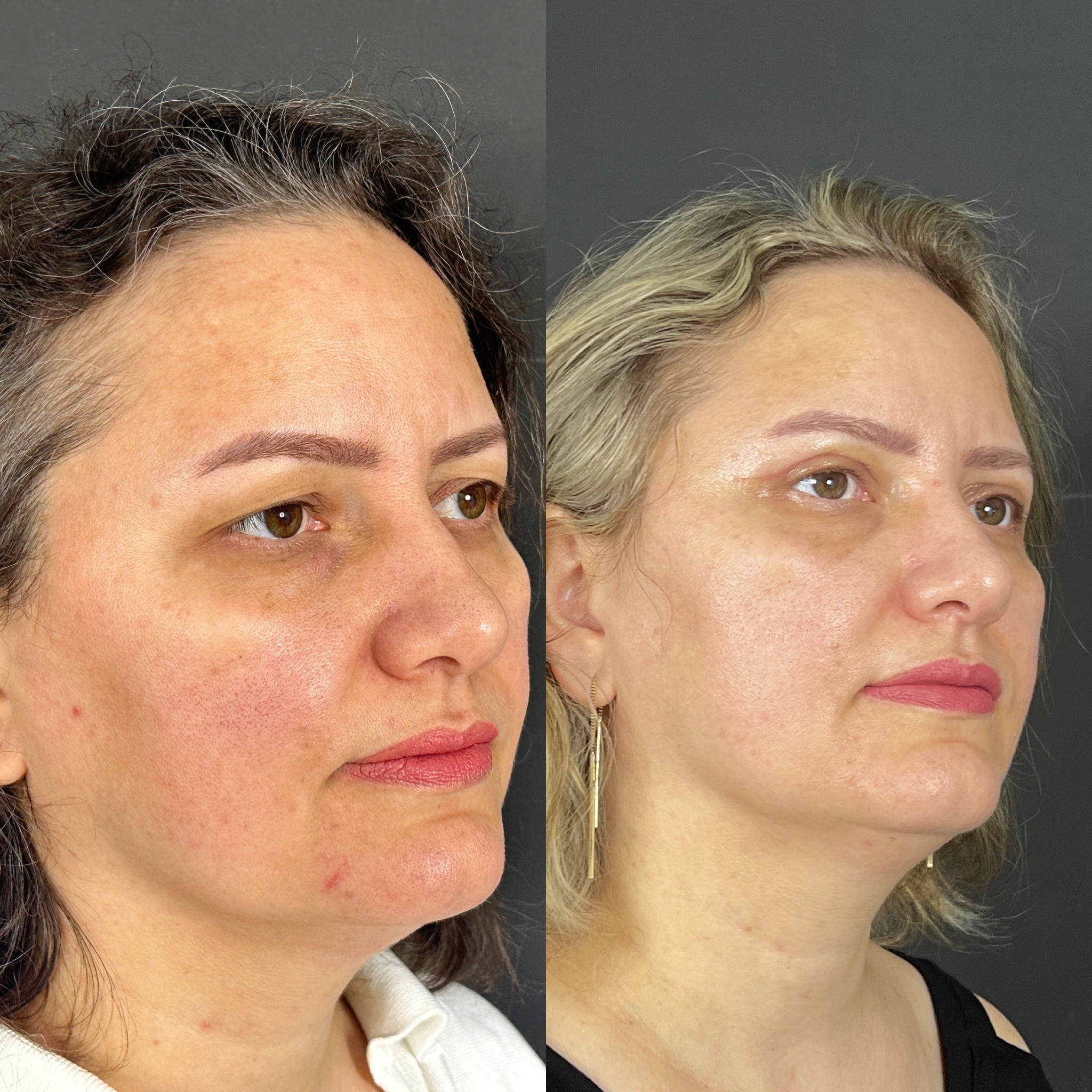
Patient Overview
Patient: Songul
Age: 47 years old
Gender: Female
Procedures: Upper eyelid surgery (upper blepharoplasty / eye lift)
After photos taken at: 10 days post-surgery
Location: Istanbul, Turkey
Day Ten: When the Result Appears for the First Time
The first three days after upper blepharoplasty belong to swelling. The first week belongs to sutures and bruising. But day ten belongs to the result. This is the moment when the healing has cleared enough for the patient to look in the mirror and see — for the first time — what her eyes actually look like after surgery. The swelling has subsided substantially. The bruising has faded to faint traces or disappeared entirely. The sutures have been removed. And the refreshed, more open eyes that the patient imagined during consultation are finally visible. Songul's ten-day photographs capture this reveal.
At forty-seven, Songul underwent an upper eyelid eye lift with Dr. Cem Berkay Sinaci, a European board-certified plastic surgeon (FEBOPRAS) and member of ISAPS and ASPS. Her ten-day images document the stage that most prospective patients are genuinely curious about — the point at which the surgery stops looking like surgery and starts looking like rejuvenation.
What Has Happened in the First Ten Days
The ten days between surgery and Songul's photographs encompass the entire acute recovery arc of upper blepharoplasty, compressed into less than two weeks.
Days one through three were dominated by the inflammatory response. The eyelids swelled as the body mobilised its healing cascade, and bruising appeared in the periorbital tissues as small blood vessels disrupted during surgery released their contents into the surrounding skin. The eyes looked worse before they looked better — the universal early blepharoplasty experience.
Days four through seven brought visible daily improvement. The swelling began receding noticeably each morning. The bruising transitioned from its initial dark phase through green and yellow tones, signalling active reabsorption. Sutures were removed between days five and seven, eliminating the visible thread lines along the eyelid crease and allowing the incision to continue healing as a clean, unsupported line.
Days eight through ten completed the transition from healing to result. The residual oedema that lingered after the first week cleared to the point where the true eyelid contour became visible. The excess skin that previously hooded the eyes is gone. The eyelid platform — the visible surface between lash line and crease — has reappeared. The eyes are open, defined, and rested.
Songul's ten-day appearance is not her final result — subtle refinement continues over the following weeks and months — but it is the first reliable preview. What she sees at day ten is approximately ninety percent of what she will see permanently.
The Suture-Free Eyelid at Ten Days
By day ten, Songul's sutures have been out for several days, and the incision is healing independently. The wound edges, which bonded during the first five to seven days under suture support, now maintain their approximation through the early collagen crosslinks that the body has formed within the healing tissue.
The incision line at ten days appears as a fine pink line within the eyelid crease. It is visible on close inspection — particularly with the eyes closed — but it is already partially concealed by the natural folding mechanics of the upper eyelid. When the eye opens, the skin above the crease folds over the skin below it, tucking the scar into a hidden fold that casual observation cannot access.
Over the next three to six months, this pink line will fade progressively to a pale thread that matches the surrounding skin colour. By one year, the scar in most patients is undetectable even under deliberate examination. The eyelid crease is one of the most forgiving locations for surgical scarring on the entire body — hidden by anatomy, protected from sun exposure by the brow, and subject to constant micro-movement that promotes scar maturation.
Why Forty-Seven Is Peak Blepharoplasty Age
Upper blepharoplasty is performed across a wide age range — from patients in their late twenties with genetic excess skin to patients in their seventies with decades of accumulated redundancy. But the late forties represent the statistical peak of demand, and the reasons are both biological and psychological.
Biologically, the late forties are when upper eyelid hooding crosses the threshold from subtle to significant in most patients. The skin laxity that has been accumulating since the thirties reaches the point where the excess skin visibly drapes over the crease, narrows the eye opening, and creates the perpetually tired expression that drives patients to consultation. The change is no longer something noticed only in photographs or under harsh lighting — it is present in every mirror, every morning.
Psychologically, patients in their late forties often feel a disconnect between their internal energy and their external appearance. They feel alert, engaged, and vital — but their hooded eyelids project the opposite. The eye lift resolves this disconnect by aligning appearance with reality, producing eyes that communicate the alertness the patient actually feels.
Songul at forty-seven fits this profile precisely. Her eye lift was not about looking younger than her age — it was about looking as awake and energetic as she genuinely is.
The Eye Lift Effect on Daily Life
The practical changes that an eye lift produces extend into everyday activities that patients may not have anticipated before surgery.
Morning routine changes. The heavy, hooded upper eyelids that greeted Songul in the mirror each morning — creating a tired first impression regardless of sleep quality — have been replaced by open, rested eyes that reflect how she actually feels. The psychological impact of this daily change is substantial and cumulative.
Makeup application transforms. The eyelid platform that was hidden beneath excess skin is now visible, providing a surface for eyeshadow, liner, and the eye makeup techniques that hooded lids make impossible. Patients frequently report that their makeup looks better after blepharoplasty — not because their technique has changed but because they now have the anatomical canvas to work with.
Photographs improve immediately. The shadows, hooding, and narrowed eye appearance that upper eyelid excess creates in photographs — particularly in flash photography — are eliminated. The eyes photograph as open and bright, without the patient needing to consciously widen them for every shot.
Screen presence changes. In an era where video calls are a daily occurrence, the refreshed eye area communicates engagement and alertness to colleagues, clients, and contacts who see the patient primarily through a camera.
What Remains Between Day Ten and the Final Result
The changes that occur after day ten are refinements rather than revelations. The residual swelling that adds subtle puffiness at ten days will resolve completely over the next two to four weeks. The incision line will continue its gradual fade from pink to pale. The eyelid tissue will soften to its final texture as the last traces of healing firmness dissipate.
By three weeks, the result is socially invisible — no observer would suspect surgery. By three months, the scar has matured to near-final quality. By six months, the eyelid contour, scar appearance, and tissue softness have reached their permanent state.
Songul's ten-day result is the preview. The three-month result is the finished product. The difference between them is measured in subtle degrees of refinement rather than dramatic change — because the fundamental improvement is already established at day ten.
Upper Eyelid Eye Lift in Istanbul
Songul's ten-day before and after captures the upper blepharoplasty result at the moment it first becomes clearly visible — sutures removed, bruising resolved, and the refreshed eye contour emerging through the final traces of healing. For patients considering an eye lift in Istanbul, her case demonstrates that the window between surgery and a visible, natural-looking result is remarkably brief — ten days from the operating table to the first genuine preview of eyes that look rested, open, and entirely unoperated.