
Upper Eyelid Blepharoplasty Day Three Healing
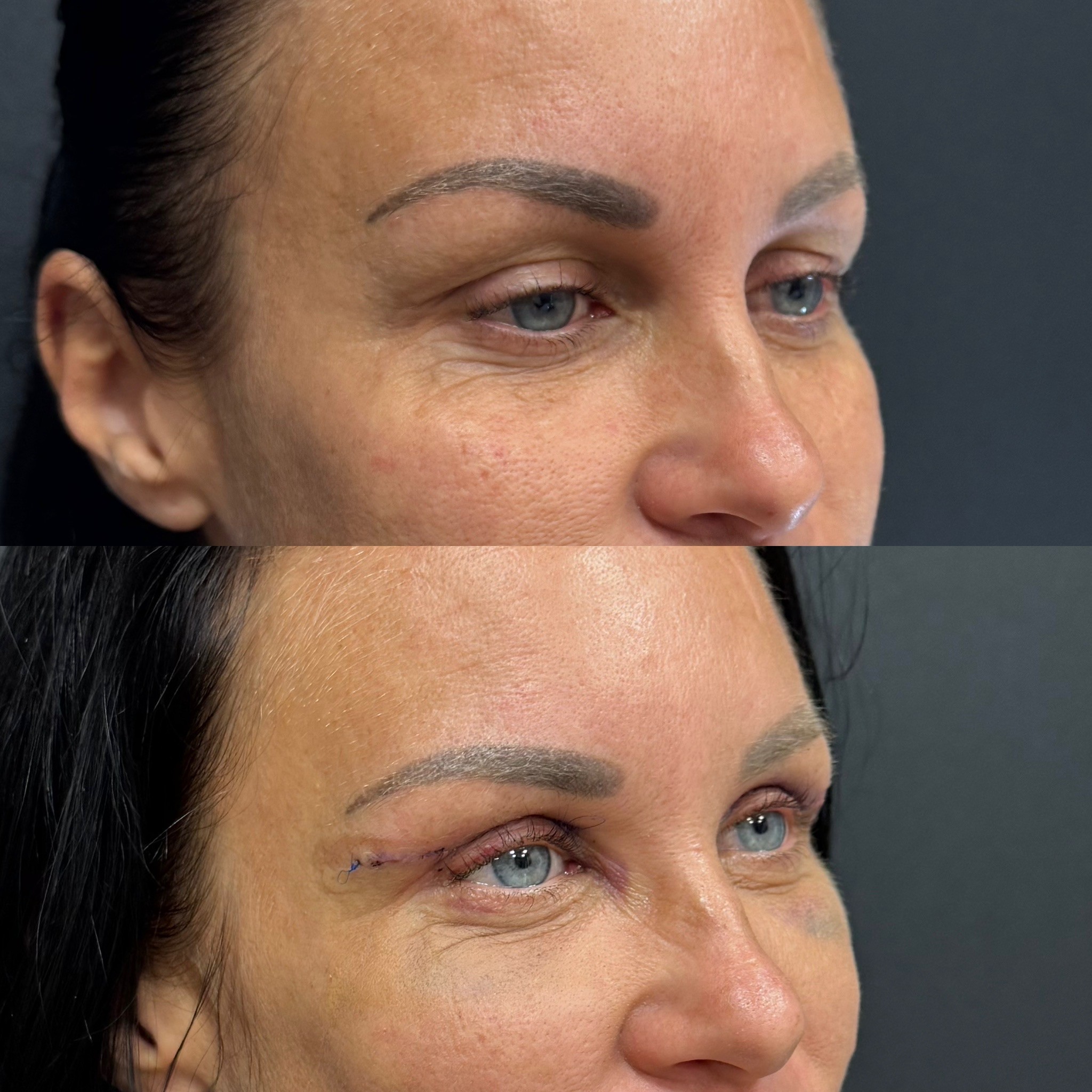
Before and after upper eyelid blepharoplasty at day three showing early eye lift healing and initial improvement. Dr. CBS eyelid surgery in Istanbul, Turkey.


Patient Overview
Patient: Daniela
Age: 41 years old
Gender: Female
Procedures: Upper eyelid blepharoplasty
After photos taken at: 3 days post-surgery
Location: Istanbul, Turkey
Why Day-Three Photos Exist in This Gallery
Most before and after galleries show polished final results — healed scars, resolved swelling, the best possible version of the surgical outcome. Day-three photographs serve a different purpose entirely. They exist because the most anxious period for any eyelid surgery patient is the first week, when the mirror shows bruising, swelling, and suture lines rather than the refreshed eyes she was promised. Daniela's three-day images provide the honest reference that prospective patients search for and rarely find: what upper blepharoplasty actually looks like before the healing is done.
At forty-one, Daniela underwent upper eyelid surgery with Dr. Cem Berkay Sinaci, a European board-certified plastic surgeon (FEBOPRAS) and member of ISAPS and ASPS. Her three-day photographs are shared not because they represent her final result — they emphatically do not — but because they demonstrate that the early post-operative appearance is temporary, expected, and no cause for concern.
What Day Three Actually Looks Like
Three days after upper blepharoplasty, the eyelids are at or near the peak of their post-operative response. The tissue has reacted to the surgical excision with the inflammatory cascade that every wound triggers, and the visible results of that reaction are concentrated in the thinnest, most delicate skin on the body.
Swelling is the dominant feature. The upper eyelids appear puffy, and the oedema may extend to the inner corners of the eyes and the upper cheek area. This swelling obscures the very improvement the surgery created — the excess skin has been removed, but the inflammatory fluid temporarily replaces some of the volume that was excised. Patients who do not understand this biology can feel alarmed, believing the procedure made their eyes look worse. It has not. It has triggered a healing response that will resolve predictably over the next ten to fourteen days.
Bruising varies considerably between patients. Some patients show significant periorbital discolouration at day three — purple or blue-black shadows beneath and around the eyes. Others show minimal bruising. The variation depends on individual blood vessel fragility, blood pressure during surgery, and genetic factors in coagulation. Daniela's bruising pattern at day three, whatever its extent, falls within the normal range and will transition through green and yellow phases before clearing completely within two weeks.
The suture line is visible at day three. Fine stitches sit along the eyelid crease, holding the wound edges in precise alignment while the tissue bonds. These sutures will be removed between days five and seven, and the incision will continue healing into a scar that disappears within the crease fold when the eye opens.
The Gap Between Day Three and the Final Result
The distance between what Daniela sees at day three and what she will see at three weeks is dramatic. Understanding this gap is the single most important piece of information for any patient in the early days of blepharoplasty recovery.
By one week, the sutures are out and the bruising is fading rapidly. The swelling has decreased enough that the improved eyelid contour is beginning to emerge beneath the residual puffiness. The patient starts to see glimpses of the result she came for.
By two weeks, the bruising has cleared entirely in most patients. The swelling has reduced to a level where it is noticeable to the patient but not to casual observers. Social activities, work, and daily life have resumed. Makeup can be applied to the eye area, though most patients find they do not need it to conceal any remaining signs.
By three weeks, the recovery is essentially invisible. The eyes look refreshed, open, and natural. The scar is hidden in the crease. The day-three appearance is a distant memory that bears no resemblance to the current result.
This transformation from day three to week three is one of the fastest and most complete in all of facial surgery. The recovery window is brief, the trajectory is predictable, and the endpoint is a natural improvement that shows no evidence of surgical intervention.
Why Forty-One Is a Common Age for This Procedure
The early forties represent a convergence point for upper eyelid surgery. The age-related skin changes that produce upper eyelid hooding have progressed far enough to create a visible, daily-impact aesthetic concern. But the surrounding facial structures — the brow, the mid-face, the skin quality — remain youthful enough that upper blepharoplasty alone, without additional procedures, produces a comprehensive refreshment of the eye area.
At forty-one, Daniela's upper eyelid skin had developed enough redundancy to create the hooded, heavy-lidded appearance that made her look tired regardless of how rested she felt. The excess skin obscured her eyelid platform, complicated makeup application, and created shadows over her eyes that were visible in photographs and video calls.
Upper blepharoplasty at this stage intercepts the ageing process at an optimal point. The correction removes the accumulated excess and resets the eyelid contour to a more youthful configuration. The result looks natural because the surrounding facial anatomy still matches a refreshed eye area — there is no incongruity between rejuvenated eyelids and an aged surrounding face.
Managing the First Three Days
The practical management of days one through three after upper blepharoplasty is straightforward. Cold compresses applied gently to the eye area during the first forty-eight hours help limit swelling and reduce bruising. The head is kept elevated during sleep — an extra pillow or a wedge cushion prevents the gravitational fluid accumulation that sleeping flat promotes in the periorbital region.
Eye drops or ointment prescribed by Dr. Sinaci keep the ocular surface lubricated during the early healing period when the eyelid may not close with its full pre-surgical contact. This lubrication is a comfort measure rather than a medical necessity — the eyelid function is not compromised by the surgery, but the mild swelling can temporarily reduce the completeness of eyelid closure during the first few days.
Activity is restricted to gentle movement. No bending, straining, heavy lifting, or vigorous exercise during the first week — all of these increase blood pressure in the head and face, which can worsen swelling and increase bruising risk. Reading, screen time, and light household activities are permitted as comfort allows.
The Value of Honest Early Photography
Daniela's day-three photographs serve every future patient who types "eyelid surgery day 3" into a search engine at two in the morning, worried about what she sees in her own mirror. These images confirm that the early post-operative appearance is not the result — it is the price of admission to the result. The swelling resolves. The bruising clears. The sutures come out. And what remains, within three weeks, is a pair of eyes that look naturally more open, more alert, and more like the patient feels on the inside.
Upper Blepharoplasty Recovery in Istanbul
Daniela's three-day before and after provides the transparent, early-recovery reference that polished gallery images cannot offer. For patients considering upper eyelid surgery in Istanbul, her case demonstrates that the first days after blepharoplasty involve visible healing signs that resolve rapidly and completely — a brief biological process that stands between the procedure and the refreshed, natural eye lift result that emerges within weeks.