
Blepharoplasty Temporal Lift: Periorbital Rejuvenation
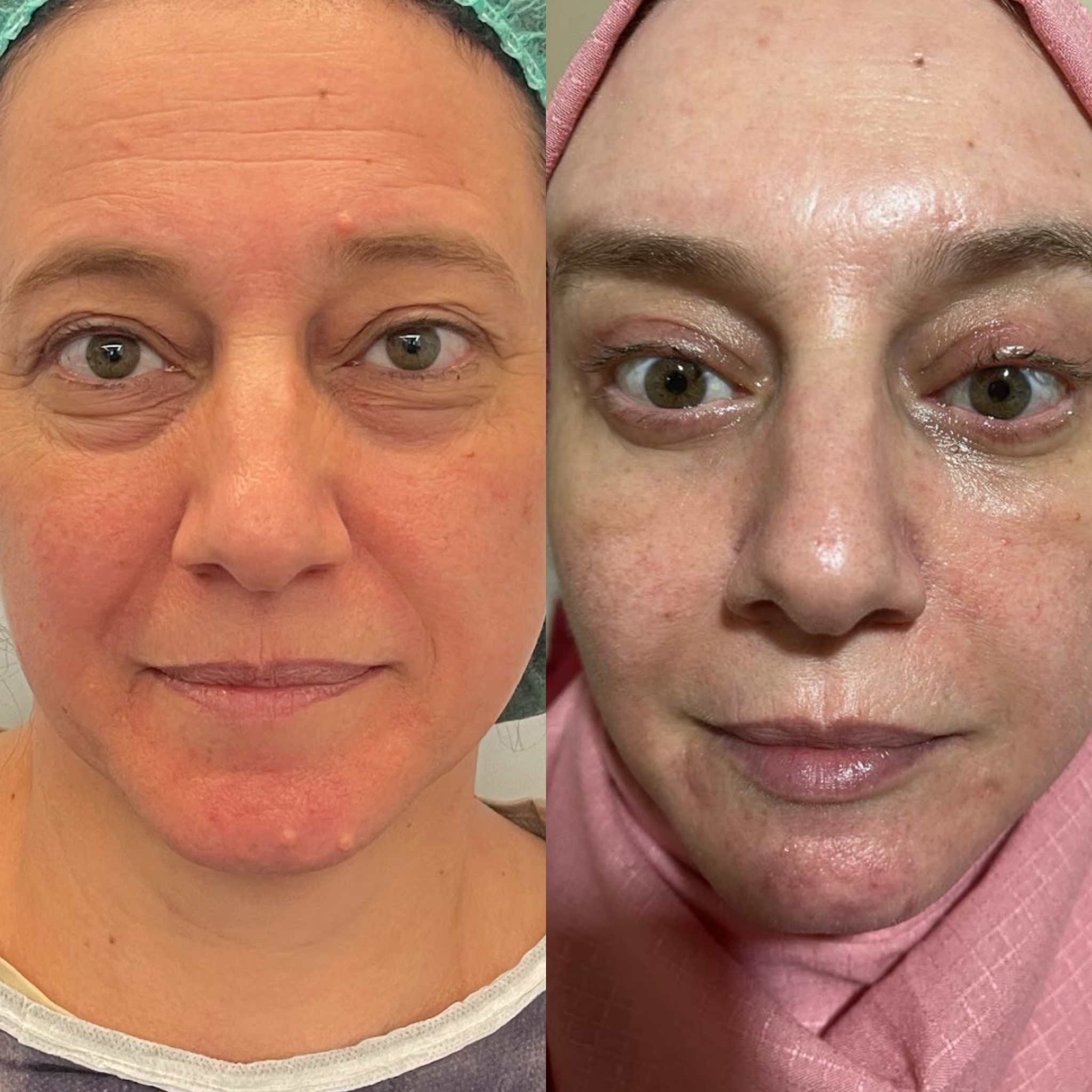
Before & after upper and lower blepharoplasty with temporal browlift in a 59-year-old. 3-week results showing eye rejuvenation in Istanbul, Turkey

Patient Overview
Patient: Lindia
Age: 59
Gender: Female
Procedures: Upper blepharoplasty, lower blepharoplasty (subciliary with fat repositioning), temporal browlift
After photos taken at: 3 weeks post-op
Location: Istanbul, Turkey
When Eyelid Surgery Alone Is Not Enough
Not every patient who looks tired around the eyes needs only blepharoplasty. In some cases, the eyelid heaviness that brings a patient to consultation is caused not solely by excess eyelid skin but by a combination of lid redundancy and brow descent. Performing a blepharoplasty without addressing the brow in these patients can lead to a result that looks incomplete or, worse, creates an unnaturally tight upper lid while a heavy brow continues to weigh the area down from above. Lindia, a 59-year-old female patient, presented with exactly this combination — significant upper lid hooding compounded by lateral brow ptosis, prominent lower lid fat bags with skin laxity, and an overall periorbital appearance that had aged beyond what any single procedure could fully correct.
Dr. Cem Berkay Sinaci, a European board-certified plastic surgeon (FEBOPRAS) and member of ISAPS and ASPS, planned a three-level approach: temporal browlift to restore the outer brow to its youthful position, upper blepharoplasty to remove true eyelid skin excess, and subciliary lower blepharoplasty with fat repositioning and skin removal to address the under-eye area. This comprehensive strategy treats the periorbital region as a single aesthetic unit rather than as isolated parts.
What Is a Temporal Browlift?
A temporal browlift specifically targets the lateral portion of the brow — the outer third that tends to descend most noticeably with age. Unlike a full coronal or endoscopic browlift that addresses the entire brow from inner to outer corner, the temporal approach focuses on lifting the tail of the brow where the heaviness has the greatest impact on the adjacent upper eyelid. Through small incisions concealed within the hairline at the temples, the tissues are elevated and secured in a higher position.
In Lindia's case, the temporal browlift served a critical preparatory function. By restoring the brow to its appropriate height first, the true amount of upper eyelid skin excess could be accurately assessed. Without this step, there would be a risk of removing too much upper lid skin — tissue that was being pushed downward by the brow rather than being genuinely redundant. Having trained in advanced facial rejuvenation through fellowship in Brazil under Raul Gonzalez and cadaver dissection courses in Bangkok, Dr. Sinaci approaches the brow and upper lid as mechanically connected structures that must be evaluated together.
Subciliary Lower Blepharoplasty with Fat Repositioning
For Lindia's lower eyelids, the subciliary approach was chosen — an incision placed just beneath the lash line that provides direct access to the lower lid fat compartments, the orbital septum, and the skin envelope. Through this single incision, Dr. Sinaci performed fat repositioning: the herniated fat pads that were creating visible bags were released from their compartments while maintaining their blood supply, then redirected inferiorly to fill the hollow tear trough depression beneath them. This technique transforms a liability — protruding fat — into a solution for the adjacent hollow, creating a smooth lid-cheek transition without the use of fillers or implants.
Excess lower lid skin was also trimmed conservatively through the same subciliary incision, addressing the crepey texture and fine wrinkling that had developed in the lower lid skin envelope.
Subciliary Versus Transconjunctival Blepharoplasty
The choice between a subciliary and transconjunctival approach for lower blepharoplasty depends entirely on what the patient's anatomy requires. A transconjunctival blepharoplasty places the incision inside the lower eyelid — on the conjunctival surface — leaving no external scar whatsoever. It is an excellent approach for younger patients whose primary concern is fat herniation without significant skin excess, as the incision provides access to the fat compartments but does not allow for meaningful skin removal.
Lindia's lower lids presented both fat herniation and skin laxity, making the subciliary approach the more appropriate choice. The external incision, while technically leaving a scar, heals to near-invisibility when placed precisely along the subciliary line and closed with proper technique. Dr. Sinaci selects between these two approaches on a case-by-case basis, using whichever provides the access needed to fully address the patient's specific anatomy.
General Anaesthesia for Comprehensive Procedures
While isolated upper blepharoplasty is routinely performed under local anaesthesia, Lindia's operation combined three distinct procedures across the brow and both sets of eyelids. The operative time, the extent of tissue dissection involved in the temporal browlift, and the precision required for lower lid fat repositioning all favoured general anaesthesia. This allows the surgeon to work methodically through each stage without time pressure and ensures the patient's complete comfort throughout a longer procedure.
General anaesthesia for facial surgery is performed as a day case — Lindia was discharged the same day and recovered at her accommodation in Istanbul, returning for follow-up visits to monitor healing and remove sutures.
Non-Dissolvable Sutures Across All Incision Sites
For every incision in Lindia's procedure — the upper blepharoplasty creases, the subciliary lower lid incisions, and the temporal browlift sites — Dr. Sinaci used non-dissolvable suture material. The rationale is consistent regardless of location: non-dissolvable sutures generate minimal inflammatory tissue reaction, hold wound edges in precise alignment, and produce finer scars than their dissolvable counterparts, which trigger an enzymatic breakdown reaction that widens the healing wound. The sutures from the eyelid incisions were removed at four to six days, while the temporal incisions followed a similar timeline.
Reading a Three-Week Combined Result
Lindia's before and after photographs at three weeks capture a moment where the major transformation is already visible but the tissues are continuing to refine. The temporal browlift has restored the outer brow to a more youthful position, relieving the lateral hooding that was compressing the outer portion of her upper lids. The upper blepharoplasty has created a clean, defined crease now that it is no longer being obscured by brow descent. The lower lids show a smooth contour — the bags are gone and the tear trough has been filled by the repositioned fat, creating the continuous lid-cheek surface that defines a youthful under-eye area.
At three weeks, residual swelling is still present, particularly in the lower lids where the fat repositioning involves deeper tissue manipulation. This will continue to resolve over the following four to six weeks. The incision lines are maturing but will fade further over two to three months. The temporal browlift result will settle slightly as the tissues relax into their final position, though the lateral lift will be maintained.
The Logic of Treating the Entire Periorbital Frame
Lindia's case illustrates a principle that applies broadly in facial rejuvenation: the best results come from treating anatomical units comprehensively rather than in isolation. An upper blepharoplasty alone would have improved her lids but left a descended brow creating persistent lateral heaviness. A browlift without blepharoplasty would have lifted the brow but left redundant eyelid skin. Lower blepharoplasty without fat repositioning would have reduced the bags but left the tear trough hollow. By addressing all three levels in a single session, each procedure complements the others, producing a harmonious result that no individual component could achieve alone.
Considering Comprehensive Eye Rejuvenation in Istanbul
For international patients researching periorbital rejuvenation in Turkey, Lindia's case demonstrates the importance of choosing a board-certified plastic surgeon who can assess and treat the entire region — brow, upper lid, and lower lid — as an integrated system. At 59, her anatomy required a tailored combination of techniques, and the three-week result shown here reflects the kind of natural, balanced outcome that comes from matching the surgical plan precisely to the individual patient's needs.