
Upper Blepharoplasty at 52: 6-Day Early Results
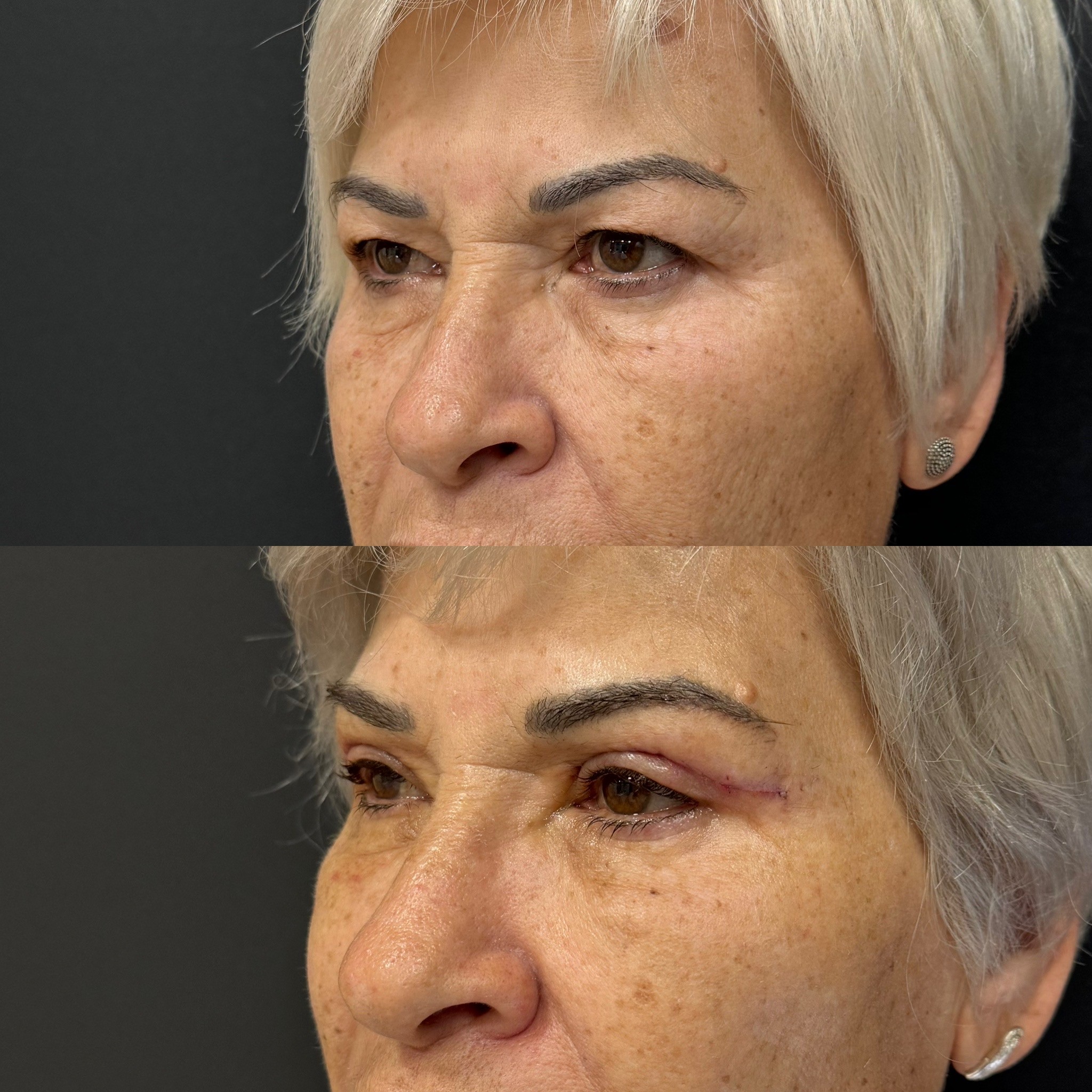
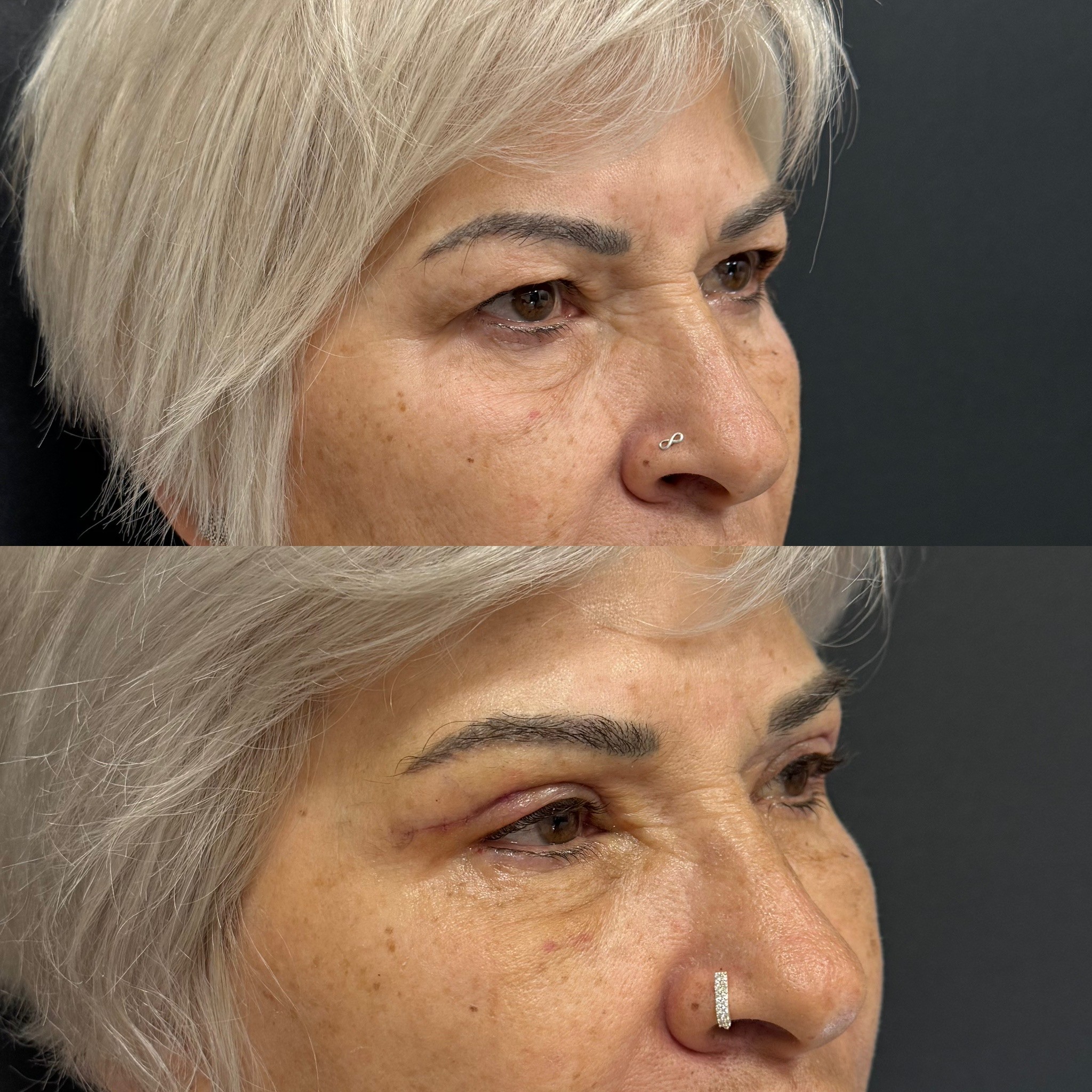
Before & after upper eyelid blepharoplasty at 6 days post-op in a 52-year-old female. Eye lift recovery results from board-certified plastic surgeon in Istanbul

Patient Overview
Patient: Hatice
Age: 52
Gender: Female
Procedures: Upper eyelid surgery (blepharoplasty)
After photos taken at: 6 days post-op
Location: Istanbul, Turkey
Six Days: The Earliest Window Into Your Blepharoplasty Result
Sharing a six-day postoperative photograph requires a certain confidence in the work. At this stage, the non-dissolvable sutures have just been removed — or were removed the day before — and the eyelids are still in the earliest phase of independent healing. There is no time for swelling to mask imprecise work or for months of maturation to smooth over irregularities. What you see at six days is a raw, unfinished preview that reveals the precision of the surgical execution itself. Hatice's case, photographed at this unusually early stage, shows what meticulous upper blepharoplasty looks like before the body has had the chance to refine it further.
Upper Eyelid Ageing in the Fifties
By 52, the upper eyelid has typically undergone changes that extend beyond simple skin excess. The dermis has thinned, the collagen network has loosened, and the orbital septum — the fibrous membrane that holds the orbital fat behind the lid — may have weakened enough to allow subtle fat prolapse medially, near the inner corner of the eye. In some patients, the brow has descended slightly as well, contributing additional tissue weight to the upper lid.
Hatice presented with significant upper eyelid skin redundancy that had progressed to the point where the excess was not merely cosmetic but was beginning to encroach on her superior visual field. This overlap of functional and aesthetic concern is common in patients in their fifties and makes the indication for surgery particularly clear. Dr. Cem Berkay Sinaci, a European board-certified plastic surgeon (FEBOPRAS) and member of ISAPS and ASPS, assessed Hatice's brow position, lid crease symmetry, and skin elasticity to design a removal pattern that would restore both a defined crease and comfortable peripheral vision.
Why Tissue Quality Matters More Than the Amount Removed
A common misconception is that more advanced eyelid ageing simply requires removing more skin. In reality, the quality of the remaining tissue determines the outcome more than the quantity excised. In a 52-year-old eyelid, the skin that stays must be thick enough and elastic enough to drape smoothly, close fully without tension, and heal with an inconspicuous scar. Over-resection in tissue with reduced elasticity can lead to lagophthalmos — incomplete eyelid closure — which causes dryness, irritation, and potential corneal damage.
Dr. Sinaci's approach prioritises leaving an adequate skin reserve above the crease. The pinch test performed during preoperative marking determines exactly how much tissue can be safely removed while maintaining a comfortable margin for full closure. This conservative philosophy becomes increasingly important with age, as the consequences of over-resection are harder to correct in less elastic tissue.
The Non-Dissolvable Suture Advantage at Six Days
Hatice's sutures were removed at the standard window of four to six days post-surgery. Because Dr. Sinaci uses non-dissolvable suture material for all blepharoplasty cases, the removal is a brief, straightforward clinic visit — the stitches slide out with minimal discomfort, and no residual suture material remains in the tissue to provoke an inflammatory reaction.
This is particularly relevant at the six-day mark because the photograph captures the incision line at its most exposed moment — freshly revealed after suture removal, with no ongoing inflammation from dissolving material. The fine, precise line visible along Hatice's crease at this early stage is a direct reflection of the suture technique used. Dissolvable alternatives, while convenient, would still be actively degrading within the tissue at this point, generating the low-grade inflammation that can widen the eventual scar.
What Changes Between Day Six and the Final Result
At six days, Hatice's eyes already look meaningfully different from her preoperative photographs. The hooding is corrected, the crease is visible, and the overall expression reads as more alert and rested. However, this is decidedly not the final result. Several changes will unfold over the coming weeks and months.
Residual swelling, though modest at this point, will continue to decrease over two to four weeks. The incision line, currently visible as a fine pink mark, will progressively fade — first to a light pink, then to a nearly invisible thread within the crease fold. Any minor asymmetry between the two sides, common at this stage due to slightly different swelling rates, will equalise. The crease itself will soften and assume a more natural depth as the deep fixation between the skin and underlying tissue matures.
By three months, the transformation from what is visible at day six to the final result is subtle but meaningful — like the difference between a painting that has just been completed and one that has been varnished.
The Functional Dimension of Upper Blepharoplasty
While many patients seek upper eyelid surgery primarily for aesthetic rejuvenation, cases like Hatice's remind us that this procedure often carries a functional benefit as well. When redundant upper eyelid skin descends far enough to sit on or near the lash margin, it can obstruct the upper portion of the visual field. Patients may not notice this immediately because the change is gradual — they unconsciously compensate by raising their brows or tilting their head back slightly. The functional improvement after surgery is often described by patients as feeling like a curtain has been lifted, with a noticeable expansion in their upward and peripheral vision.
Planning Eyelid Surgery in Istanbul at Any Age
Hatice's case at 52 demonstrates that upper blepharoplasty remains highly effective and safe in the fifth decade when performed by an experienced, board-certified plastic surgeon who understands how tissue behaviour changes with age. The procedure was performed under local anaesthesia as a day case, with suture removal at the routine follow-up visit and a recovery trajectory that allows return to daily activities within the first week. For international patients considering an eye lift in Turkey, six-day results like these offer a transparent glimpse into the early postoperative period — the stage that polished marketing photographs rarely show.