
Chin Lipo & Buccal Fat Removal 20 Day Result | Age 24
Double chin liposuction with buccal fat removal before and after at 20 days. Jawline and cheek contouring by Dr. Cem Berkay Sinaci, Istanbul, Turkey.
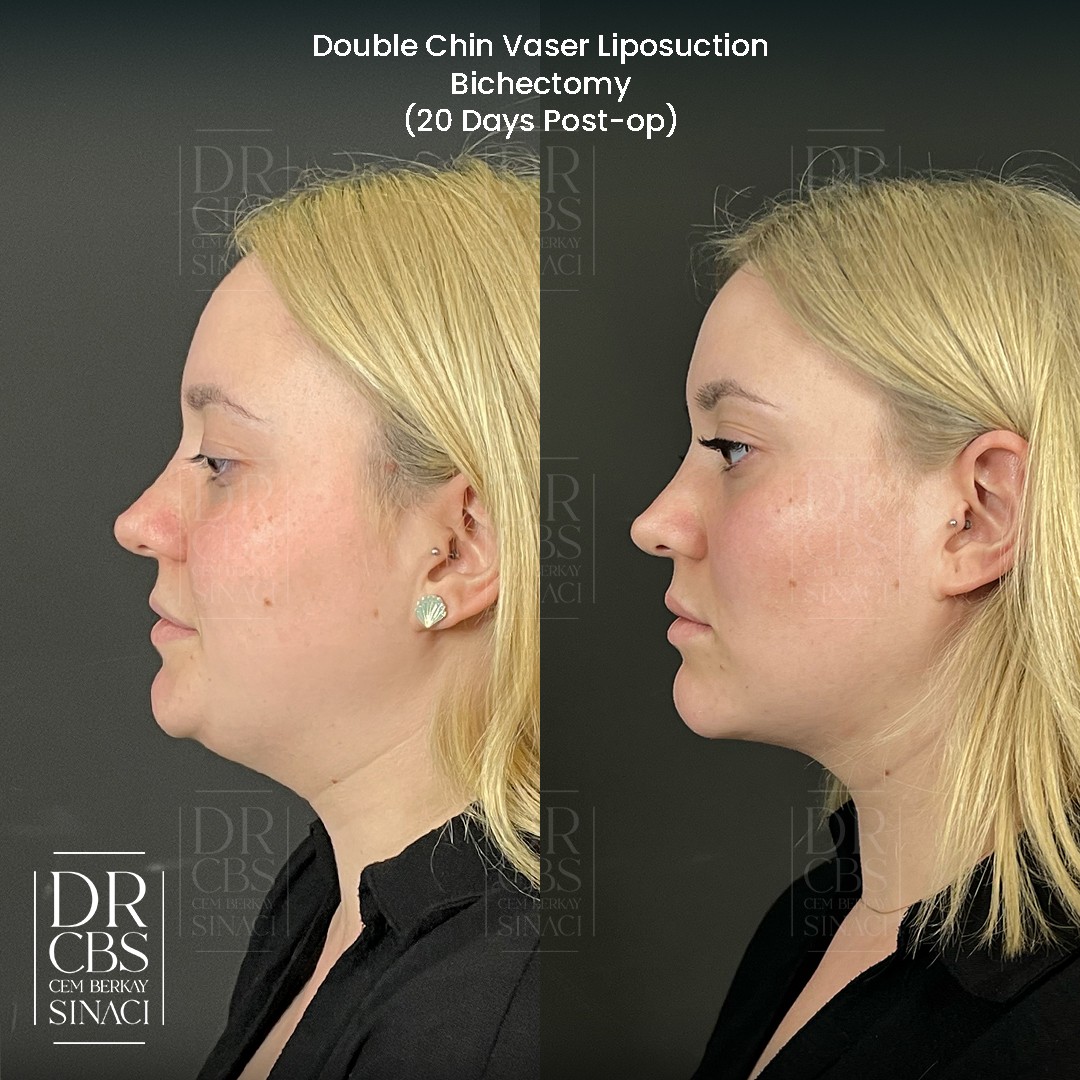
Patient Overview
Patient: Ilyada
Age: 24 years old
Gender: Female
Procedures: Laser liposuction of the submental area, buccal fat pad removal
After photos taken at: 20 days post-surgery
Case Description
Ilyada is the youngest patient in our facial contouring gallery at 24 years old, and her case introduces a procedure combination we have not yet documented: submental laser liposuction paired with buccal fat removal. While liposuction addressed the fullness beneath her chin, the buccal fat removal targeted the rounded volume in her lower cheeks. Together, these two procedures transformed the geometry of her lower face — narrowing the cheeks, defining the jawline, and creating the sculpted facial contour she was seeking.
Her concerns were not about aging. At 24, there was no laxity, no descent, no loss of skin elasticity. Her issue was facial shape — a genetically round lower face that made her feel her features lacked definition. This is a fundamentally different motivation than the patients in our gallery who are seeking rejuvenation, and it requires a different surgical mindset. The goal is not restoration but refinement.
What Is Buccal Fat Removal?
The buccal fat pad is a distinct, encapsulated mass of fat that sits deep within each cheek, between the buccinator muscle and the masseter. It is responsible for much of the rounded fullness in the mid-to-lower cheek area. Unlike subcutaneous fat that fluctuates with weight, the buccal fat pad is a defined anatomical structure whose size is largely genetic. Some people have naturally small buccal fat pads and angular cheekbones from adolescence. Others — like Ilyada — carry prominent buccal pads that maintain a round facial shape regardless of body weight.
The procedure is performed through a small incision inside the mouth, on the inner surface of each cheek. No external incisions are made — there are no visible scars whatsoever. The buccal fat pad is carefully identified, dissected from the surrounding tissue, and partially or fully removed depending on the desired degree of cheek reduction. The incision is closed with dissolvable sutures that do not require removal.
The entire procedure takes approximately 30 minutes and can be performed under local anesthesia. When combined with chin liposuction, as in Ilyada's case, both procedures are completed in a single session.
Why Combine These Two Procedures?
The lower face is a visual unit. The cheeks, jawline, and submental area all contribute to the overall facial shape, and addressing one without considering the others can create an imbalanced result. Removing buccal fat to slim the cheeks while leaving a full double chin would make the chin appear even more prominent by contrast. Removing chin fat while leaving round cheeks would define the jawline from the neck but leave the face appearing wide from the front.
Ilyada had fullness in both zones. By treating them together, the entire lower face was contoured as a unified composition. The reduced cheek volume reveals the cheekbone structure above, while the reduced submental volume reveals the jawline below. The two improvements amplify each other, creating a result that is more impactful than either procedure alone.
Results at 20 Days
At 20 days, the submental liposuction result is well into its settling phase — the acute swelling has resolved and the jawline definition is clearly visible. The buccal fat removal result, however, is still maturing. Cheek swelling after buccal fat removal takes longer to resolve than submental swelling because the buccal region has a richer blood supply and the tissue sits deeper, surrounded by muscle on both sides.
At this stage, Ilyada's cheeks show noticeable reduction compared to her preoperative appearance, but they have not yet reached their final degree of slimness. The full effect of buccal fat removal typically becomes apparent at two to three months, when all deep tissue swelling has resolved and the overlying cheek skin has fully settled against the reduced volume beneath it.
The jawline, by contrast, is already sharply defined. The combined effect of a slimming cheek above and a contoured neck below is creating the angular, sculpted lower face profile that Ilyada wanted — and it will only become more pronounced as the cheek swelling continues to resolve.
Buccal Fat Removal at 24: The Age Consideration
Buccal fat removal in younger patients warrants careful discussion because the buccal fat pad naturally diminishes with age. A face that appears round at 24 often becomes naturally more angular by the mid-thirties as the buccal pad atrophies and overall facial fat volume decreases. Removing buccal fat aggressively in a young patient carries a theoretical risk of creating an excessively hollow or gaunt appearance in later decades.
This is why conservative removal is essential in younger patients. In Ilyada's case, the goal was not to eliminate the buccal fat entirely but to reduce it to a degree that created visible cheek definition while preserving enough deep volume to age gracefully. The difference between an elegant result and an over-resected one is often just a few grams of tissue — precision that requires experience and restraint.
During the consultation, we discussed this long-term perspective openly. Ilyada understood that the youthful volume she wanted to reduce now is the same volume that will support her midface structure decades from now. The conservative approach we agreed upon balances her current aesthetic goals with her future facial aging trajectory.
Surgeon's Note
Ilyada's case represents a category of facial contouring that is distinct from rejuvenation — it is about refining a facial shape that the patient was born with rather than reversing changes that time has created. The surgical philosophy is different. There is no "before" state to restore. The goal is to sculpt a contour that enhances features that already exist.
At 24, the technical execution requires particular discipline around volume preservation. It is easy to over-resect buccal fat in a young patient because the immediate result looks dramatic and satisfying. But the long view matters. I removed enough to create the definition Ilyada wanted while leaving a reserve that will serve her well as her face matures naturally over the coming decades. At 20 days, I am pleased with the emerging contour and confident that the final result at three months will deliver the balance between definition and natural softness that we discussed.
Frequently Asked Questions
Does buccal fat removal leave any visible scars?
No. The incision is made inside the mouth, on the inner cheek surface. There are no external cuts or scars. The intraoral incision heals quickly — typically within seven to ten days — and is closed with dissolvable sutures that do not require removal.
How long does it take to see the final result of buccal fat removal?
The cheeks appear noticeably slimmer within the first two to three weeks, but deep tissue swelling persists longer than surface swelling. The final, settled result is typically visible at two to three months post-procedure. Patients often report continued subtle improvement even at the four-month mark as the last traces of deep swelling resolve.
Am I too young for buccal fat removal at 24?
Not necessarily, but age is an important consideration. The buccal fat pad naturally decreases with age, so aggressive removal in younger patients can lead to a hollow appearance later in life. Conservative reduction — removing enough to create visible definition while preserving adequate deep volume — is the appropriate approach for patients in their twenties. A surgeon experienced with this procedure in younger demographics will calibrate the removal to balance your current goals with your long-term facial aging.
Can I eat normally after buccal fat removal?
A soft diet is recommended for the first five to seven days to allow the intraoral incisions to heal without irritation. Warm soups, smoothies, yogurt, and soft foods are ideal during this period. Avoid spicy, acidic, or crunchy foods that could irritate the incision sites. Most patients return to their normal diet within one week. Rinsing with an antiseptic mouthwash after meals helps keep the incision sites clean during healing.
Is the combination of chin lipo and buccal fat removal common?
Yes, this is one of the most popular facial contouring combinations, particularly among younger patients seeking overall lower face definition rather than anti-aging treatment. The two procedures complement each other anatomically — buccal removal slims the cheeks while chin liposuction defines the jawline and neck, together creating a cohesive, sculpted lower face contour in a single session.