
Breast Lift with Implants 5 Day Result | Age 37
Breast lift with implants before and after at 5 days. Mastopexy-augmentation by European board-certified Dr. Cem Berkay Sinaci in Istanbul, Turkey.


Patient Overview
Patient: Nina
Age: 37 years old
Gender: Female
Procedures: Breast lift (mastopexy) with implant augmentation
After photos taken at: 5 days post-surgery
Case Description
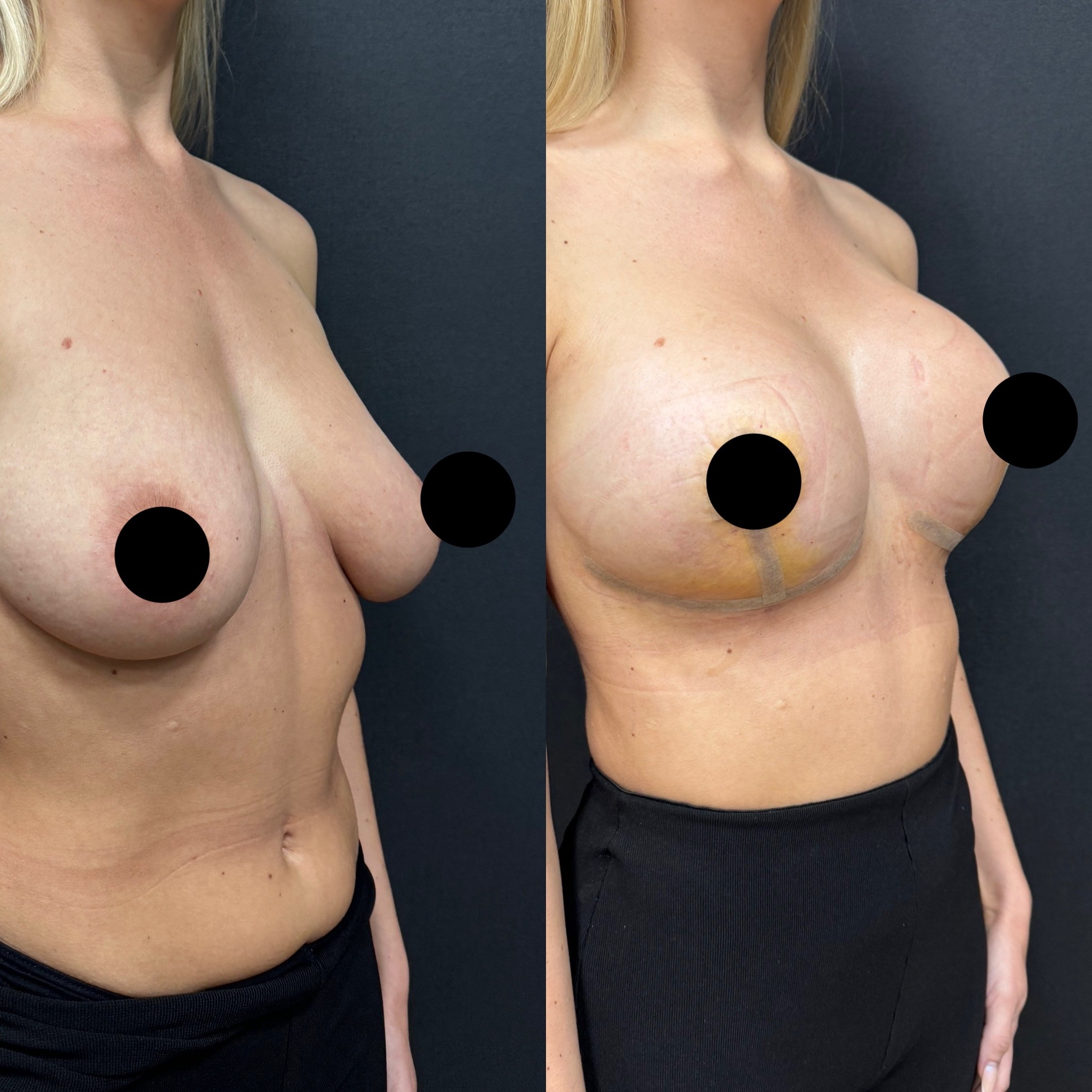
Nina underwent mastopexy-augmentation at our clinic in Istanbul to address breasts that had lost both their position and volume over time. At 37, she was dealing with a combination that a breast lift alone or implants alone could not fully correct — significant drooping with the nipple sitting below the inframammary fold, and deflation of the upper pole that left the breasts appearing flat and bottom-heavy. The combination of lift plus implant addresses both dimensions in a single procedure: the lift restores the nipple position and tightens the skin envelope, while the implant restores the fullness and projection that volume loss had taken away.
Her after photographs at five days show the very early postoperative stage — a point that is particularly informative for this specific procedure because of how dramatically the breast shape evolves between week one and month three.
What Day 5 Looks Like After Mastopexy-Augmentation
At five days, Nina's breasts appear high, tight, and somewhat boxy compared to what the final shape will be. This is completely normal and expected. Several overlapping factors create this early appearance.
The implants are sitting in an elevated position. The pectoralis muscle and the skin envelope have not yet relaxed to allow the implants to descend into their natural pocket. The breast looks top-heavy because the implant volume is concentrated in the upper pole rather than distributed naturally across the full breast mound.
The skin envelope is tight. The lift component removed excess skin and closed the remaining envelope firmly around the implant. At five days, there has been no tissue stretch or relaxation — the closure is at its tightest point, which compresses the implant and gives the breast a firm, rounded-at-the-top shape.
Swelling is present, adding volume and firmness throughout. The lower pole of the breast — the area below the nipple — has not yet filled out because the implant has not descended enough to project into this space.
All of these factors change significantly over the coming weeks and months through the settling process.
The Settling Process: From Week 1 to Month 6
The transformation between day five and the final result is one of the most dramatic evolutions in all of plastic surgery. Understanding it prevents the anxiety that nearly every breast augmentation patient experiences when they first see their result.
During weeks two through four, the initial tightness begins to relax. The swelling decreases noticeably. The breast starts to feel less like a firm mass and more like tissue. The implant begins its gradual descent as the pocket stretches under the combined influence of gravity and the implant's weight.
During months one through three, the most visible changes occur. The implant drops into the lower pole, filling out the natural curve below the nipple. The upper pole transitions from a rounded bulge to a gentle, natural slope. The breast shape shifts from obviously augmented to naturally full. The overall breast softens considerably.
Between months three and six, the final refinements settle in. The breast reaches its definitive shape and position. The implant has found its permanent resting place within the pocket. The scars, which were pink and firm at week one, have faded and flattened substantially.
Nina's five-day photographs, viewed alongside results from our later-stage cases, illustrate the starting point of this arc. What she sees in the mirror at day five is not her result — it is the raw material from which her result will emerge.
Why Mastopexy-Augmentation Is More Complex Than Either Procedure Alone
Combining a breast lift with implants is one of the most technically demanding breast procedures because the two components work in opposing directions. The lift tightens and reduces the skin envelope. The implant expands and fills the envelope. The surgeon must balance these competing forces precisely — removing enough skin to eliminate the droop while leaving enough to accommodate the implant without excessive tension on the closure.
Too much skin removed with too large an implant creates a breast under high tension that is at increased risk for wound healing issues and an unnatural, overly tight appearance. Too little skin removed leaves residual laxity that undermines the lifting effect. The calibration happens intraoperatively — the surgeon assesses the tissue in real time, adjusts the skin excision pattern, and selects the final implant size based on how the breast sits on the table with trial sizers in place.
This is why mastopexy-augmentation requires specific surgical experience beyond standard augmentation or standard lift. The decision-making is continuous throughout the procedure, and the margin between an excellent result and a compromised one is narrower than in either standalone operation.
Surgeon's Note
Nina's case at day five is a useful addition to our gallery because mastopexy-augmentation produces the most dramatic evolution of any breast procedure between the early postoperative period and the final result. Patients who see only the day-five appearance may feel uncertain about the shape. Patients who understand the settling timeline recognize that the high, tight, boxy appearance is simply the starting configuration — the breast equivalent of scaffolding that will gradually reshape itself into the final form.
At 37, Nina's tissue quality is well-suited to this procedure. Her skin has enough elasticity to adapt as the implant settles, and her breast tissue provides adequate coverage to produce a natural-looking result once the swelling resolves and the pocket matures. I am confident that her three-month result will show the soft, naturally full breast shape that this procedure is designed to create.
Frequently Asked Questions
Why do breasts look so high and tight immediately after a breast lift with implants?
The implants have not yet settled into their final position, the skin envelope is at its tightest from the lift closure, and postoperative swelling adds firmness and volume. This high, firm appearance is universal in the first week and changes dramatically over the following two to three months as the implants descend and the tissues soften — a process known as "drop and fluff."
How long does it take for breast implants to drop after a mastopexy?
The settling process begins within the first two weeks and continues for three to six months. Most patients see the most noticeable change between weeks four and twelve. The final breast shape — with natural upper pole slope and full lower pole projection — is typically achieved by four to six months. Patience during this period is essential, as the day-five appearance bears little resemblance to the final outcome.
Is a breast lift with implants riskier than implants alone?
The procedure is more complex because the surgeon must balance skin removal with implant volume, but in experienced hands the complication rate is comparable to either standalone procedure. The key is appropriate surgical planning — selecting an implant size that the reduced skin envelope can accommodate without excessive tension. This balance is what makes surgeon experience with this specific combination procedure particularly important.
What scars does a breast lift with implants leave?
The lift component requires incisions around the areola and vertically down the lower pole of the breast, sometimes with a short horizontal component in the inframammary fold. These scars are concealed within the natural contours of the breast and hidden by all bras and swimwear. They are most visible in the first three months, then progressively fade over 12 to 18 months to thin, pale lines.