
Upper Eyelid Blepharoplasty Two-Week Recovery Progress
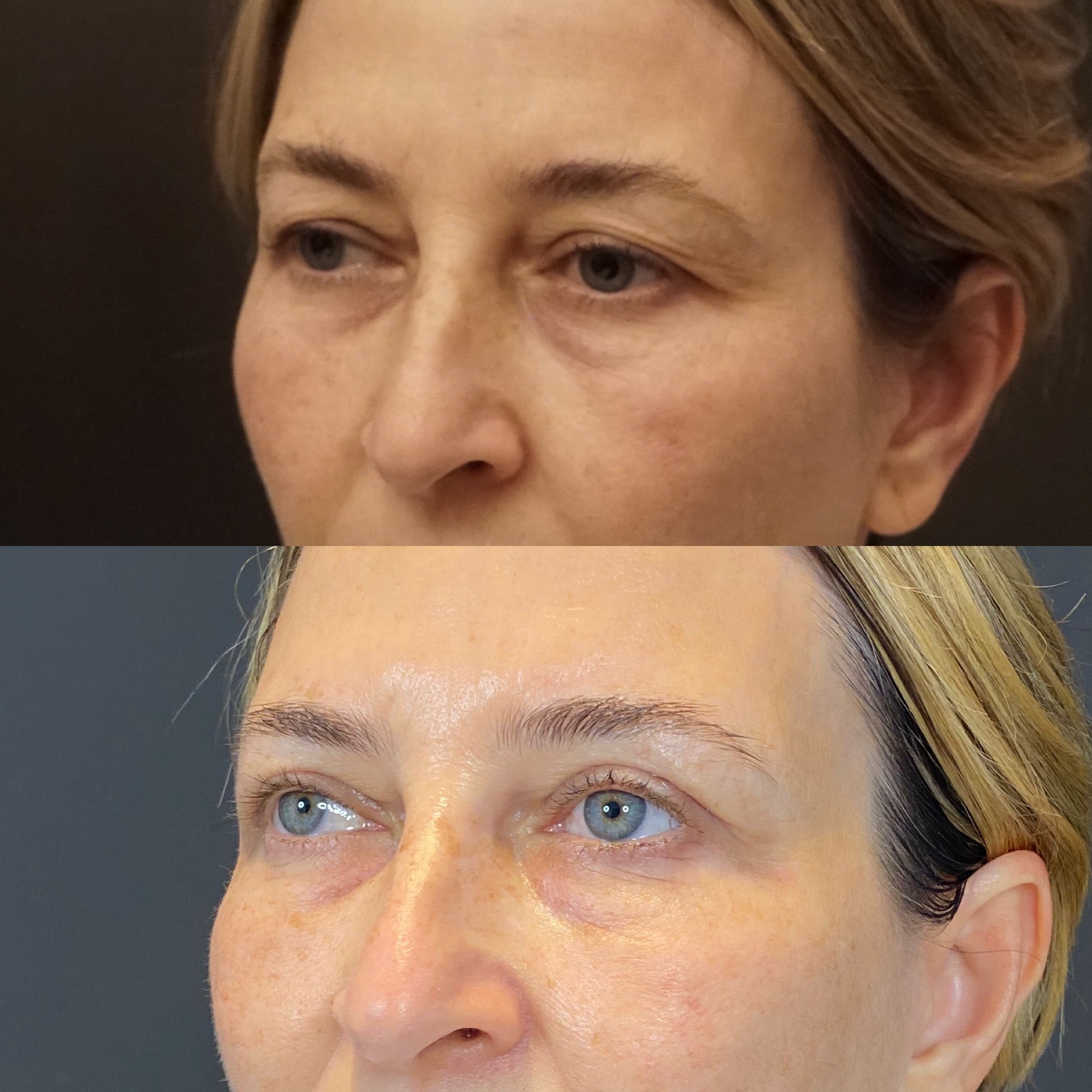
Before and after upper blepharoplasty at 14 days in a 44-year-old female. Two-week eye lift recovery photos from board-certified plastic surgeon in Istanbul


Patient Overview
Patient: Ayten
Age: 44
Gender: Female
Procedures: Upper eyelid surgery (blepharoplasty)
After photos taken at: 14 days post-op
Location: Istanbul, Turkey
What Two Weeks After Upper Blepharoplasty Actually Looks Like
Most patients researching eyelid surgery online encounter either dramatic before and after comparisons taken months apart or heavily filtered images that obscure the reality of early healing. Ayten's fourteen-day result offers something more useful — an honest look at what the two-week mark genuinely delivers. At this stage, the surgical correction is clearly visible, but the tissues are still settling. Understanding what is normal at two weeks versus what represents the final result helps patients set realistic expectations and reduces the anxiety that can accompany early recovery.
Why the Mid-Forties Upper Eyelid Responds Well to Surgery
At 44, Ayten presented with a common concern — upper eyelid skin that had gradually descended to obscure her natural crease, creating a heavy, hooded appearance. The mid-forties represent a point where eyelid skin redundancy has typically progressed beyond what can be managed with skincare, makeup techniques, or non-surgical treatments, yet the underlying tissue quality remains fundamentally healthy. Skin elasticity, while reduced compared to a decade earlier, is still sufficient to heal cleanly and drape smoothly over the lid after excess has been removed.
Dr. Cem Berkay Sinaci, a European board-certified plastic surgeon (FEBOPRAS) and member of ISAPS and ASPS, notes that patients in this age group often achieve some of the most satisfying blepharoplasty results precisely because the problem is clearly defined and the tissue cooperates well with the correction.
The Anatomy of an Upper Blepharoplasty Incision
The surgery begins with meticulous preoperative marking while the patient is seated upright — a detail that matters because eyelid skin shifts when the patient lies down. The incision is placed within the natural upper eyelid crease, following its contour from near the inner corner to slightly beyond the outer corner where it blends into a natural skin line. Through this incision, the redundant skin is excised along with a conservative strip of the underlying orbicularis oculi muscle when appropriate. If orbital fat is contributing to medial fullness near the inner corner, it can be conservatively reduced through the same approach.
The entire procedure is performed under local anaesthesia. Ayten was awake and comfortable throughout, with the operation lasting approximately forty-five minutes for both eyes.
The Role of Non-Dissolvable Sutures in Scar Quality
Once the excess tissue is removed, the incision edges are meticulously aligned and closed using non-dissolvable suture material. Dr. Sinaci's preference for non-dissolvable stitches in all blepharoplasty cases is deliberate. The eyelid skin measures less than one millimetre in thickness — the thinnest skin on the body. When dissolvable sutures degrade, the chemical reaction they undergo triggers an inflammatory response in the surrounding tissue. In skin this fine, that inflammation can widen the scar and create visible irregularity. Non-dissolvable sutures generate virtually no tissue reaction, hold the wound edges in precise alignment during the critical first days of healing, and are removed in four to six days at a brief clinic visit.
At fourteen days, Ayten's incision line is already thinning into a fine mark that sits hidden within her eyelid crease when her eyes are open.
Day-by-Day: What Happens During the First Two Weeks
The first forty-eight hours bring the most visible swelling and potential bruising. Cold compresses and head elevation help manage both. By day three to four, the sutures are removed, which immediately improves comfort and gives the lids a more natural appearance. Days five through seven typically see the bruising, if present, transition from darker shades to yellowish tones as it resolves. By the end of the first week, most patients feel comfortable being seen in public, though some residual puffiness remains.
During the second week — where Ayten's photos were taken — the swelling continues to diminish daily. The crease definition becomes increasingly apparent, and the eyes begin to look genuinely refreshed rather than simply post-surgical. Many patients find that by day fourteen they can wear light makeup if desired, and the remaining signs of surgery are subtle enough that casual observers would not identify them.
The Difference Between a Two-Week Result and a Final Result
Ayten's fourteen-day photographs already show the meaningful improvement in her upper eye area. The hooding has been corrected, the crease is visible and well-positioned, and the eyes appear more open and alert. However, this is not yet the final result. Over the coming weeks, residual swelling — particularly any mild asymmetry between the two sides — will continue to equalise. The incision line will soften and fade further. By two to three months, the scar typically becomes nearly imperceptible, blending completely into the crease.
This timeline is important for patients to understand. The two-week mark often triggers concern about whether the result looks "done enough" or whether subtle asymmetries will persist. In the vast majority of cases, what appears slightly uneven at two weeks resolves completely as healing progresses.
Upper Blepharoplasty as a Gateway to Facial Rejuvenation
For many patients, upper eyelid surgery is the first aesthetic procedure they consider. The eyes are the focal point of the face and the first area where ageing becomes noticeable to the patient themselves. Ayten's experience illustrates why blepharoplasty holds this position — it is a relatively brief procedure performed under local anaesthesia with a fast recovery and a natural-looking result that does not alter facial identity. It refreshes rather than transforms, which is precisely what many patients approaching their mid-forties are looking for.
Considering Eyelid Surgery in Turkey
International patients researching eye lift procedures in Istanbul will find that upper blepharoplasty is one of the most commonly performed operations by experienced plastic surgeons in the city. The procedure requires no overnight hospital stay, and the two-week recovery timeline shown in Ayten's case means that patients travelling for surgery can plan a relatively short trip with confidence that they will be comfortable for their return journey.