
Two-Week Breast Augmentation Recovery and Healing
Before and after breast augmentation with round silicone implants at two weeks post-op. Dr. CBS shows early recovery and natural results in Istanbul, Turkey.
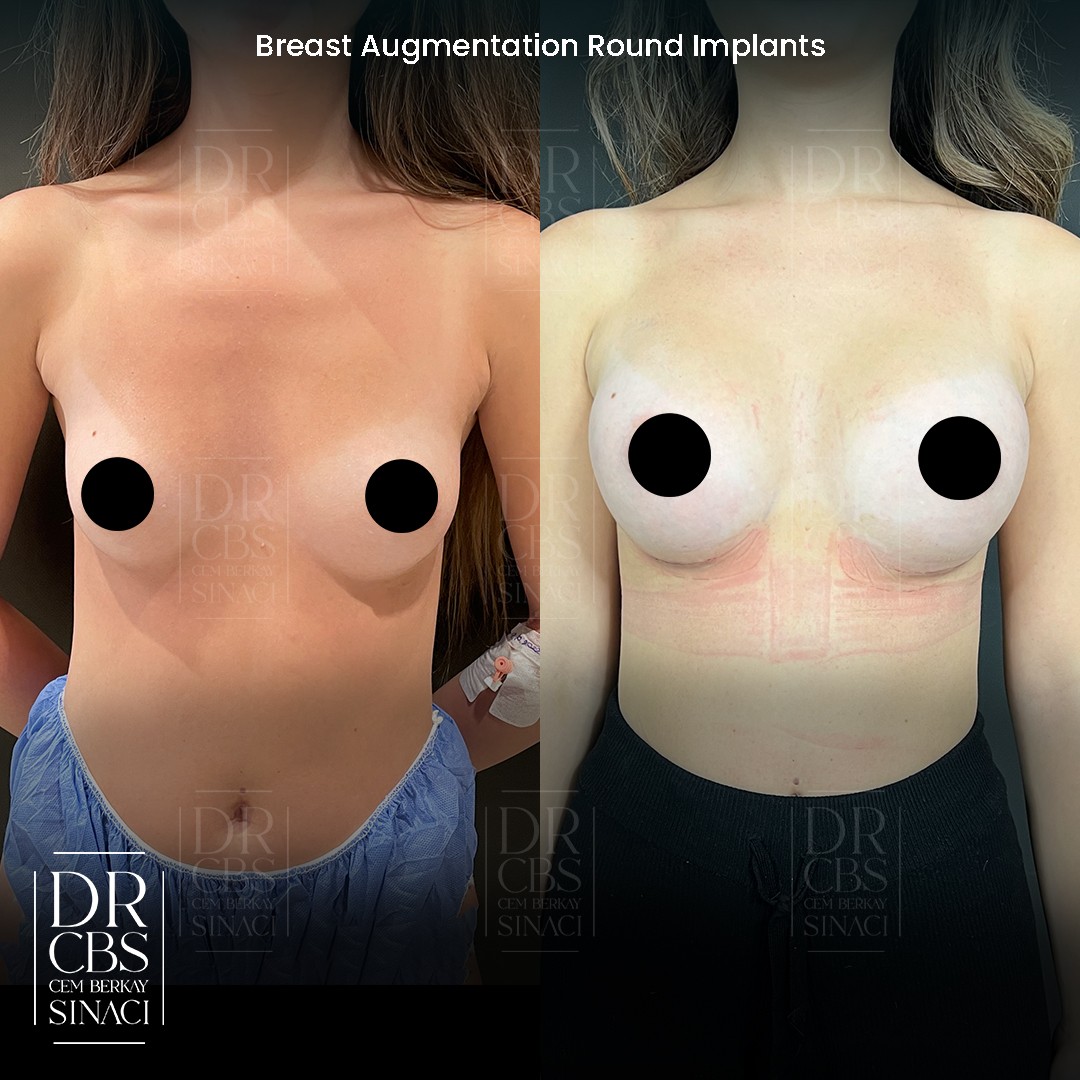


Patient Overview
Patient: Dicle
Age: 33 years old
Gender: Female
Procedures: Breast augmentation with round silicone implants
After photos taken at: 2 weeks post-surgery
Location: Istanbul, Turkey
What Two Weeks of Healing Tells You About Your Final Result
The two-week mark after breast augmentation is when most patients begin to reconcile their expectations with what they see in the mirror. The initial shock of surgery has passed, the most intense discomfort has faded, and the breasts are starting to resemble something closer to the result they hoped for — but not quite there yet. Dicle's two-week photographs document this precise transitional moment, offering future patients an honest reference point for what this stage of recovery actually looks like with round silicone implants.
Dr. Cem Berkay Sinaci, a European board-certified plastic surgeon (FEBOPRAS) and active member of ISAPS and ASPS, schedules a detailed clinical assessment at the two-week point for every breast augmentation patient. This appointment serves a dual purpose: confirming that healing is progressing normally and providing the patient with a realistic framework for the changes still to come. Understanding what is temporary at two weeks and what is permanent prevents unnecessary anxiety during a period when patience is the most important element of recovery.
The Anatomy of Two-Week Swelling
At fourteen days post-surgery, the inflammatory cascade that began in the operating room is transitioning from its acute phase into resolution. The peak of post-operative oedema typically occurs between days three and seven, meaning that by week two, the swelling has already begun to decrease — but it has by no means disappeared. Dicle's breasts at this stage carry residual interstitial fluid that adds temporary volume and firmness beyond what the implants alone produce.
This residual swelling is most noticeable in the upper pole of the breast, where fluid accumulates due to the anatomy of lymphatic drainage in the chest wall. The result is an upper breast fullness that appears slightly more projected than the final outcome will show. Patients who are unaware of this phenomenon sometimes worry that their implants are too large, when in reality they are seeing implant volume plus inflammatory fluid — a combination that will reduce to implant volume alone over the coming weeks.
The lower pole, by contrast, has not yet fully expanded. The implant is still settling into its pocket, and the tissue beneath the nipple has not yet stretched to accommodate the final implant position. This creates a temporary shape that appears top-heavy relative to the eventual balanced contour.
How Round Implants Behave During the Settling Period
Round silicone implants undergo a predictable settling process that is particularly visible during the two-to-six-week window. Immediately after surgery, the pectoralis muscle and surrounding soft tissue exert compressive forces on the implant, holding it in a position that is higher and tighter than its intended final location. As these tissues gradually relax and adapt to the new volume, the implant descends into a lower, more natural resting position.
For Dicle at two weeks, this process is actively underway but not yet complete. The implant has begun its descent from the elevated post-operative position, but the lower pole of the breast has not yet achieved the gentle, rounded fullness that will characterise the mature result. This is entirely normal and expected with round implants, which require approximately four to eight weeks to reach their final position depending on the patient's tissue characteristics and the surgical plane used.
One reassuring feature of round implants during this settling period is their rotational symmetry. Unlike anatomical implants, which must maintain a specific orientation within the pocket, round implants produce a consistent breast shape regardless of any micro-rotation. This means that the settling process involves only vertical descent — the implant drops into position without any concern about directional alignment.
The Two-Week Consultation: What the Surgeon Evaluates
When Dr. Sinaci examines a breast augmentation patient at two weeks, the assessment extends far beyond asking "how do you feel." Several specific clinical parameters are evaluated to confirm that healing is on track.
Incision integrity is the first checkpoint. By fourteen days, the wound edges should be well-approximated with no signs of separation, infection, or abnormal scarring. The suture line may still be slightly raised and pink, but it should be dry, intact, and showing progressive improvement from the one-week appearance.
Implant symmetry is assessed by comparing the position, projection, and contour of both breasts. Perfect symmetry at two weeks is neither expected nor realistic — minor differences in swelling and settling rate between the two sides are normal and typically equalise by six weeks. Significant asymmetry, however, warrants closer monitoring to ensure both implants are tracking toward the same final position.
Tissue softness provides information about capsule formation. At two weeks, the breasts are expected to feel firm due to residual swelling and the early stages of capsule development. This firmness will progressively diminish over the next several months as the capsule matures and the oedema resolves completely.
Returning to Daily Life at Two Weeks
Dicle's stage of recovery at fourteen days corresponds with the period when most breast augmentation patients begin resuming normal daily routines. Light activities, desk work, driving, and gentle walking are typically well tolerated by this point. The surgical bra or compression garment remains essential, providing support that assists the settling process and protects the healing incision line.
Restrictions that remain firmly in place at two weeks include any form of upper body exercise, heavy lifting, and vigorous physical activity. The implant pocket is still stabilising, and forces generated by chest muscle contraction can disrupt the healing tissue plane, potentially affecting the final implant position. Dr. Sinaci typically clears patients for progressive return to exercise between weeks four and six, with full upper body training permitted after six to eight weeks depending on individual healing progression.
Sleep position also matters during this phase. Patients are advised to continue sleeping on their back or slightly elevated rather than face-down or on their sides, as lateral pressure on the settling implants can influence their final position within the pocket.
The Bridge Between Surgery and Final Result
Dr. Sinaci's approach to breast augmentation, shaped by his fellowship with the internationally renowned plastic surgeon Raul Gonzalez in Brazil and cadaver dissection training in Bangkok, treats the two-week result as a clinical checkpoint rather than an aesthetic endpoint. The surgical technique determines the framework; the body's biological healing process fills in the details over the subsequent months.
For patients researching breast augmentation in Istanbul, Dicle's two-week before and after photographs provide a realistic expectation of what early recovery looks like — visible enhancement that is clearly present but still refining, swelling that is resolving but not yet gone, and a breast shape that is emerging toward its final natural contour. The transformation from a two-week result to a three-month result is one of the most satisfying arcs in cosmetic surgery, and understanding that this progression is normal allows patients to appreciate each stage of their recovery rather than rushing toward the finish line.