
Dual Plane Breast Augmentation Before and After
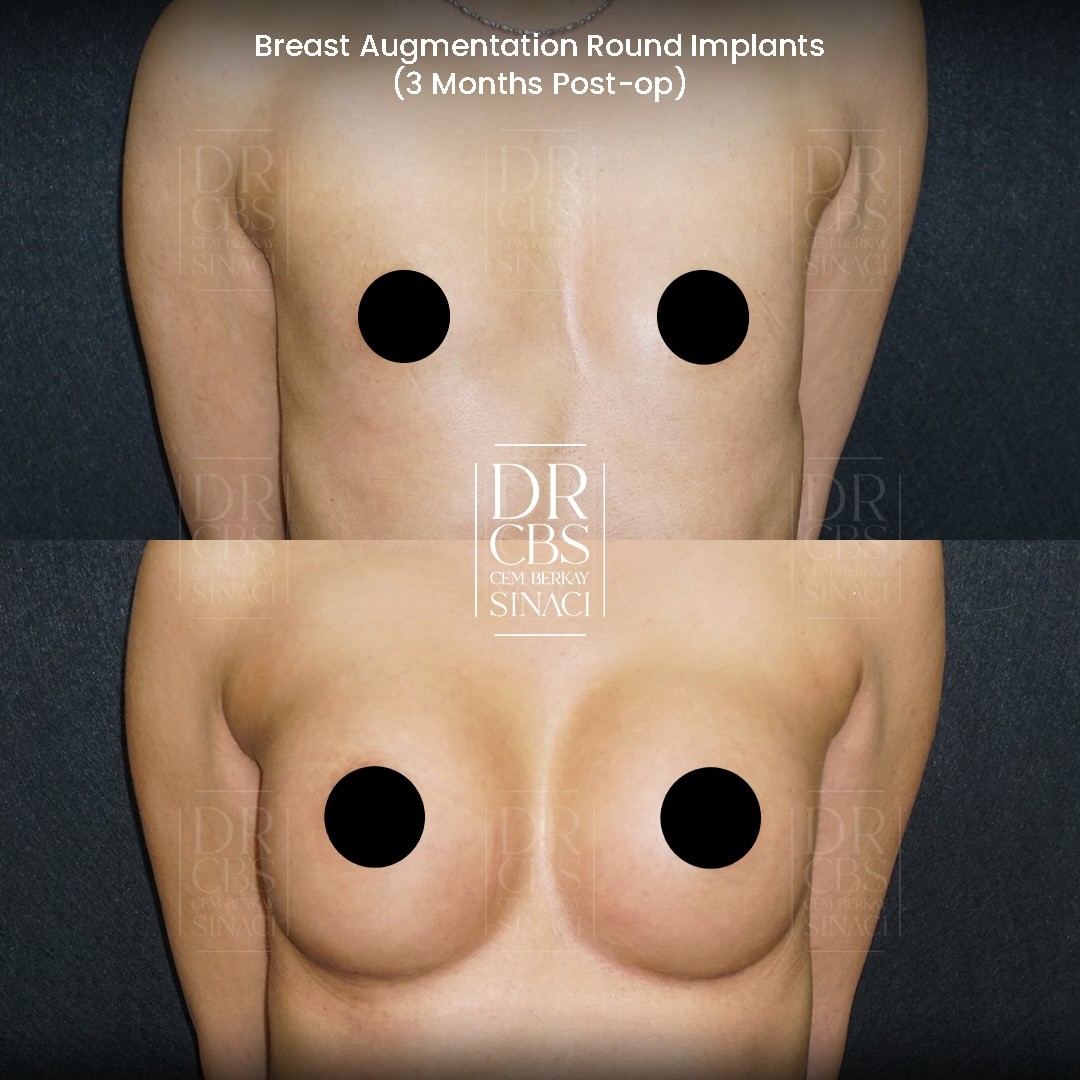
Before and after dual plane breast augmentation at two months. Dr. CBS explains how partially releasing the muscle creates natural implant shape in Istanbul.


Patient Overview
Patient: Julia
Age: 33 years old
Gender: Female
Procedures: Breast augmentation with silicone implants (dual plane technique)
After photos taken at: 2 months post-surgery
Location: Istanbul, Turkey
What Makes the Dual Plane Different from Standard Submuscular
In breast augmentation, the surgical plane — the precise anatomical layer where the implant is positioned — determines how the breast looks, moves, and ages over time. Most patients have heard of "under the muscle" placement as a general concept, but within that category exists a refined technique that produces a distinctly more natural result: the dual plane approach. Julia's two-month before and after photographs demonstrate what this technique achieves when applied to the right candidate by a surgeon who understands its mechanics.
Dr. Cem Berkay Sinaci, a European board-certified plastic surgeon (FEBOPRAS) and active member of ISAPS and ASPS, selects the dual plane method for patients whose anatomy will benefit from the specific advantages it offers over standard complete submuscular coverage. The distinction between these approaches may sound subtle in description, but the visual difference in the final result is immediately recognisable.
The Anatomy Behind the Technique
To understand the dual plane, one must first understand what happens in a standard submuscular placement. The pectoralis major muscle is elevated from the chest wall, and the implant is positioned entirely behind it. The muscle then drapes over the implant like a blanket, providing a layer of soft tissue coverage that camouflages the implant edges and creates a smooth transition from chest wall to breast.
The limitation of this approach becomes apparent in the lower pole. Because the muscle remains attached to the breast tissue along its inferior border, it can tether the implant high on the chest wall and restrict how fully the lower breast fills out. The result can be a breast that looks slightly compressed in the lower half — adequate projection in the upper pole but a flat or underfilled appearance below the nipple.
The dual plane solves this by partially releasing the lower fibres of the pectoralis muscle from their attachment to the overlying breast tissue. This selective release accomplishes two things simultaneously. The muscle, freed from its inferior connection, retracts slightly upward. This repositioning allows the lower portion of the implant to sit directly behind the breast gland rather than behind the muscle, giving it the freedom to fill the lower pole naturally. Meanwhile, the upper portion of the implant remains covered by the intact muscle, preserving all the camouflage and soft tissue coverage benefits of submuscular placement where they matter most — in the upper pole where the implant edge is closest to the skin surface.
Why the Lower Pole Matters for Natural Appearance
The lower pole of the breast — the curved fullness below the nipple — is arguably the most important element in creating a natural-looking augmentation. In a natural breast, this region carries the majority of the visible volume, creating the gentle teardrop curve that defines feminine breast shape. The nipple sits at or near the point of maximum projection, with the breast tapering smoothly above and curving softly below.
When standard submuscular placement restricts lower pole fill, the breast can appear unnaturally top-heavy. The upper pole shows pronounced fullness from the muscle pushing the implant forward, but the lower half lacks the corresponding curve that would make the shape look natural. Patients sometimes describe this as looking "stuck on" rather than being a natural part of their body.
Julia's dual plane result at two months demonstrates how releasing the lower muscle fibres resolves this issue. The implant fills the lower pole freely, creating the rounded inferior curve that the eye recognises as natural. The upper pole, still covered by the intact pectoralis, shows soft fullness without the visible implant edges or sharp transitions that can occur with above-muscle placement. The overall shape is a unified, natural-appearing breast that moves and sits on the chest wall the way a natural breast would.
Selecting the Right Plane for Each Patient
Dr. Sinaci does not apply the dual plane to every breast augmentation patient. The technique is one option within a decision framework that also includes complete submuscular, subfascial, and subglandular placement. Each plane has specific indications based on the patient's tissue characteristics, degree of existing ptosis, body frame, and aesthetic goals.
The dual plane is particularly well suited for patients like Julia who have moderate soft tissue coverage and desire a natural breast shape with good lower pole projection. Patients with very thin tissue and minimal breast volume may benefit more from complete submuscular coverage, which maximises soft tissue camouflage. Patients with mild ptosis and adequate tissue thickness may be better served by subfascial placement, which keeps the implant and breast gland in the same compartment to prevent waterfall deformity.
This individualised decision-making process reflects the training philosophy Dr. Sinaci developed during his fellowship with the internationally renowned plastic surgeon Raul Gonzalez in Brazil. Brazilian breast augmentation technique places exceptional emphasis on lower pole aesthetics and the natural interplay between implant and tissue — principles that the dual plane technique embodies when applied to the appropriate candidate.
Reading the Two-Month Result
Julia's photographs at two months capture a result that is very close to final. By this stage, the implant has completed the majority of its settling process. The lower pole has filled to its intended volume, the upper pole has softened from its early post-operative fullness, and the breast shape has achieved the balanced contour that the dual plane was designed to produce.
Residual changes between two months and the final result at six months are subtle. The breast may soften slightly further as the capsule continues to mature, and the scar will progress through its maturation cycle toward its final pale, flat appearance. But the fundamental shape — the proportion between upper and lower pole, the position of maximum projection, and the overall relationship between breast and body frame — is essentially established at this point.
The naturalness of Julia's result is best appreciated in how the breast transitions from the chest wall. There is no abrupt step-off at the upper pole, no visible implant edge, and no flattening in the lower breast. The contour flows in a continuous curve from the clavicle to the inframammary fold, with the implant serving as an invisible internal scaffold rather than a visible foreign body.
The Dual Plane and Long-Term Stability
Beyond its aesthetic advantages, the dual plane offers structural benefits that contribute to long-term implant stability. The intact upper muscle coverage resists gravitational descent of the implant over time, reducing the risk of bottoming out — a complication where the implant migrates below the inframammary fold. Simultaneously, the released lower fibres allow the implant to sit in a position that distributes its weight naturally across the lower breast, avoiding the concentrated forces that can cause tissue stretching in other planes.
For a thirty-three-year-old patient like Julia, this long-term stability means the result seen at two months is designed to endure. The dual plane creates a partnership between the muscle, the fascia, and the breast tissue that shares the responsibility of supporting the implant — a biomechanical advantage that becomes increasingly relevant as years pass and tissues naturally age.
Surgical Precision in Breast Augmentation in Istanbul
Julia's case demonstrates that the difference between a good breast augmentation and an exceptional one often lies not in the implant chosen but in the plane where it is placed. The dual plane technique requires precise surgical execution — the degree of muscle release must be calibrated to the individual patient's anatomy, and the transition zone between muscle-covered and gland-covered portions of the implant must be seamless. For patients researching breast augmentation in Istanbul, understanding that plane selection is as important as implant selection provides a framework for evaluating surgical expertise and asking informed questions during the consultation process.