
Can Breast Implants Correct Mild Sagging Alone?
Before and after of breast augmentation correcting mild sagging without lift scars. 9-day implant result in selected cases by Dr. CBS in Istanbul.


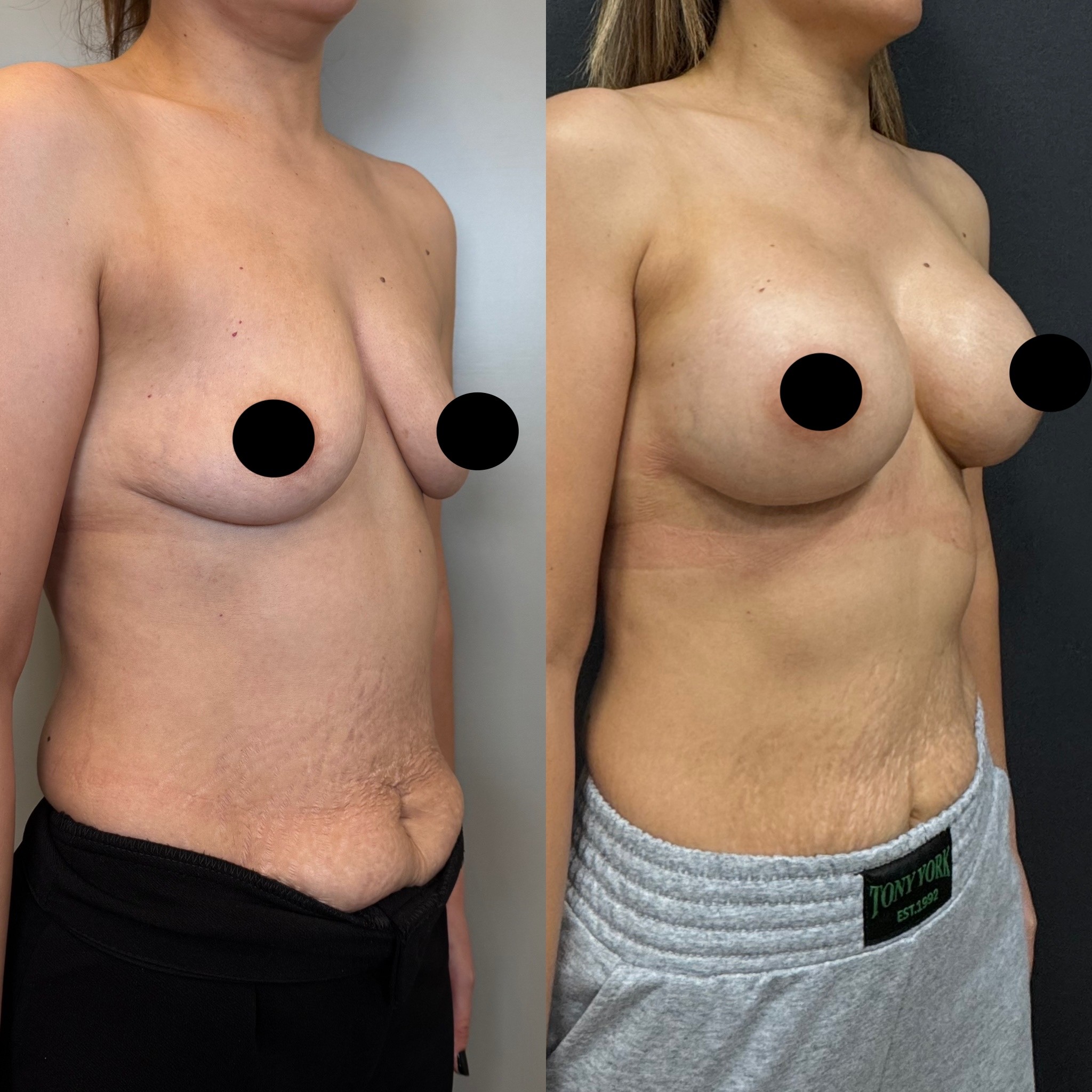
Patient Overview
Patient: Hilal
Age: 29 years old
Gender: Female
Procedures: Breast augmentation with silicone implants (internal lift effect)
After photos taken at: 9 days post-surgery
Location: Istanbul, Turkey
When Implants Alone Can Replace a Breast Lift
One of the most common concerns patients bring to a breast augmentation consultation is mild sagging. The breast tissue has begun to descend, the nipple sits slightly lower than ideal, and the upper pole has lost its youthful fullness. The conventional assumption — shared by many patients and even some surgeons — is that any degree of ptosis automatically requires a mastopexy, commonly known as a breast lift. This means additional incisions, longer scars, and a more complex recovery.
Hilal's case challenges that assumption. At twenty-nine years old with mild glandular ptosis, she was a candidate for an approach that Dr. Cem Berkay Sinaci selects carefully in appropriate cases: using the implant itself to achieve the lifting effect, avoiding the longer scars that accompany formal breast lift surgery entirely.
Dr. Sinaci, a European board-certified plastic surgeon (FEBOPRAS) and active member of ISAPS and ASPS, emphasises that this approach is not appropriate for every patient with sagging breasts. It works in selected cases where the degree of ptosis is mild, the skin envelope retains adequate elasticity, and the implant volume can fill and support the existing tissue sufficiently to reposition the breast mound on the chest wall. The surgical judgement required to identify these candidates — and equally important, to recognise when a formal lift is truly necessary — is what separates a predictable outcome from a disappointing one.
Understanding Glandular Ptosis
Ptosis in breast surgery is classified by the position of the nipple relative to the inframammary fold — the natural crease beneath the breast. True ptosis exists when the nipple has descended below this fold. Glandular ptosis, which Hilal presented with, describes a slightly different condition: the nipple remains at or near the fold level, but the breast gland itself has descended, creating a bottom-heavy appearance with an empty upper pole.
This distinction matters enormously for surgical planning. In true moderate-to-severe ptosis, the skin envelope has stretched significantly and the nipple has migrated well below the fold. Implants alone cannot reposition the nipple or remove excess skin — a mastopexy is required. In glandular ptosis, however, the skin envelope is often still competent. The problem is not excess skin but rather volume displacement — the breast tissue has shifted downward, leaving the upper breast hollow while the lower pole appears full and heavy.
An implant placed behind this ptotic gland can push the tissue upward and outward, effectively redistributing the breast volume into a more youthful configuration. The implant fills the deflated upper pole while the natural tissue, now supported from behind, sits in a higher, more projected position on the chest wall. The result mimics the effect of a surgical lift without the incisions that a lift requires.
Why This Approach Only Works in Selected Cases
Dr. Sinaci is careful to define the boundaries of this technique because overapplying it leads to poor outcomes. The implant-as-lift approach requires three conditions to be present simultaneously.
First, the ptosis must be mild. If the nipple has descended significantly below the inframammary fold, no implant can lift it back to an aesthetically acceptable position. The implant will simply add volume behind and below the nipple, creating a breast that is both large and droopy — a worse result than the starting point.
Second, the skin must retain sufficient elasticity to contract around the implant and hold the new breast shape. Young patients like Hilal, at twenty-nine, typically have skin quality that meets this criterion. Older patients or those who have experienced significant weight fluctuation may have skin that has lost its elastic recoil, making it unable to tighten over the implant adequately.
Third, the implant volume must be carefully calibrated. Too small an implant will not generate enough internal pressure to reposition the gland. Too large an implant will overwhelm the tissue support, accelerating future sagging rather than correcting the current ptosis. The volume must be precisely enough to fill the envelope, lift the gland, and maintain that position long-term.
Dr. Sinaci's ability to assess these three factors accurately reflects the clinical judgement developed through years of experience and advanced training, including his fellowship with the internationally renowned plastic surgeon Raul Gonzalez in Brazil, where breast surgery is performed with exceptional frequency and the nuances of implant-based lifting have been extensively studied.
What the Nine-Day Result Reveals
Hilal's photographs at nine days capture the breast in its very early post-operative state. At this stage, the implants are still positioned slightly high on the chest wall, the tissue carries inflammatory oedema, and the breast shape has not yet reached its final contour. Despite these expected early-stage characteristics, the lifting effect is already visible.
Compared to her preoperative appearance, the breast mound sits higher on the chest wall, the upper pole demonstrates fullness where it was previously hollow, and the nipple position appears improved relative to the overall breast contour. These changes will become more refined as the implants settle over the coming weeks, but the fundamental repositioning of the glandular tissue is already evident at day nine.
The residual swelling at this stage adds temporary volume and firmness that will gradually resolve over the next four to six weeks. As the oedema dissipates and the implant descends into its final position, the breast will adopt a softer, more natural shape while retaining the lifted contour that the implant provides.
The Scar Advantage
The most tangible benefit of achieving a lift through augmentation alone is what is absent from Hilal's result: the scars that a formal mastopexy would leave behind. A standard breast lift involves an incision around the areola and a vertical incision extending downward to the inframammary fold — sometimes with an additional horizontal incision along the fold itself, creating the pattern known as an anchor or inverted-T scar.
These scars, while they fade significantly over time, are permanent. For a twenty-nine-year-old patient with mild ptosis, avoiding these incisions while still achieving the desired lifting effect represents a meaningful advantage. Hilal's breast augmentation incision is minimal and strategically placed where it will become virtually invisible as it matures over the following twelve to eighteen months.
The Consultation Decision That Changes Everything
Hilal's case illustrates why the preoperative consultation may be the single most important step in breast surgery. A patient presenting with mild glandular ptosis could receive three entirely different recommendations depending on the surgeon she consults: augmentation alone, augmentation with lift, or lift alone. Each of these approaches produces a fundamentally different outcome in terms of shape, scarring, recovery, and long-term stability.
The correct recommendation depends on honest anatomical assessment, not on defaulting to the most aggressive option or the simplest one. For patients considering breast augmentation in Istanbul who have been told they need a breast lift, seeking a second evaluation from a surgeon experienced in implant-based lifting may reveal that their mild ptosis can be addressed with augmentation alone — preserving their skin, avoiding additional scars, and achieving the fuller, lifted result they envision through a single procedure.