
Subfascial Breast Augmentation for Saggy Breasts
Before and after subfascial breast augmentation with 375cc implants correcting ptosis without a lift at 3 weeks. Dr. CBS avoids waterfall deformity in Istanbul.
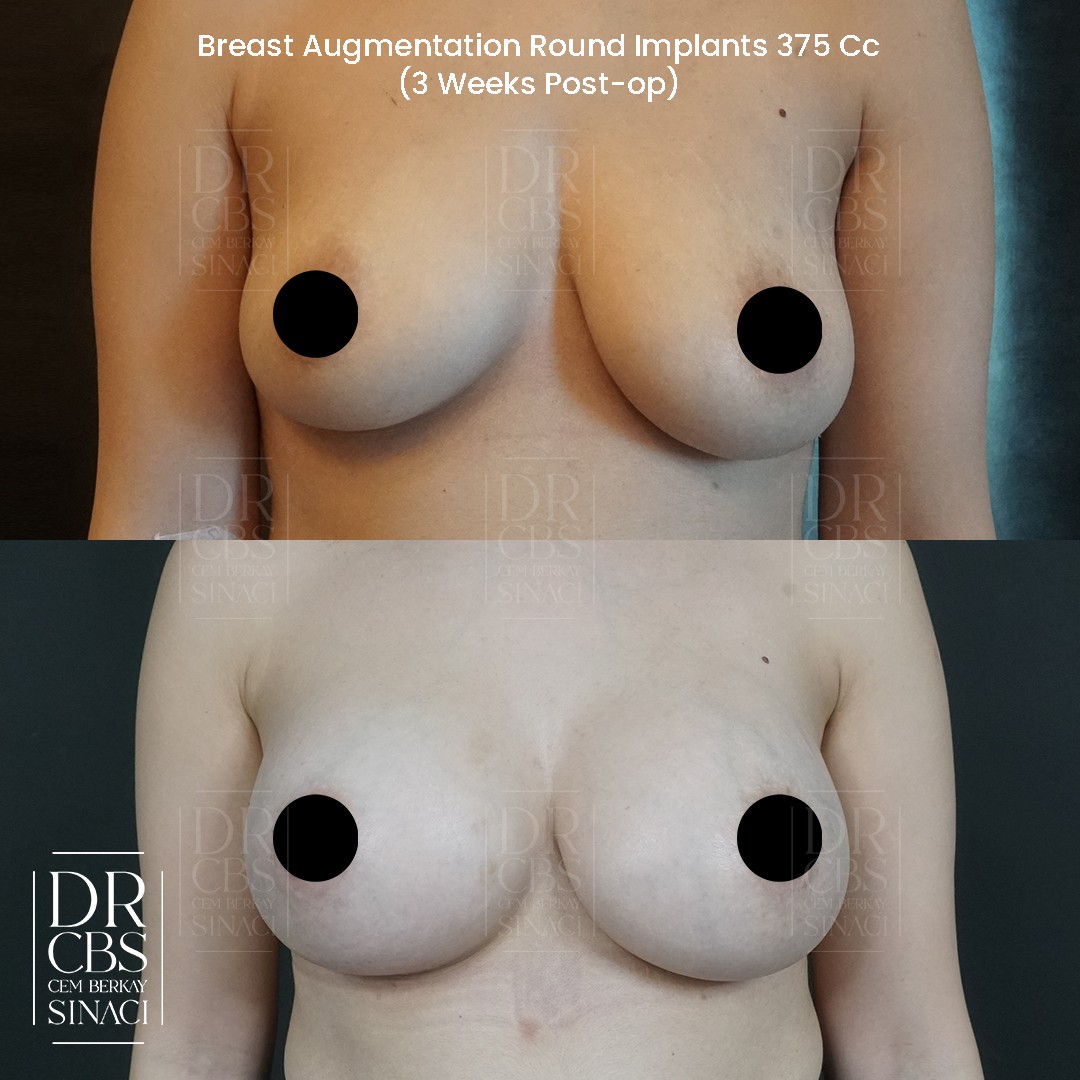

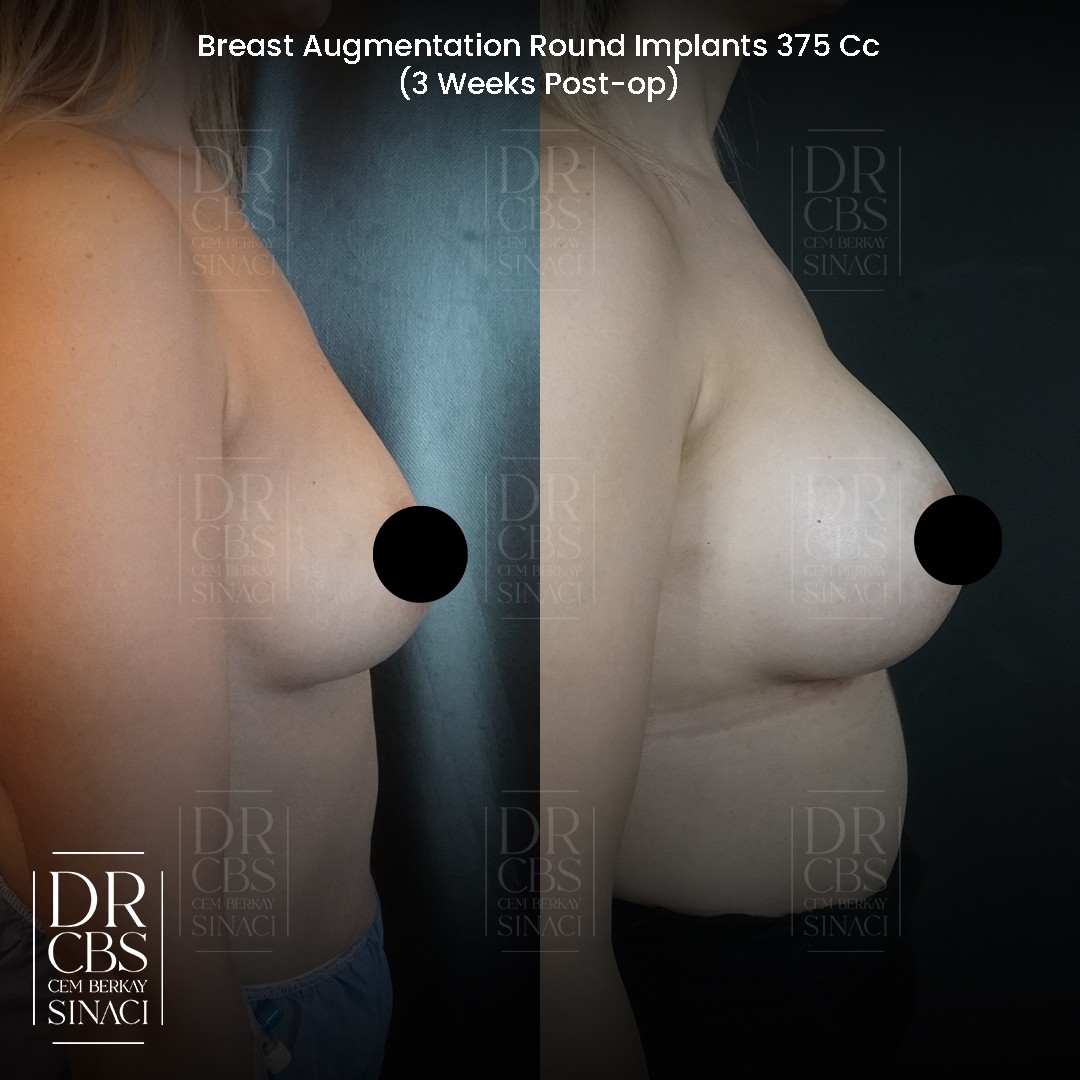
Patient Overview
Patient: Cindy
Age: 41 years old
Gender: Female
Procedures: Breast augmentation with 375cc round silicone implants (subfascial plane), internal lift effect
After photos taken at: 3 weeks post-surgery
Location: Istanbul, Turkey
Why Under Muscle Was Not an Option for Cindy
The instinct of many breast augmentation surgeons when a patient presents with moderate tissue coverage and desires natural-looking results is to place the implant under the muscle. It is the most commonly taught technique, the most frequently performed worldwide, and in many anatomical scenarios it produces excellent results. But for Cindy — a forty-one-year-old patient with existing breast ptosis — under muscle placement would not have produced an excellent result. It would have produced a waterfall deformity.
Dr. Cem Berkay Sinaci, a European board-certified plastic surgeon (FEBOPRAS) and active member of ISAPS and ASPS, identified this risk during Cindy's preoperative assessment and made the decision that defined the success of her outcome: placing the 375cc round implants in the subfascial plane, which is one of the over muscle positions. This single decision — choosing where the implant would sit within the chest — was the difference between a natural, lifted result and a complication that would have required revision surgery to correct.
The Waterfall Problem with Under Muscle Planes in Ptotic Breasts
Waterfall deformity occurs when the implant and the natural breast tissue occupy different anatomical compartments and behave independently of each other. In under muscle or dual plane placement, the pectoralis major holds the implant against the chest wall. The natural breast tissue sits in front of the muscle. When that natural tissue has already begun to sag — as Cindy's had at forty-one — the muscle pins the implant high while the breast gland continues to hang below it.
The visual result is a breast that appears to have two distinct volumes: a round, projected mound from the implant visible in the upper chest, and a separate droop of natural tissue falling over and below it like water cascading over a ledge. The nipple points downward while the implant projection sits above it. The breast looks divided rather than unified, and the overall appearance is worse than if no augmentation had been performed at all.
This is not a rare theoretical complication. It is a predictable biomechanical consequence of placing an implant behind a muscle in a breast where the overlying tissue has already separated from the chest wall. Any patient with meaningful ptosis who receives under muscle or dual plane placement is at risk. The more ptotic the breast, the greater the risk. For Cindy, with ptosis already established at forty-one, both under muscle and dual plane approaches carried an unacceptable probability of this outcome.
How the Subfascial Plane Solves the Problem
The subfascial plane positions the implant above the pectoralis muscle but beneath the thin, strong fascial layer that envelops it. This means the implant sits in the same anatomical compartment as the breast gland — not separated from it by a layer of muscle. When the implant and the natural breast tissue share the same space, they move together as a single unit. There is no possibility of the tissue falling independently in front of a muscle-restrained implant, because the muscle is not involved in implant coverage at all.
For Cindy, this plane selection meant that the 375cc implant and her natural breast tissue would behave as one structure. The implant fills the breast from behind, pushing the gland upward and forward, while the fascia provides a defined pocket boundary that helps maintain implant position. The result is a breast where the implant volume and the natural tissue volume are unified — creating the fuller, perkier contour that Cindy desired without the dual-mound appearance that under muscle placement would have risked.
The subfascial plane also delivers a secondary benefit that is particularly relevant in Cindy's case: the lifting effect of the implant is transmitted directly to the ptotic tissue. Because no muscle layer buffers the implant's expansive force from the gland, the full volume of the 375cc implant acts directly on the descended breast tissue, pushing it into a higher, more projected position on the chest wall. This internal lift effect is what allowed Cindy to achieve perkier breasts without the additional incisions and scars of a formal mastopexy.
375cc: The Right Volume for Structure and Lift
The selection of 375cc for Cindy's implants was not driven by a desire for a particular cup size — it was calculated to serve a structural purpose. In a ptotic breast where the implant is being asked not only to add volume but also to lift and support descended tissue, the implant must be large enough to fill the redundant skin envelope and exert the internal pressure necessary to reposition the gland.
An implant that is too small for this purpose would sit within the ptotic envelope without adequately filling it, leaving the breast still appearing saggy despite the added volume. The tissue would drape over an undersized implant rather than being supported by it, and the lifting effect would be negligible.
Conversely, an implant that is too large would overfill the envelope, creating excessive tension on the skin and accelerating long-term stretching. The initial result might look impressively full, but the heavy implant would gradually drive the breast further downward over the following years, creating recurrent ptosis worse than the starting point.
At 375cc, Cindy's implants fill her existing skin envelope precisely — enough to eliminate the redundancy that ptosis created, enough to push the gland into a lifted position, and not so much that the tissue cannot support the volume long-term. This calibration reflects Dr. Sinaci's measurement-based approach to implant sizing, refined through his fellowship with the internationally renowned plastic surgeon Raul Gonzalez in Brazil where the biomechanical relationship between implant volume and tissue support is considered as important as the aesthetic outcome.
Reading the Three-Week Result
Cindy's three-week photographs capture the augmentation at a point where the early post-operative swelling has substantially resolved but the implant is still completing its settling process. The breasts at three weeks are noticeably fuller and sit higher on the chest wall than they did preoperatively — the lifting effect of the subfascial implant placement is already clearly evident.
The upper pole shows natural fullness that corresponds to the round implant shape, without the exaggerated projection that would suggest an overly large implant. The lower pole curves smoothly toward the inframammary fold, demonstrating the unified contour that the subfascial plane creates when implant and tissue occupy the same compartment. There is no separation between implant volume and breast tissue — no hint of the waterfall deformity that under muscle placement would have risked.
Some residual firmness is expected at three weeks as the capsule continues to form and the tissues adapt to the 375cc volume. Over the next four to eight weeks, the breast will soften further, the implant will settle into a slightly lower and more relaxed position, and the final contour will emerge. By three months, the result will be essentially complete.
The Importance of Matching Plane to Ptosis
Cindy's case reinforces a principle that runs through Dr. Sinaci's approach to breast augmentation: the surgical plane must be selected based on the breast's existing condition, not on surgeon convention or patient assumption. A patient who arrives at consultation requesting "under the muscle" because she has read that it produces the most natural results may be requesting a technique that will produce the least natural result if she has ptosis.
The consultation process must include honest assessment of breast position, tissue descent, and skin quality — followed by transparent explanation of why certain planes are appropriate and others are not. For Cindy, that conversation resulted in the subfascial approach, and her three-week before and after photographs validate the decision. The breast is fuller, perkier, and naturally shaped — the three qualities she wanted — achieved through a plane selection that respected her anatomy rather than ignoring it.
Breast Augmentation for Ptotic Breasts in Istanbul
For patients with breast sagging who are researching augmentation in Istanbul, Cindy's case provides an important lesson: not all "under the muscle" placements are equal, and in ptotic breasts, the over muscle subfascial plane may be the only approach that produces a natural, unified result without waterfall deformity. The surgical plane decision is not a minor technical detail — it is the architectural foundation of the entire result, and getting it right requires a surgeon who evaluates each breast individually and selects the technique that serves the anatomy rather than following a single default approach.
Why Under Muscle Was Not an Option for Cindy
The instinct of many breast augmentation surgeons when a patient presents with moderate tissue coverage and desires natural-looking results is to place the implant under the muscle. It is the most commonly taught technique, the most frequently performed worldwide, and in many anatomical scenarios it produces excellent results. But for Cindy — a forty-one-year-old patient with existing breast ptosis — under muscle placement would not have produced an excellent result. It would have produced a waterfall deformity.
Dr. Cem Berkay Sinaci, a European board-certified plastic surgeon (FEBOPRAS) and active member of ISAPS and ASPS, identified this risk during Cindy's preoperative assessment and made the decision that defined the success of her outcome: placing the 375cc round implants in the subfascial plane, which is one of the over muscle positions. This single decision — choosing where the implant would sit within the chest — was the difference between a natural, lifted result and a complication that would have required revision surgery to correct.
The Waterfall Problem with Under Muscle Planes in Ptotic Breasts
Waterfall deformity occurs when the implant and the natural breast tissue occupy different anatomical compartments and behave independently of each other. In under muscle or dual plane placement, the pectoralis major holds the implant against the chest wall. The natural breast tissue sits in front of the muscle. When that natural tissue has already begun to sag — as Cindy's had at forty-one — the muscle pins the implant high while the breast gland continues to hang below it.
The visual result is a breast that appears to have two distinct volumes: a round, projected mound from the implant visible in the upper chest, and a separate droop of natural tissue falling over and below it like water cascading over a ledge. The nipple points downward while the implant projection sits above it. The breast looks divided rather than unified, and the overall appearance is worse than if no augmentation had been performed at all.
This is not a rare theoretical complication. It is a predictable biomechanical consequence of placing an implant behind a muscle in a breast where the overlying tissue has already separated from the chest wall. Any patient with meaningful ptosis who receives under muscle or dual plane placement is at risk. The more ptotic the breast, the greater the risk. For Cindy, with ptosis already established at forty-one, both under muscle and dual plane approaches carried an unacceptable probability of this outcome.
How the Subfascial Plane Solves the Problem
The subfascial plane positions the implant above the pectoralis muscle but beneath the thin, strong fascial layer that envelops it. This means the implant sits in the same anatomical compartment as the breast gland — not separated from it by a layer of muscle. When the implant and the natural breast tissue share the same space, they move together as a single unit. There is no possibility of the tissue falling independently in front of a muscle-restrained implant, because the muscle is not involved in implant coverage at all.
For Cindy, this plane selection meant that the 375cc implant and her natural breast tissue would behave as one structure. The implant fills the breast from behind, pushing the gland upward and forward, while the fascia provides a defined pocket boundary that helps maintain implant position. The result is a breast where the implant volume and the natural tissue volume are unified — creating the fuller, perkier contour that Cindy desired without the dual-mound appearance that under muscle placement would have risked.
The subfascial plane also delivers a secondary benefit that is particularly relevant in Cindy's case: the lifting effect of the implant is transmitted directly to the ptotic tissue. Because no muscle layer buffers the implant's expansive force from the gland, the full volume of the 375cc implant acts directly on the descended breast tissue, pushing it into a higher, more projected position on the chest wall. This internal lift effect is what allowed Cindy to achieve perkier breasts without the additional incisions and scars of a formal mastopexy.
375cc: The Right Volume for Structure and Lift
The selection of 375cc for Cindy's implants was not driven by a desire for a particular cup size — it was calculated to serve a structural purpose. In a ptotic breast where the implant is being asked not only to add volume but also to lift and support descended tissue, the implant must be large enough to fill the redundant skin envelope and exert the internal pressure necessary to reposition the gland.
An implant that is too small for this purpose would sit within the ptotic envelope without adequately filling it, leaving the breast still appearing saggy despite the added volume. The tissue would drape over an undersized implant rather than being supported by it, and the lifting effect would be negligible.
Conversely, an implant that is too large would overfill the envelope, creating excessive tension on the skin and accelerating long-term stretching. The initial result might look impressively full, but the heavy implant would gradually drive the breast further downward over the following years, creating recurrent ptosis worse than the starting point.
At 375cc, Cindy's implants fill her existing skin envelope precisely — enough to eliminate the redundancy that ptosis created, enough to push the gland into a lifted position, and not so much that the tissue cannot support the volume long-term. This calibration reflects Dr. Sinaci's measurement-based approach to implant sizing, refined through his fellowship with the internationally renowned plastic surgeon Raul Gonzalez in Brazil where the biomechanical relationship between implant volume and tissue support is considered as important as the aesthetic outcome.
Reading the Three-Week Result
Cindy's three-week photographs capture the augmentation at a point where the early post-operative swelling has substantially resolved but the implant is still completing its settling process. The breasts at three weeks are noticeably fuller and sit higher on the chest wall than they did preoperatively — the lifting effect of the subfascial implant placement is already clearly evident.
The upper pole shows natural fullness that corresponds to the round implant shape, without the exaggerated projection that would suggest an overly large implant. The lower pole curves smoothly toward the inframammary fold, demonstrating the unified contour that the subfascial plane creates when implant and tissue occupy the same compartment. There is no separation between implant volume and breast tissue — no hint of the waterfall deformity that under muscle placement would have risked.
Some residual firmness is expected at three weeks as the capsule continues to form and the tissues adapt to the 375cc volume. Over the next four to eight weeks, the breast will soften further, the implant will settle into a slightly lower and more relaxed position, and the final contour will emerge. By three months, the result will be essentially complete.
The Importance of Matching Plane to Ptosis
Cindy's case reinforces a principle that runs through Dr. Sinaci's approach to breast augmentation: the surgical plane must be selected based on the breast's existing condition, not on surgeon convention or patient assumption. A patient who arrives at consultation requesting "under the muscle" because she has read that it produces the most natural results may be requesting a technique that will produce the least natural result if she has ptosis.
The consultation process must include honest assessment of breast position, tissue descent, and skin quality — followed by transparent explanation of why certain planes are appropriate and others are not. For Cindy, that conversation resulted in the subfascial approach, and her three-week before and after photographs validate the decision. The breast is fuller, perkier, and naturally shaped — the three qualities she wanted — achieved through a plane selection that respected her anatomy rather than ignoring it.
Breast Augmentation for Ptotic Breasts in Istanbul
For patients with breast sagging who are researching augmentation in Istanbul, Cindy's case provides an important lesson: not all "under the muscle" placements are equal, and in ptotic breasts, the over muscle subfascial plane may be the only approach that produces a natural, unified result without waterfall deformity. The surgical plane decision is not a minor technical detail — it is the architectural foundation of the entire result, and getting it right requires a surgeon who evaluates each breast individually and selects the technique that serves the anatomy rather than following a single default approach.