
375cc Subfascial Breast Augmentation at Three Weeks
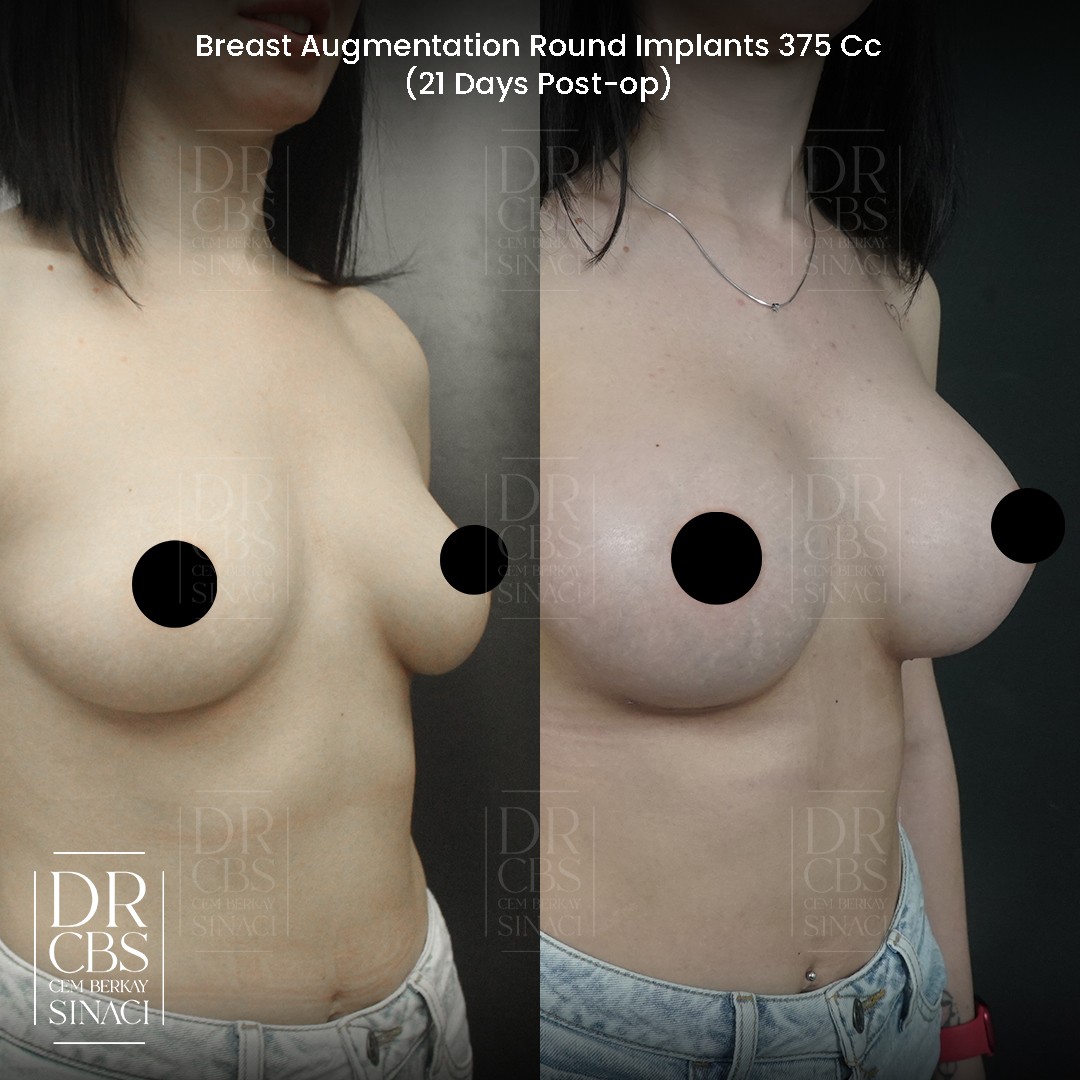
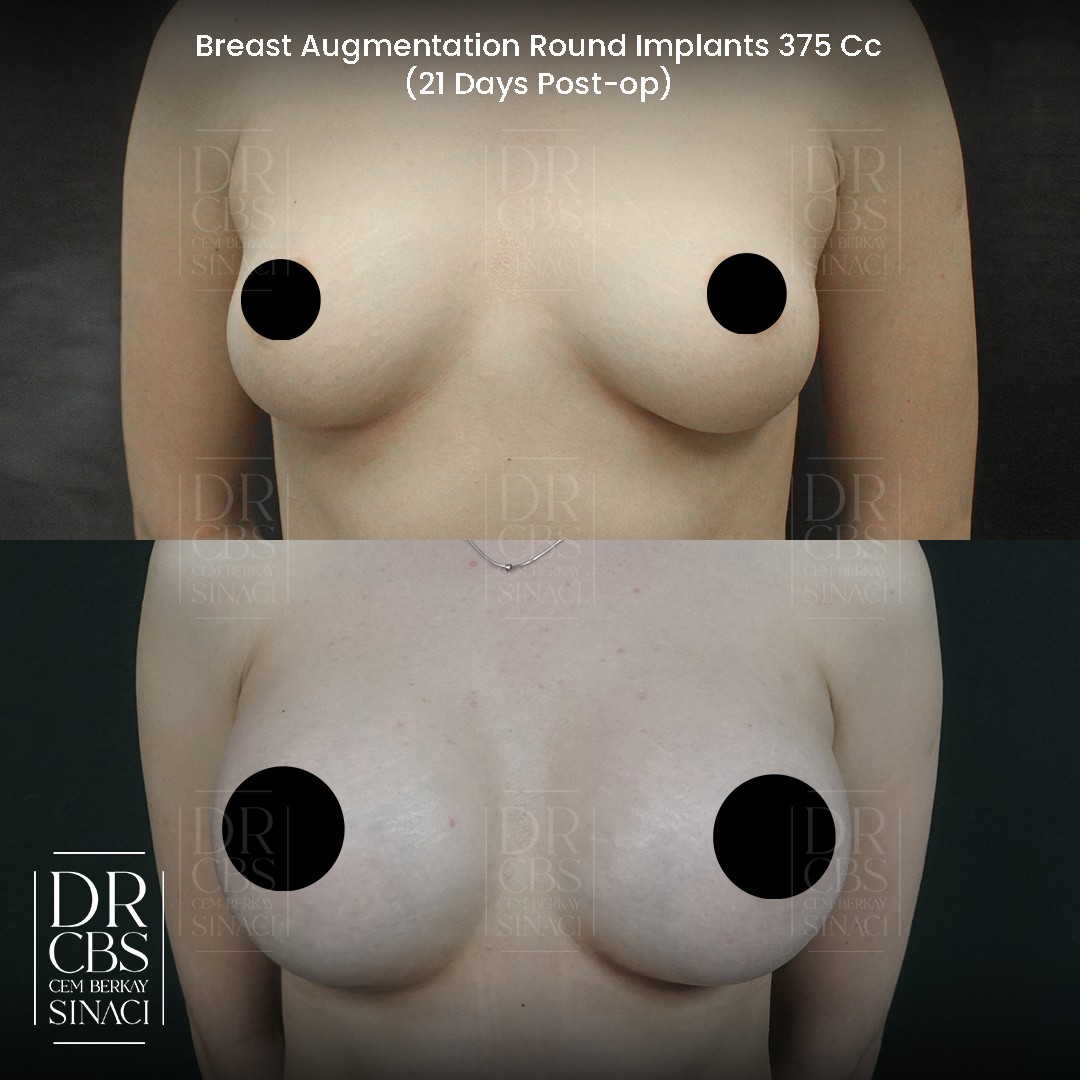
Before and after 375cc round silicone breast augmentation with subfascial technique at 21 days. Dr. CBS shows natural settling results in Istanbul, Turkey.

Patient Overview
Patient: Oksana
Age: 28 years old
Gender: Female
Procedures: Breast augmentation with 375cc round silicone implants (subfascial plane)
After photos taken at: 21 days post-surgery
Location: Istanbul, Turkey
The Subfascial Plane in a Young Patient Without Ptosis
The subfascial plane is most frequently discussed in the context of ptotic breasts — cases where existing sagging makes under muscle placement risky due to waterfall deformity. But this surgical plane is not reserved exclusively for patients with ptosis. In carefully selected cases, the subfascial approach offers distinct advantages even in young patients with firm, well-positioned breasts. Oksana, a twenty-eight-year-old patient of Dr. Cem Berkay Sinaci, is one such case — a patient whose anatomy and goals aligned perfectly with what the subfascial technique delivers, despite having no breast sagging whatsoever.
Dr. Sinaci, a European board-certified plastic surgeon (FEBOPRAS) and active member of ISAPS and ASPS, selected the subfascial plane for Oksana based on a clinical rationale that had nothing to do with ptosis prevention and everything to do with how the breast would look, feel, and move once the 375cc round implants had fully settled.
Why Subfascial When There Is No Sagging
In a patient like Oksana with youthful, non-ptotic breasts, the surgeon has the full range of planes available — under muscle, dual plane, subfascial, or subglandular. None are contraindicated by the anatomy, so the selection becomes a matter of which plane will produce the most natural result given the patient's specific tissue characteristics and implant volume.
The subfascial plane offered Oksana several advantages that are independent of ptosis considerations. First, because the implant sits above the muscle, it is not subject to animation deformity — the visible distortion of breast shape that occurs when the pectoralis muscle contracts during upper body movement. In under muscle placement, activities as common as pushing a door, lifting a bag, or performing a chest exercise can cause the implant to shift and the breast to change shape momentarily. For a twenty-eight-year-old with an active lifestyle, eliminating this phenomenon preserves a natural breast appearance during physical activity, not just at rest.
Second, the subfascial plane produces breast movement that more closely mimics natural tissue. When the implant sits in the same compartment as the breast gland, the entire breast moves as a unified structure with body position changes. Under muscle placement can sometimes create a discrepancy between how the implant moves — restrained by the muscle — and how the overlying tissue moves — free to shift with gravity. This subtle inconsistency may not be obvious in photographs, but it is noticeable in daily life.
Third, the fascia itself provides a meaningful structural contribution. While only one to two millimetres thick, the pectoralis fascia is a dense connective tissue layer that creates a defined pocket boundary. It provides a degree of implant coverage that pure subglandular placement lacks, helping to smooth the implant edges and reduce palpability in the upper pole where Oksana's tissue is naturally thinner.
The Significance of 375cc in Oksana's Frame
Implant volume selection is always a conversation between patient desire and anatomical reality, and the same number can mean completely different things on different bodies. At twenty-eight, Oksana's body proportions — her chest wall width, breast base diameter, and tissue thickness — were measured precisely during her preoperative consultation to determine the range of implant volumes that would produce a proportional result.
The 375cc volume falls in a range that provides significant enhancement without crossing into the territory of obvious augmentation on Oksana's specific frame. The implant fills the breast envelope generously, creating visible fullness and projection, while remaining within the structural capacity of her tissue to support the volume long-term. Had her frame been narrower, 375cc might have appeared disproportionate. Had she been taller with a broader chest, the same volume might have produced a more modest change.
This relativity of implant volume is why Dr. Sinaci's consultation process focuses on measurements and tissue analysis rather than cup size targets or volume comparisons with other patients. The 375cc implant that produces Oksana's result would produce a different result on every other body it was placed in. Her outcome is a product of the volume-to-anatomy match, not the volume alone.
Twenty-One Days: The Transition Point
Three weeks after breast augmentation marks a transition in the recovery arc that is visible in Oksana's photographs. The acute post-operative phase has concluded — the intense swelling, tissue firmness, and high implant position of the first two weeks have given way to a breast that is beginning to show its intended shape.
At twenty-one days, the 375cc implants have begun their descent from the elevated post-surgical position into a more natural resting point on the chest wall. The upper pole, which appeared overly full during the first two weeks as swelling and muscle tension held the implant high, is now starting to soften. The lower pole is progressively filling out as the implant settles downward, creating the gentle curve beneath the nipple that characterises a natural-looking augmentation.
The breast at this stage is approximately seventy to eighty percent of the way to its final appearance. The remaining twenty to thirty percent of change will occur gradually over the next five to nine weeks, involving continued implant descent, further softening of the tissue, and resolution of any residual oedema that the lymphatic system is still clearing.
How the Subfascial Pocket Matures
One characteristic of the subfascial plane that distinguishes its healing trajectory from under muscle placement is the rate and nature of pocket maturation. In submuscular augmentation, the pectoralis muscle must gradually stretch and accommodate the implant — a process that involves muscle fibre adaptation and can take two to three months. This muscular accommodation is what produces the prolonged "tight" sensation and high implant position that submuscular patients experience.
In the subfascial plane, the pocket maturation involves the fascia and the overlying breast tissue adapting to the implant, without the additional variable of muscular accommodation. This typically results in a somewhat faster settling process, as the fascia and glandular tissue are more pliable than active muscle. Oksana may notice that her implants reach their final position slightly earlier than a submuscular patient with the same implant volume would — potentially achieving near-final contour by six to eight weeks rather than the ten to twelve weeks that under muscle placement sometimes requires.
The capsule that forms around the implant in the subfascial plane develops in the same biological sequence as in any other plane — inflammatory phase, proliferative phase, and maturation phase — but the mechanical environment is different. Without the dynamic forces of muscle contraction acting on the capsule, it matures in a more stable mechanical environment, which some clinical evidence suggests may contribute to a lower rate of capsular contracture in certain patient populations.
The Recovery Experience at Three Weeks
Oksana's daily experience at twenty-one days reflects the comfort advantages of the subfascial approach. Because the pectoralis muscle has not been elevated or dissected, the post-operative pain profile is generally milder than what submuscular patients report. The muscle remains intact and functional, meaning that upper body movements — reaching, lifting light objects, dressing — are less restricted and less uncomfortable during recovery.
At three weeks, most subfascial patients have returned to the majority of their normal daily activities. Light exercise, including lower body training and gentle cardiovascular activity, is typically permitted. The surgical bra continues to provide support during the settling phase, but the breast feels substantially more natural than it did during the first two weeks. The tightness and pressure sensation of the early post-operative period has been replaced by a growing awareness that the implants are beginning to feel like a natural part of the body.
Dr. Sinaci's recovery protocols, informed by his fellowship training with the internationally renowned plastic surgeon Raul Gonzalez in Brazil and cadaver dissection courses in Bangkok, are tailored to the surgical plane used. Subfascial patients follow a slightly accelerated return-to-activity timeline compared to submuscular patients, reflecting the reduced muscular disruption and faster tissue adaptation that this plane permits.
Subfascial Augmentation in Istanbul
Oksana's twenty-one-day result demonstrates that the subfascial plane is not merely an alternative for patients with ptosis but a primary technique with its own set of advantages for appropriately selected candidates of any age. The elimination of animation deformity, the natural breast movement, the faster settling trajectory, and the reduced post-operative discomfort make it an option that deserves serious consideration in every breast augmentation consultation. For patients researching their surgical options in Istanbul, understanding that the subfascial plane exists alongside under muscle and dual plane approaches — and that each serves different anatomical needs — is essential to making an informed decision about which technique will produce the best result for their individual body.
The Subfascial Plane in a Young Patient Without Ptosis
The subfascial plane is most frequently discussed in the context of ptotic breasts — cases where existing sagging makes under muscle placement risky due to waterfall deformity. But this surgical plane is not reserved exclusively for patients with ptosis. In carefully selected cases, the subfascial approach offers distinct advantages even in young patients with firm, well-positioned breasts. Oksana, a twenty-eight-year-old patient of Dr. Cem Berkay Sinaci, is one such case — a patient whose anatomy and goals aligned perfectly with what the subfascial technique delivers, despite having no breast sagging whatsoever.
Dr. Sinaci, a European board-certified plastic surgeon (FEBOPRAS) and active member of ISAPS and ASPS, selected the subfascial plane for Oksana based on a clinical rationale that had nothing to do with ptosis prevention and everything to do with how the breast would look, feel, and move once the 375cc round implants had fully settled.
Why Subfascial When There Is No Sagging
In a patient like Oksana with youthful, non-ptotic breasts, the surgeon has the full range of planes available — under muscle, dual plane, subfascial, or subglandular. None are contraindicated by the anatomy, so the selection becomes a matter of which plane will produce the most natural result given the patient's specific tissue characteristics and implant volume.
The subfascial plane offered Oksana several advantages that are independent of ptosis considerations. First, because the implant sits above the muscle, it is not subject to animation deformity — the visible distortion of breast shape that occurs when the pectoralis muscle contracts during upper body movement. In under muscle placement, activities as common as pushing a door, lifting a bag, or performing a chest exercise can cause the implant to shift and the breast to change shape momentarily. For a twenty-eight-year-old with an active lifestyle, eliminating this phenomenon preserves a natural breast appearance during physical activity, not just at rest.
Second, the subfascial plane produces breast movement that more closely mimics natural tissue. When the implant sits in the same compartment as the breast gland, the entire breast moves as a unified structure with body position changes. Under muscle placement can sometimes create a discrepancy between how the implant moves — restrained by the muscle — and how the overlying tissue moves — free to shift with gravity. This subtle inconsistency may not be obvious in photographs, but it is noticeable in daily life.
Third, the fascia itself provides a meaningful structural contribution. While only one to two millimetres thick, the pectoralis fascia is a dense connective tissue layer that creates a defined pocket boundary. It provides a degree of implant coverage that pure subglandular placement lacks, helping to smooth the implant edges and reduce palpability in the upper pole where Oksana's tissue is naturally thinner.
The Significance of 375cc in Oksana's Frame
Implant volume selection is always a conversation between patient desire and anatomical reality, and the same number can mean completely different things on different bodies. At twenty-eight, Oksana's body proportions — her chest wall width, breast base diameter, and tissue thickness — were measured precisely during her preoperative consultation to determine the range of implant volumes that would produce a proportional result.
The 375cc volume falls in a range that provides significant enhancement without crossing into the territory of obvious augmentation on Oksana's specific frame. The implant fills the breast envelope generously, creating visible fullness and projection, while remaining within the structural capacity of her tissue to support the volume long-term. Had her frame been narrower, 375cc might have appeared disproportionate. Had she been taller with a broader chest, the same volume might have produced a more modest change.
This relativity of implant volume is why Dr. Sinaci's consultation process focuses on measurements and tissue analysis rather than cup size targets or volume comparisons with other patients. The 375cc implant that produces Oksana's result would produce a different result on every other body it was placed in. Her outcome is a product of the volume-to-anatomy match, not the volume alone.
Twenty-One Days: The Transition Point
Three weeks after breast augmentation marks a transition in the recovery arc that is visible in Oksana's photographs. The acute post-operative phase has concluded — the intense swelling, tissue firmness, and high implant position of the first two weeks have given way to a breast that is beginning to show its intended shape.
At twenty-one days, the 375cc implants have begun their descent from the elevated post-surgical position into a more natural resting point on the chest wall. The upper pole, which appeared overly full during the first two weeks as swelling and muscle tension held the implant high, is now starting to soften. The lower pole is progressively filling out as the implant settles downward, creating the gentle curve beneath the nipple that characterises a natural-looking augmentation.
The breast at this stage is approximately seventy to eighty percent of the way to its final appearance. The remaining twenty to thirty percent of change will occur gradually over the next five to nine weeks, involving continued implant descent, further softening of the tissue, and resolution of any residual oedema that the lymphatic system is still clearing.
How the Subfascial Pocket Matures
One characteristic of the subfascial plane that distinguishes its healing trajectory from under muscle placement is the rate and nature of pocket maturation. In submuscular augmentation, the pectoralis muscle must gradually stretch and accommodate the implant — a process that involves muscle fibre adaptation and can take two to three months. This muscular accommodation is what produces the prolonged "tight" sensation and high implant position that submuscular patients experience.
In the subfascial plane, the pocket maturation involves the fascia and the overlying breast tissue adapting to the implant, without the additional variable of muscular accommodation. This typically results in a somewhat faster settling process, as the fascia and glandular tissue are more pliable than active muscle. Oksana may notice that her implants reach their final position slightly earlier than a submuscular patient with the same implant volume would — potentially achieving near-final contour by six to eight weeks rather than the ten to twelve weeks that under muscle placement sometimes requires.
The capsule that forms around the implant in the subfascial plane develops in the same biological sequence as in any other plane — inflammatory phase, proliferative phase, and maturation phase — but the mechanical environment is different. Without the dynamic forces of muscle contraction acting on the capsule, it matures in a more stable mechanical environment, which some clinical evidence suggests may contribute to a lower rate of capsular contracture in certain patient populations.
The Recovery Experience at Three Weeks
Oksana's daily experience at twenty-one days reflects the comfort advantages of the subfascial approach. Because the pectoralis muscle has not been elevated or dissected, the post-operative pain profile is generally milder than what submuscular patients report. The muscle remains intact and functional, meaning that upper body movements — reaching, lifting light objects, dressing — are less restricted and less uncomfortable during recovery.
At three weeks, most subfascial patients have returned to the majority of their normal daily activities. Light exercise, including lower body training and gentle cardiovascular activity, is typically permitted. The surgical bra continues to provide support during the settling phase, but the breast feels substantially more natural than it did during the first two weeks. The tightness and pressure sensation of the early post-operative period has been replaced by a growing awareness that the implants are beginning to feel like a natural part of the body.
Dr. Sinaci's recovery protocols, informed by his fellowship training with the internationally renowned plastic surgeon Raul Gonzalez in Brazil and cadaver dissection courses in Bangkok, are tailored to the surgical plane used. Subfascial patients follow a slightly accelerated return-to-activity timeline compared to submuscular patients, reflecting the reduced muscular disruption and faster tissue adaptation that this plane permits.
Subfascial Augmentation in Istanbul
Oksana's twenty-one-day result demonstrates that the subfascial plane is not merely an alternative for patients with ptosis but a primary technique with its own set of advantages for appropriately selected candidates of any age. The elimination of animation deformity, the natural breast movement, the faster settling trajectory, and the reduced post-operative discomfort make it an option that deserves serious consideration in every breast augmentation consultation. For patients researching their surgical options in Istanbul, understanding that the subfascial plane exists alongside under muscle and dual plane approaches — and that each serves different anatomical needs — is essential to making an informed decision about which technique will produce the best result for their individual body.