
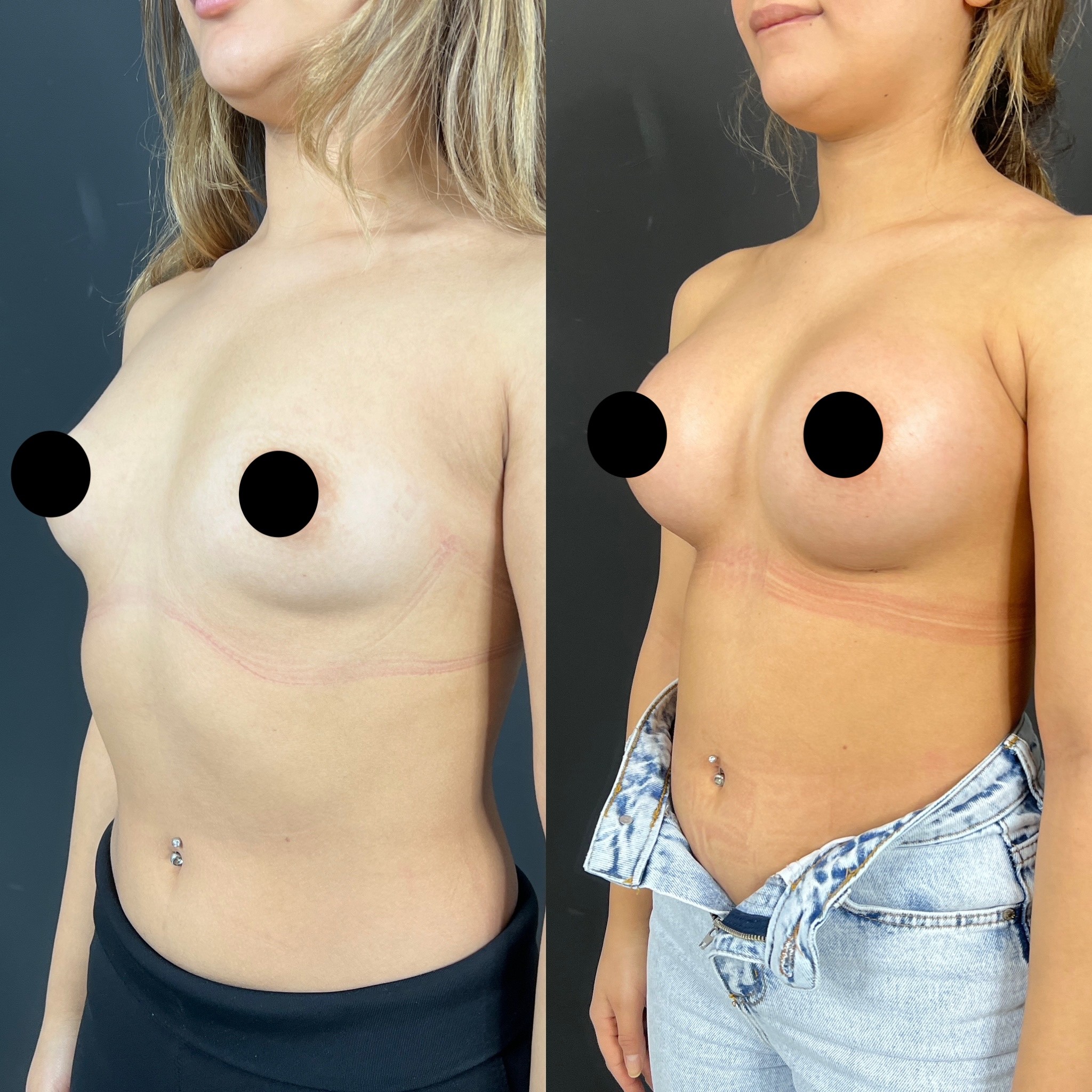
Dual Plane Breast Augmentation Three-Month Result
Before and after dual plane breast augmentation at three months showing final natural result. Dr. CBS compares surgical plane options in Istanbul, Turkey.


Patient Overview
Patient: Aysenur
Age: 28 years old
Gender: Female
Procedures: Breast augmentation with silicone implants (dual plane technique)
After photos taken at: 3 months post-surgery
Location: Istanbul, Turkey
Choosing the Right Surgical Plane: The Decision That Shapes Everything
Every breast augmentation begins with a question that the patient never sees answered on social media or in online galleries: where exactly within the chest will the implant be placed? This single decision — the surgical plane — influences the breast shape, the way it moves, how natural it looks, how it ages over the years, and even which complications are more or less likely to occur. Aysenur's three-month result demonstrates what happens when the dual plane technique is selected for the right candidate by a surgeon who understands not only this approach but every alternative it was chosen over.
Dr. Cem Berkay Sinaci, a European board-certified plastic surgeon (FEBOPRAS) and active member of ISAPS and ASPS, does not default to a single plane for every patient. His practice utilises the full spectrum of available options — under muscle, over muscle, subfascial, and dual plane — selecting the technique that best serves each individual's anatomy and aesthetic goals. Aysenur's anatomy at twenty-eight pointed clearly toward the dual plane, and her three-month photographs confirm that this selection was correct.
Understanding Every Plane Option
To appreciate why the dual plane was right for Aysenur, it helps to understand what each surgical plane offers and where its limitations lie.
The under muscle plane — complete submuscular placement — positions the implant entirely behind the pectoralis major. The muscle provides excellent soft tissue coverage, reducing visible implant edges and creating a smooth upper pole transition. However, the intact lower muscle fibres can compress the implant inferiorly, restricting lower pole fullness and sometimes producing a tight, flattened appearance in the lower breast. This plane works best for very lean patients with minimal breast tissue who need maximum camouflage and have no ptosis.
The over muscle plane — also called subglandular placement — positions the implant directly behind the breast gland but in front of the muscle. This allows the implant to fill the lower pole freely and produces excellent breast movement, but it sacrifices the soft tissue coverage that the muscle provides. In thin patients, implant edges may be visible or palpable in the upper pole. This plane suits patients with adequate native breast tissue thickness who can provide their own natural camouflage.
The subfascial plane occupies a middle position — the implant sits above the muscle but beneath the pectoralis fascia. This thin but strong connective tissue layer provides an additional coverage element beyond what subglandular placement offers, while keeping the implant in the same anatomical compartment as the breast gland. The subfascial approach is particularly effective when mild glandular ptosis is present, as it avoids the waterfall deformity risk that under muscle placement can create in ptotic breasts.
The dual plane combines the strengths of submuscular and subglandular placement within a single pocket. The upper implant sits behind the intact pectoralis muscle, gaining the camouflage and smooth transition of the under muscle approach. The lower implant sits behind the breast gland only, freed from muscle compression, gaining the natural lower pole fullness of the over muscle approach. This hybrid construction makes the dual plane the most versatile option in breast augmentation — suitable for a wide range of anatomies and aesthetic goals.
Why Dual Plane Was Right for Aysenur
Aysenur's preoperative assessment revealed anatomy that would benefit specifically from the dual plane's hybrid advantages. At twenty-eight, her skin retained excellent elasticity, but her upper pole tissue was moderately thin — not so thin as to mandate complete under muscle coverage, but not thick enough to comfortably camouflage an implant in the over muscle or subfascial position without risk of visible edges.
Her lower breast presented the opposite consideration. Adequate tissue in the lower pole meant that muscle coverage was unnecessary in this region, and keeping the muscle intact across the lower breast would have restricted the implant from filling this area naturally. The dual plane solved both problems simultaneously — muscle coverage where she needed it above, tissue-only coverage where it was sufficient below.
This decision-making process reflects the surgical philosophy Dr. Sinaci refined during his fellowship with the internationally renowned plastic surgeon Raul Gonzalez in Brazil, where breast augmentation technique is tailored to tissue analysis rather than surgeon habit. The Brazilian approach treats plane selection as the cornerstone of the operation, not a secondary consideration after implant size has been chosen.
The Three-Month Milestone: Seeing the True Result
Three months is the time point at which breast augmentation results can be evaluated as essentially final. For Aysenur, this means every temporary post-operative phenomenon has resolved and what her photographs show is what she will see for years to come.
The post-operative swelling that added temporary volume during the first month has been completely reabsorbed. The implant, which sat high and firm on the chest wall during the initial weeks, has completed its descent into the natural resting position that the dual plane pocket was designed to accommodate. The upper pole shows gentle, natural fullness — the pectoralis muscle draping smoothly over the implant without visible edges or abrupt transitions. The lower pole displays the rounded, soft curve that the released lower muscle fibres allow the implant to create.
The breast moves naturally with body position, which is one of the most telling indicators of a well-executed dual plane augmentation. When Aysenur changes posture — standing, leaning forward, lying down — the breast responds the way natural tissue does, with the implant following the gland rather than sitting rigidly behind the muscle. This dynamic quality is something that complete under muscle placement can sometimes compromise, as the intact muscle may animate the implant during chest contraction, causing unnatural movement.
How the Dual Plane Ages Over Time
One advantage of the dual plane that becomes apparent only with years of follow-up is how it manages the natural ageing process of the augmented breast. All breast tissue descends gradually under gravitational influence over time. The question is whether the implant and the tissue descend together or separately.
In complete under muscle placement, the muscle can hold the implant high while the overlying breast tissue continues its natural descent, potentially creating a separation between implant projection and tissue position — the waterfall effect. In purely over muscle placement, the implant may descend faster than ideal without the muscular support, potentially bottoming out below the inframammary fold.
The dual plane mitigates both risks. The intact upper muscle resists excessive superior displacement of the implant, while the released lower portion allows the implant and breast tissue to occupy the same compartment inferiorly, encouraging them to age as a unified structure. For a twenty-eight-year-old patient like Aysenur, this long-term stability means the result she sees at three months is designed to endure through the coming decades with minimal change, assuming stable weight and no intervening pregnancies.
The Incision and Scar at Three Months
By three months, Aysenur's surgical incision has progressed well into its maturation phase. The scar has transitioned from the pink, slightly raised appearance of early healing to a flatter, lighter line that is becoming progressively less conspicuous. Complete scar maturation takes twelve to eighteen months, but the trajectory is established by month three — a scar that is fading well at this point will continue to improve steadily.
The incision placement, chosen by Dr. Sinaci based on Aysenur's anatomy and implant dimensions, is designed to fall within a natural anatomical landmark where it will ultimately become difficult to identify. Scar management protocols including silicone-based products and sun protection continue during this period, optimising the final scar quality.
Breast Augmentation Plane Selection in Istanbul
Aysenur's three-month result illustrates why the surgical plane is arguably the most important technical decision in breast augmentation — more consequential than implant brand, more impactful than implant size, and more relevant to long-term satisfaction than any other single variable. Whether a patient requires the full camouflage of an under muscle approach, the tissue unity of a subfascial or over muscle technique, or the balanced advantages of the dual plane depends entirely on her individual anatomy. For patients researching breast augmentation in Istanbul, understanding that these options exist and that each serves a different anatomical need provides the foundation for asking informed questions and recognising the surgeon who will match technique to tissue rather than applying a single approach to every breast.
Choosing the Right Surgical Plane: The Decision That Shapes Everything
Every breast augmentation begins with a question that the patient never sees answered on social media or in online galleries: where exactly within the chest will the implant be placed? This single decision — the surgical plane — influences the breast shape, the way it moves, how natural it looks, how it ages over the years, and even which complications are more or less likely to occur. Aysenur's three-month result demonstrates what happens when the dual plane technique is selected for the right candidate by a surgeon who understands not only this approach but every alternative it was chosen over.
Dr. Cem Berkay Sinaci, a European board-certified plastic surgeon (FEBOPRAS) and active member of ISAPS and ASPS, does not default to a single plane for every patient. His practice utilises the full spectrum of available options — under muscle, over muscle, subfascial, and dual plane — selecting the technique that best serves each individual's anatomy and aesthetic goals. Aysenur's anatomy at twenty-eight pointed clearly toward the dual plane, and her three-month photographs confirm that this selection was correct.
Understanding Every Plane Option
To appreciate why the dual plane was right for Aysenur, it helps to understand what each surgical plane offers and where its limitations lie.
The under muscle plane — complete submuscular placement — positions the implant entirely behind the pectoralis major. The muscle provides excellent soft tissue coverage, reducing visible implant edges and creating a smooth upper pole transition. However, the intact lower muscle fibres can compress the implant inferiorly, restricting lower pole fullness and sometimes producing a tight, flattened appearance in the lower breast. This plane works best for very lean patients with minimal breast tissue who need maximum camouflage and have no ptosis.
The over muscle plane — also called subglandular placement — positions the implant directly behind the breast gland but in front of the muscle. This allows the implant to fill the lower pole freely and produces excellent breast movement, but it sacrifices the soft tissue coverage that the muscle provides. In thin patients, implant edges may be visible or palpable in the upper pole. This plane suits patients with adequate native breast tissue thickness who can provide their own natural camouflage.
The subfascial plane occupies a middle position — the implant sits above the muscle but beneath the pectoralis fascia. This thin but strong connective tissue layer provides an additional coverage element beyond what subglandular placement offers, while keeping the implant in the same anatomical compartment as the breast gland. The subfascial approach is particularly effective when mild glandular ptosis is present, as it avoids the waterfall deformity risk that under muscle placement can create in ptotic breasts.
The dual plane combines the strengths of submuscular and subglandular placement within a single pocket. The upper implant sits behind the intact pectoralis muscle, gaining the camouflage and smooth transition of the under muscle approach. The lower implant sits behind the breast gland only, freed from muscle compression, gaining the natural lower pole fullness of the over muscle approach. This hybrid construction makes the dual plane the most versatile option in breast augmentation — suitable for a wide range of anatomies and aesthetic goals.
Why Dual Plane Was Right for Aysenur
Aysenur's preoperative assessment revealed anatomy that would benefit specifically from the dual plane's hybrid advantages. At twenty-eight, her skin retained excellent elasticity, but her upper pole tissue was moderately thin — not so thin as to mandate complete under muscle coverage, but not thick enough to comfortably camouflage an implant in the over muscle or subfascial position without risk of visible edges.
Her lower breast presented the opposite consideration. Adequate tissue in the lower pole meant that muscle coverage was unnecessary in this region, and keeping the muscle intact across the lower breast would have restricted the implant from filling this area naturally. The dual plane solved both problems simultaneously — muscle coverage where she needed it above, tissue-only coverage where it was sufficient below.
This decision-making process reflects the surgical philosophy Dr. Sinaci refined during his fellowship with the internationally renowned plastic surgeon Raul Gonzalez in Brazil, where breast augmentation technique is tailored to tissue analysis rather than surgeon habit. The Brazilian approach treats plane selection as the cornerstone of the operation, not a secondary consideration after implant size has been chosen.
The Three-Month Milestone: Seeing the True Result
Three months is the time point at which breast augmentation results can be evaluated as essentially final. For Aysenur, this means every temporary post-operative phenomenon has resolved and what her photographs show is what she will see for years to come.
The post-operative swelling that added temporary volume during the first month has been completely reabsorbed. The implant, which sat high and firm on the chest wall during the initial weeks, has completed its descent into the natural resting position that the dual plane pocket was designed to accommodate. The upper pole shows gentle, natural fullness — the pectoralis muscle draping smoothly over the implant without visible edges or abrupt transitions. The lower pole displays the rounded, soft curve that the released lower muscle fibres allow the implant to create.
The breast moves naturally with body position, which is one of the most telling indicators of a well-executed dual plane augmentation. When Aysenur changes posture — standing, leaning forward, lying down — the breast responds the way natural tissue does, with the implant following the gland rather than sitting rigidly behind the muscle. This dynamic quality is something that complete under muscle placement can sometimes compromise, as the intact muscle may animate the implant during chest contraction, causing unnatural movement.
How the Dual Plane Ages Over Time
One advantage of the dual plane that becomes apparent only with years of follow-up is how it manages the natural ageing process of the augmented breast. All breast tissue descends gradually under gravitational influence over time. The question is whether the implant and the tissue descend together or separately.
In complete under muscle placement, the muscle can hold the implant high while the overlying breast tissue continues its natural descent, potentially creating a separation between implant projection and tissue position — the waterfall effect. In purely over muscle placement, the implant may descend faster than ideal without the muscular support, potentially bottoming out below the inframammary fold.
The dual plane mitigates both risks. The intact upper muscle resists excessive superior displacement of the implant, while the released lower portion allows the implant and breast tissue to occupy the same compartment inferiorly, encouraging them to age as a unified structure. For a twenty-eight-year-old patient like Aysenur, this long-term stability means the result she sees at three months is designed to endure through the coming decades with minimal change, assuming stable weight and no intervening pregnancies.
The Incision and Scar at Three Months
By three months, Aysenur's surgical incision has progressed well into its maturation phase. The scar has transitioned from the pink, slightly raised appearance of early healing to a flatter, lighter line that is becoming progressively less conspicuous. Complete scar maturation takes twelve to eighteen months, but the trajectory is established by month three — a scar that is fading well at this point will continue to improve steadily.
The incision placement, chosen by Dr. Sinaci based on Aysenur's anatomy and implant dimensions, is designed to fall within a natural anatomical landmark where it will ultimately become difficult to identify. Scar management protocols including silicone-based products and sun protection continue during this period, optimising the final scar quality.
Breast Augmentation Plane Selection in Istanbul
Aysenur's three-month result illustrates why the surgical plane is arguably the most important technical decision in breast augmentation — more consequential than implant brand, more impactful than implant size, and more relevant to long-term satisfaction than any other single variable. Whether a patient requires the full camouflage of an under muscle approach, the tissue unity of a subfascial or over muscle technique, or the balanced advantages of the dual plane depends entirely on her individual anatomy. For patients researching breast augmentation in Istanbul, understanding that these options exist and that each serves a different anatomical need provides the foundation for asking informed questions and recognising the surgeon who will match technique to tissue rather than applying a single approach to every breast.