
Capsular Contracture & Implant Downsize Revision Day 6
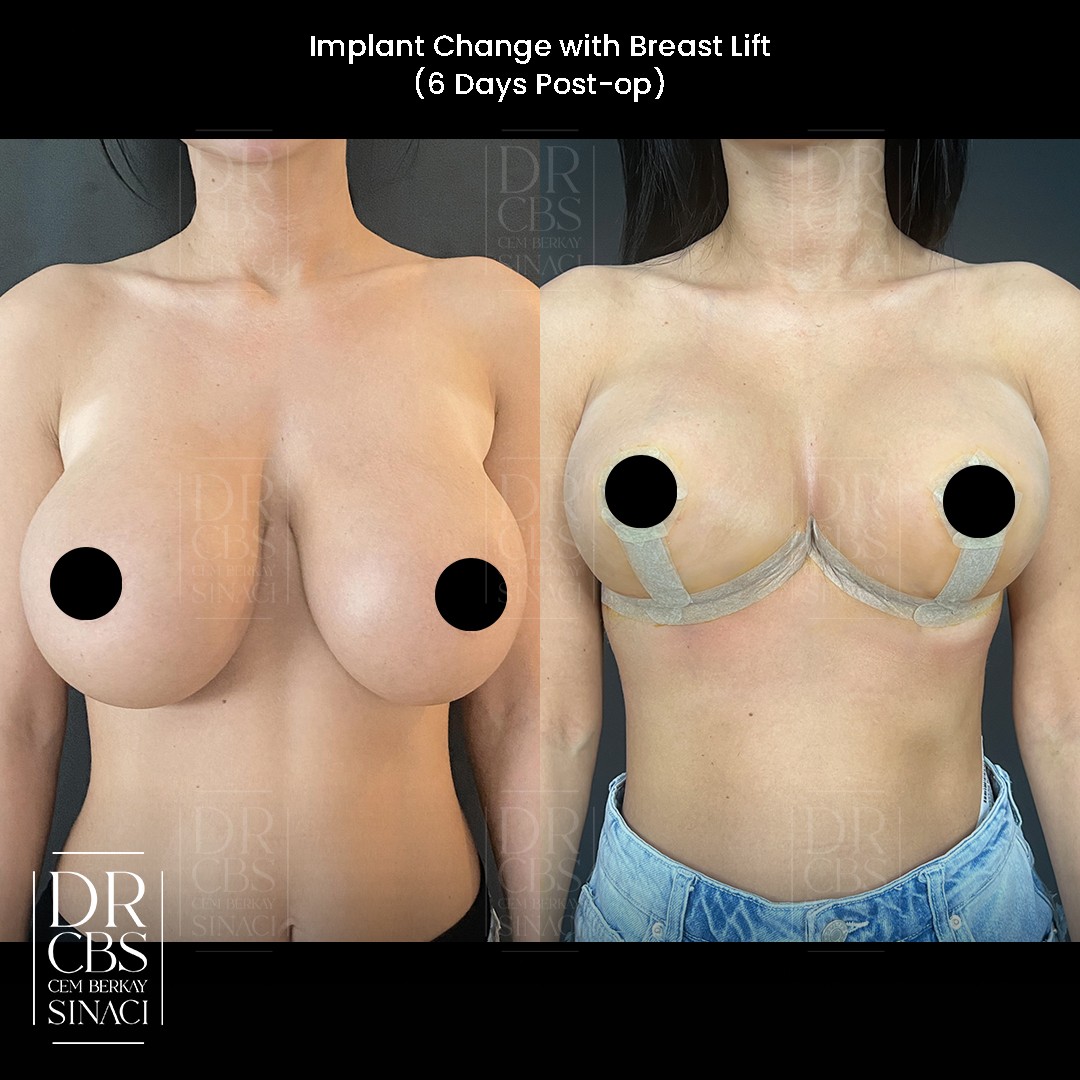
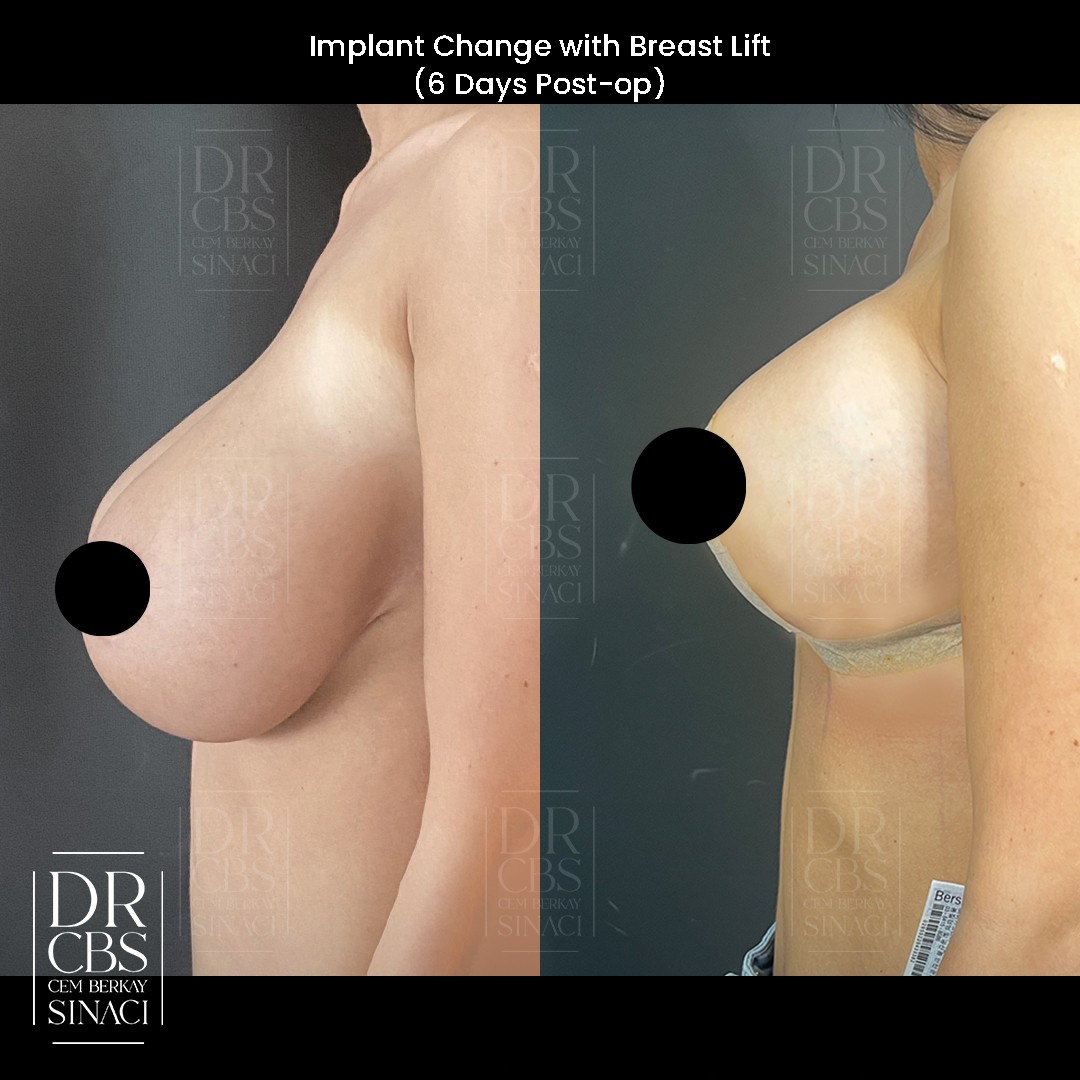
Breast implant revision for capsular contracture at 6 days. Pocket revision, implant downsize from 600cc to 400cc with lift. Dr. Sinaci, Istanbul, Turkey.

Patient Overview
Patient: Yora, 32 years old
Gender: Female
Procedures: Capsulectomy and pocket revision, implant exchange (600cc to 400cc), breast lift (mastopexy)
Previous surgery: Breast augmentation with 600cc implants (performed elsewhere)
After photos taken at: 6 days post-surgery
Case Description
Yora came to our clinic in Istanbul with two interrelated problems from a previous augmentation: capsular contracture and implants that were too large for her frame. The 600cc implants she received had caused her breasts to feel hard, look unnaturally round, and sit in an increasingly distorted position as the capsular contracture progressed. Beyond the contracture, the sheer volume of the implants had stretched her tissue significantly, and the weight was creating chronic discomfort in her shoulders, neck, and upper back.
Her goals were clear: softer breasts, a more natural shape, relief from the physical symptoms, and an end to the obviously augmented appearance that had become a source of self-consciousness rather than confidence. The revision addressed all of these through a three-component approach — treating the capsular contracture, downsizing the implants, and lifting the breast to fit the new, smaller volume.
What Is Capsular Contracture?
Every breast implant, regardless of type or placement, becomes surrounded by a capsule — a thin layer of scar tissue that the body forms naturally around any foreign object. In most patients, this capsule remains soft, thin, and imperceptible. The implant feels natural and moves freely within its pocket. This is normal capsule formation.
In capsular contracture, the capsule thickens, tightens, and contracts around the implant. As it squeezes inward, it compresses the implant into a progressively harder, rounder, and more distorted shape. The condition is graded on a four-point scale. Grade I is a normal, soft capsule. Grade II produces mild firmness that is palpable but not visible. Grade III creates obvious firmness with visible distortion of the breast shape. Grade IV adds pain to the firmness and distortion.
The exact cause of capsular contracture remains incompletely understood, though several contributing factors have been identified: subclinical bacterial contamination of the implant surface during the original surgery, implant surface characteristics, hematoma or seroma formation in the early postoperative period, and individual patient susceptibility. It can develop months or years after the original augmentation, and once established, it does not resolve on its own — surgical treatment is the only reliable correction.
Yora had developed Grade III contracture bilaterally. Her breasts were visibly firm and distorted, with the implants sitting in an unnatural position forced by the contracting capsule around them.
Why Downsize: The Case Against Oversized Implants
Yora's original 600cc implants were disproportionately large for her chest wall dimensions and tissue characteristics. While implant size is ultimately a personal choice made in collaboration with the surgeon, there are anatomical limits beyond which larger implants create predictable problems.
Excessive implant weight accelerates tissue stretching. The breast skin and parenchyma are soft tissue structures with finite load-bearing capacity. A 600cc implant exerts substantially more gravitational force than a 400cc implant — force that acts on the tissue 24 hours a day, 365 days a year. Over time, this weight stretches the skin envelope, thins the overlying tissue, and can contribute to bottoming out or lateral displacement.
Oversized implants also increase the visible and palpable artificiality of the result. When the implant volume exceeds what the natural tissue can cover and support, the implant edges become visible, rippling becomes apparent, and the breast shape looks obviously augmented rather than naturally full.
The decision to downsize from 600cc to 400cc was based on Yora's chest wall measurements, her tissue thickness after years of stretching from the larger implants, and her stated desire for a natural appearance. Four hundred cubic centimeters is still a substantial implant that provides meaningful fullness and projection — but it sits within the range that her anatomy can support comfortably and conceal naturally for the long term.
The Surgical Approach
The revision involved three integrated steps performed in sequence.
The capsulectomy addressed the contracture directly. The thickened, contracted capsule was removed from around each implant. This eliminates the constrictive scar tissue that was distorting the breast shape and hardening the feel. With the capsule removed, the pocket is effectively reset — the tissue is no longer under the abnormal compression that the contracture was creating.
The pocket revision followed. Because the new implants were 200cc smaller than the originals, the existing pocket was too large. Without reducing it, the smaller implants would have migrated within the oversized space, producing malposition and an unpredictable shape. The pocket was reduced using internal sutures — capsulorrhaphy — to create boundaries that matched the dimensions of the new 400cc implants. This ensures the implants sit in a defined position and cannot shift laterally, inferiorly, or superiorly.
The mastopexy was the final component. Years of carrying 600cc implants had stretched Yora's skin envelope significantly. Removing 200cc of volume from each side without addressing the excess skin would have left deflated, drooping breasts. The lift removed the redundant skin, repositioned the nipple-areola complex, and tightened the envelope around the new, smaller implants to create a compact, lifted shape proportionate to the reduced volume.
Results at Day 6
At six days, the most immediately apparent change is proportional. Yora's breasts are visibly smaller and more proportionate to her frame than they were with the 600cc implants. Even through the postoperative swelling, the reduction in volume is obvious and the breast sits in a more natural position on the chest wall.
The hardness from the capsular contracture is gone. Even at day six — when postoperative swelling and surgical tightness create their own firmness — the breasts feel qualitatively different from the contracture hardness. Capsular contracture produces a deep, unyielding rigidity. Postoperative firmness is superficial, distributed, and resolves over weeks. Yora noticed this difference immediately.
The shape at day six is still early — the implants are elevated, the tissue is swollen, and the lift closure is at its tightest. The settling process will bring the same progression we have documented across our other cases: gradual descent, lower pole filling, softening, and refinement over the coming months. But the foundation — correct implant size, clean pocket, contracture eliminated — is established.
Surgeon's Note
Yora's case illustrates a pattern I see regularly in revision consultations: patients whose original implants were too large for their anatomy, who developed complications as a consequence, and who arrive feeling that breast implants were a mistake. They were not — the implant size was the mistake. A properly selected implant that respects the patient's tissue dimensions produces a result that looks natural, feels comfortable, and maintains its appearance over time.
The downsize from 600cc to 400cc sounds like a significant reduction, and it is — but 400cc still provides a full, projected breast that most patients would consider generously augmented. What changes is not the patient's cup size so much as the quality of the result: softer feel, more natural shape, better tissue coverage, less gravitational stress, and dramatically reduced risk of the complications that brought Yora to revision in the first place.
Capsulectomy, pocket revision, implant exchange, and mastopexy in a single session is among the more complex breast revisions. Each component must be calibrated to the others — the pocket dimensions match the new implant, the lift accounts for the reduced volume, and the capsulectomy creates a clean environment for the new implant. At day six, Yora's healing is progressing well and the proportional improvement is already striking. The months ahead will refine this into the soft, natural result she has been wanting.
Frequently Asked Questions
What does capsular contracture feel like?
The breast feels progressively firmer over time — initially just slightly less soft than normal, eventually becoming hard and visibly distorted. In advanced stages, it can become uncomfortable or painful, particularly when lying on the stomach or wearing a tight bra. The breast may appear unusually round, high, or asymmetric compared to the other side. If you notice your implant gradually feeling harder months or years after your original surgery, a consultation is warranted.
Is it common to downsize implants during revision surgery?
Yes. Many patients who choose very large implants initially find that the long-term reality — tissue stretching, physical discomfort, visible artificiality, increased complication risk — does not match their expectations. Downsizing during revision is one of the most common requests. Patients are frequently surprised by how satisfied they are with the smaller volume once the proportions are corrected and the breast looks and feels natural.
Can capsular contracture come back after revision?
Recurrence is possible but less likely when the revision includes complete capsulectomy and measures to reduce recontracture risk. These measures include thorough irrigation of the pocket, careful handling of the new implant to minimize contamination, and selecting an implant surface type appropriate for the patient. Recurrence rates after properly performed revision capsulectomy are significantly lower than the initial contracture rate.
Will I need a breast lift if I downsize my implants?
In most cases, yes. The skin envelope has stretched to accommodate the larger implants, and removing volume without addressing the excess skin results in a deflated, ptotic appearance. A mastopexy removes the redundant skin and reshapes the envelope to fit the smaller implants, producing a lifted, compact breast that is proportionate to the new volume.