
Mommy Makeover & Brest ad Day 6 | Wafa
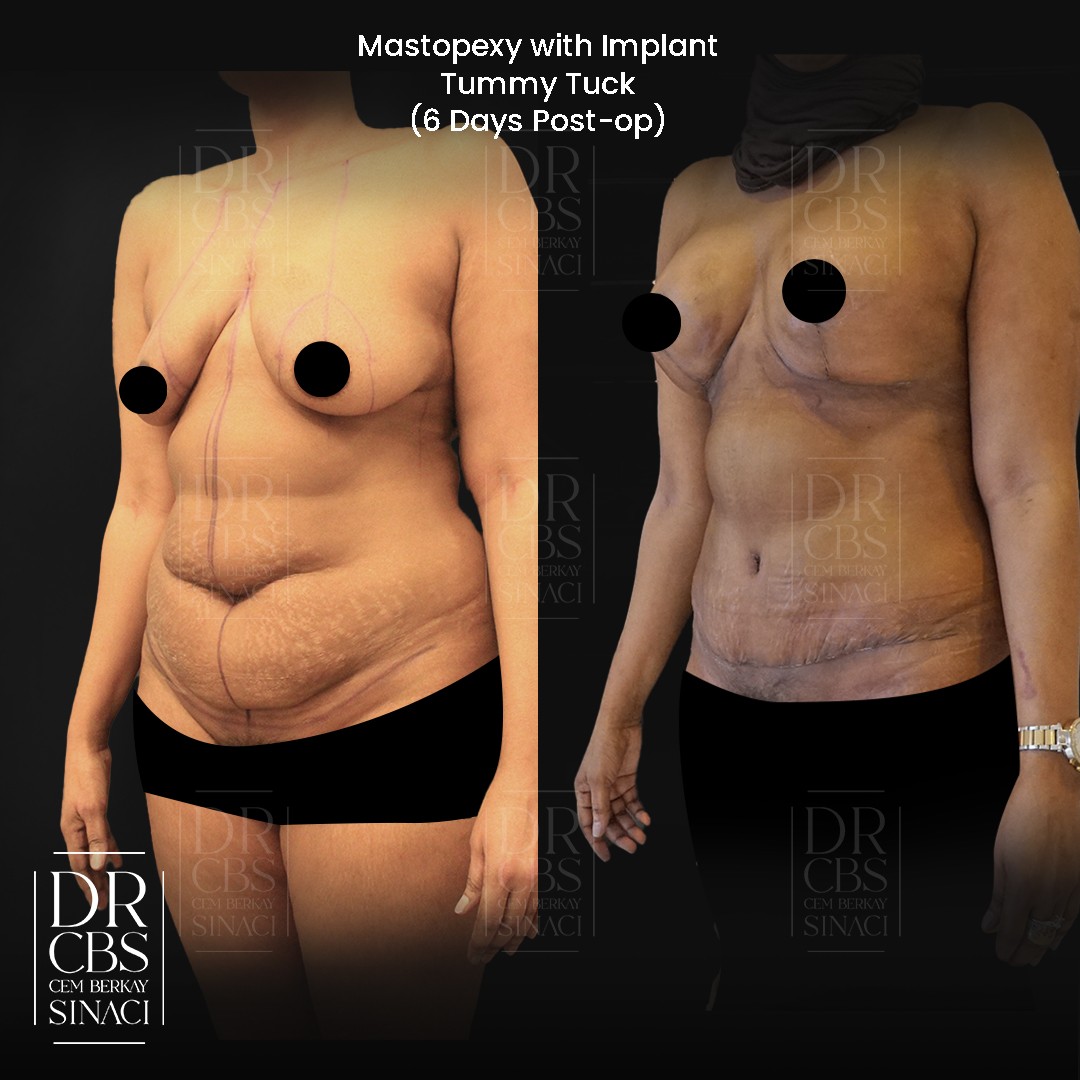
Mommy makeover at 6 days. Breast lift with implants correcting burn-related asymmetry and tummy tuck before and after. Dr. Cem Berkay Sinaci, Istanbul, Turkey.

Patient Overview
Age range: 34–40 years old
Gender: Female
Procedures: Breast lift (mastopexy) with implants, full abdominoplasty (tummy tuck), correction of breast asymmetry secondary to previous burn injury
After photos taken at: 6 days post-surgery
Case Description
Wafa's case carries a dimension that sets it apart from a standard mommy makeover. In addition to the typical post-pregnancy changes — deflated breasts, loose abdominal skin, and loss of body contour — she had significant breast asymmetry resulting from a previous burn injury. The burn had affected one breast, leaving behind scarring that distorted its shape, volume distribution, and skin quality compared to the unaffected side. This asymmetry had been a source of self-consciousness for years, compounding the cosmetic concerns that pregnancy had added.
When a patient presents with both congenital or acquired asymmetry and post-pregnancy changes, the surgical plan must account for two distinct problems simultaneously. The mommy makeover addresses the changes that both breasts experienced from pregnancy and breastfeeding. The asymmetry correction addresses the pre-existing difference between the two sides. Treating them together — rather than as separate surgeries — allows the surgeon to calibrate every decision with the final bilateral result in mind.
Correcting Burn-Related Breast Asymmetry
Burn injuries to the breast create a uniquely challenging form of asymmetry because they affect multiple tissue layers. Depending on the depth and extent of the original burn, the damage may involve the skin surface (texture, color, elasticity), the subcutaneous fat layer (volume loss or fibrosis from scarring), and the underlying breast parenchyma (distortion of shape from contracture). The scar tissue left by a burn behaves differently from normal tissue — it is stiffer, less elastic, and often contracted, pulling the surrounding breast into an asymmetric position.
Correcting this requires a different surgical mindset than addressing simple size asymmetry between two otherwise healthy breasts. With burn scarring, the surgeon must work with tissues that have altered mechanical properties. The scarred skin stretches differently, the underlying tissue planes may be obliterated by fibrosis, and the blood supply patterns can be changed by the previous injury. All of these factors influence implant selection, pocket creation, and the lift technique used on the affected side.
In Wafa's case, the approach involved tailoring each breast individually. The unaffected breast received a standard mastopexy with implant — the lift repositioned the nipple and tightened the envelope, while the implant restored upper pole fullness. The burn-affected breast required additional work: careful release of scar contracture to allow the tissue to accommodate the implant, strategic implant positioning to compensate for the volume and shape distortion caused by the burn, and modified skin management to achieve the best possible symmetry given the differences in skin quality between the two sides.
Perfect mirror-image symmetry is not a realistic goal when working with burn-scarred tissue, and this was discussed openly with Wafa during the consultation. The goal was the best achievable symmetry — a result where both breasts match closely enough in size, projection, and position that the difference is minimal in clothing and significantly improved compared to the preoperative state. Managing this expectation honestly before surgery is essential to patient satisfaction.
The Abdominoplasty Component
The abdominal portion of Wafa's mommy makeover addressed the standard post-pregnancy changes: excess lower abdominal skin, weakened abdominal musculature, and loss of waistline definition. The procedure followed the same principles as our standalone lipo-abdominoplasty cases — skin excision, muscle repair, and careful scar placement within the bikini line.
When planning the abdominal component alongside a complex breast reconstruction, operative sequencing becomes an important consideration. The total surgical time for a mommy makeover with asymmetry correction is longer than a standard combination case. This requires careful coordination with the anesthesia team, attention to patient positioning throughout the procedure, and efficient surgical planning to deliver meticulous results across both body areas within a safe operative window.
What Day 6 Looks Like After a Complex Mommy Makeover
At six days post-surgery, Wafa's body is in the acute phase of healing from two significant procedures performed simultaneously. The breasts appear elevated and firm — the implants have not yet settled, and the tissues around the burn-scarred breast are particularly tight as the released scar tissue adjusts to its new position. Over the coming weeks and months, both sides will soften and descend, though the scarred side may follow a slightly different timeline due to the altered tissue characteristics.
The abdomen shows the expected swelling and early healing signs consistent with this stage. The structural work — muscle repair and skin excision — is complete beneath the surface, and the contour will emerge progressively as the swelling resolves.
For a case with this level of complexity, the six-day photographs should be understood as the very beginning of a longer evolution than a standard mommy makeover. The burn-affected breast in particular will continue to change as the released scar tissue remodels and the implant finds its final position. Follow-up assessments at six weeks, three months, and six months are especially important for monitoring how the scarred tissue adapts.
The Intersection of Aesthetic and Reconstructive Surgery
Wafa's case illustrates something that is central to the training and philosophy of a board-certified plastic surgeon: aesthetic surgery and reconstructive surgery are not separate disciplines. They draw from the same anatomical knowledge, the same technical skill set, and the same understanding of tissue behavior. A burn-related breast asymmetry is a reconstructive problem. A mommy makeover is an aesthetic procedure. Combining them in a single operation requires fluency in both domains — the ability to restore normal anatomy where it has been damaged while simultaneously creating beautiful, proportionate aesthetic results where the tissues are healthy.
This dual expertise is one of the reasons international patients seek out surgeons who hold both aesthetic and reconstructive board certifications. The European Board of Plastic, Reconstructive and Aesthetic Surgery — of which I am a fellow — certifies competence across the full spectrum of the specialty, ensuring that the surgeon can handle complex cases where aesthetic goals and reconstructive challenges coexist.
Surgeon's Note
Wafa's case is meaningful to me because it demonstrates the breadth of what plastic surgery can accomplish in a single session. She came in carrying the combined burden of a traumatic injury and the natural changes of motherhood, both affecting her confidence and comfort in her body. Addressing everything together — the burn asymmetry, the breast deflation, the abdominal laxity — meant that she wakes up from one surgery and begins one recovery with all of these concerns being resolved simultaneously.
The technical challenge of working with burn-scarred tissue alongside healthy tissue on the opposite side requires constant intraoperative judgment. Every decision on the affected side — how much scar to release, where to position the implant, how to redistribute the available skin — is made in reference to what has been done on the healthy side. It is a continuous process of comparison and adjustment, and the result is never finalized until both sides are complete and the patient is assessed upright.
At six days, I am satisfied with the early healing trajectory. The scar release on the affected breast has allowed a degree of expansion that will improve further as the tissues relax. The symmetry, while still evolving, is already markedly better than the preoperative state. I look forward to documenting her progress at subsequent follow-up visits, where the true extent of the improvement will become increasingly apparent.
Frequently Asked Questions
Can a breast lift with implants correct asymmetry from a burn injury?
Yes, though the approach and expectations differ from standard breast augmentation. Burn scarring alters the skin's elasticity, the underlying tissue structure, and sometimes the blood supply. The surgeon must release scar contractures, adapt the implant pocket to the altered anatomy, and use modified techniques on the scarred side to achieve the closest possible match to the healthy breast. Perfect symmetry may not be achievable due to the tissue differences, but significant improvement is consistently possible.
Is it safe to combine reconstructive and aesthetic breast surgery with a tummy tuck?
Yes, provided the patient is in good health and the surgical team is experienced with extended combination procedures. The operative time is longer than a standard mommy makeover, which requires careful anesthetic management and surgical efficiency. Board-certified plastic surgeons with training in both reconstructive and aesthetic surgery are specifically equipped to manage this level of complexity safely.
How does burn scar tissue behave after breast implant surgery?
Burn scar tissue is stiffer and less elastic than normal skin, which means it stretches and settles more slowly after implant placement. The implant on the scarred side may take longer to reach its final position compared to the unaffected side. The scar tissue also tends to create more firmness around the implant initially. Over three to six months, the tissue gradually softens and adapts, though the final texture on the scarred side may remain slightly different from the healthy side.
How is implant size chosen when the two breasts are different?
When significant asymmetry is present, different implant sizes or profiles may be used on each side to achieve the best possible symmetry. The surgeon evaluates chest wall dimensions, existing breast tissue volume, and skin envelope characteristics on each side independently. In some cases, the same implant is used bilaterally but positioned differently to compensate for soft tissue differences. In other cases, a slightly larger or smaller implant is selected for the affected side. This decision is made during the consultation using clinical measurements and refined intraoperatively based on direct assessment.
What makes a surgeon qualified to handle both burn reconstruction and cosmetic breast surgery?
Board certification in plastic, reconstructive, and aesthetic surgery — such as the European Board (EBOPRAS) — certifies that the surgeon has completed comprehensive training across the entire specialty, including burn reconstruction, microsurgery, breast surgery, and aesthetic procedures. This full-spectrum training is what enables a surgeon to manage cases where reconstructive and aesthetic challenges overlap. Membership in international societies such as ISAPS and ASPS provides additional validation of ongoing professional development and adherence to global standards of practice.