
Round Textured Silicone Breast Implants at One Month
Breast augmentation with round silicone implants at one month shows natural fullness. Board-certified Dr. CBS explains implant surface choice in Istanbul.

Patient Overview
Patient: Tetianna
Age: 31 years old
Gender: Female
Procedures: Breast augmentation with round textured silicone implants
After photos taken at: 1 month post-surgery
Location: Istanbul, Turkey
Why Implant Surface Texture Matters
When patients research breast augmentation, most attention gravitates toward implant size and shape. Yet one of the most clinically significant decisions in the entire procedure receives far less public discussion: the surface texture of the implant shell. For Tetianna, a thirty-one-year-old patient of Dr. Cem Berkay Sinaci, round textured silicone implants were selected — a deliberate choice based on how the implant interacts with the body's own tissue at the microscopic level.
Dr. Sinaci, a European board-certified plastic surgeon (FEBOPRAS) and active member of ISAPS and ASPS, evaluates implant surface characteristics as a core component of surgical planning, not an afterthought. The distinction between smooth and textured surfaces is not cosmetic — it is biological, influencing how the body forms its capsule around the implant, how the implant behaves within its pocket over time, and how stable the long-term result remains.
The Science Behind Textured Silicone Implants
Every breast implant, regardless of surface type, becomes encapsulated by a thin layer of scar tissue after placement. This capsule is the body's natural response to any implanted material — it is expected, unavoidable, and in most cases entirely benign. The critical question is not whether a capsule will form, but what kind of capsule develops.
Smooth implants generate a capsule with fibres that align in parallel, creating a uniform sheath that can, in some patients, progressively contract and tighten around the implant. When this contraction becomes excessive, it produces capsular contracture — a condition where the breast feels firm, may change shape, and can cause discomfort. Capsular contracture remains one of the most common reasons for breast implant revision surgery worldwide.
Textured implants interact with the body differently. The microscopically roughened surface disrupts the orderly alignment of collagen fibres, encouraging the capsule to form in a more disorganised, interlocking pattern. This disordered capsule is inherently less prone to progressive contracture. Additionally, the textured surface promotes tissue adherence — a controlled degree of integration between the implant shell and surrounding tissue that helps maintain implant position within the pocket.
For Tetianna, this surface selection provides both stability and long-term peace of mind. The textured shell reduces the likelihood of capsular complications while keeping the implant securely positioned in the location Dr. Sinaci designed during surgery.
Assessing the One-Month Milestone
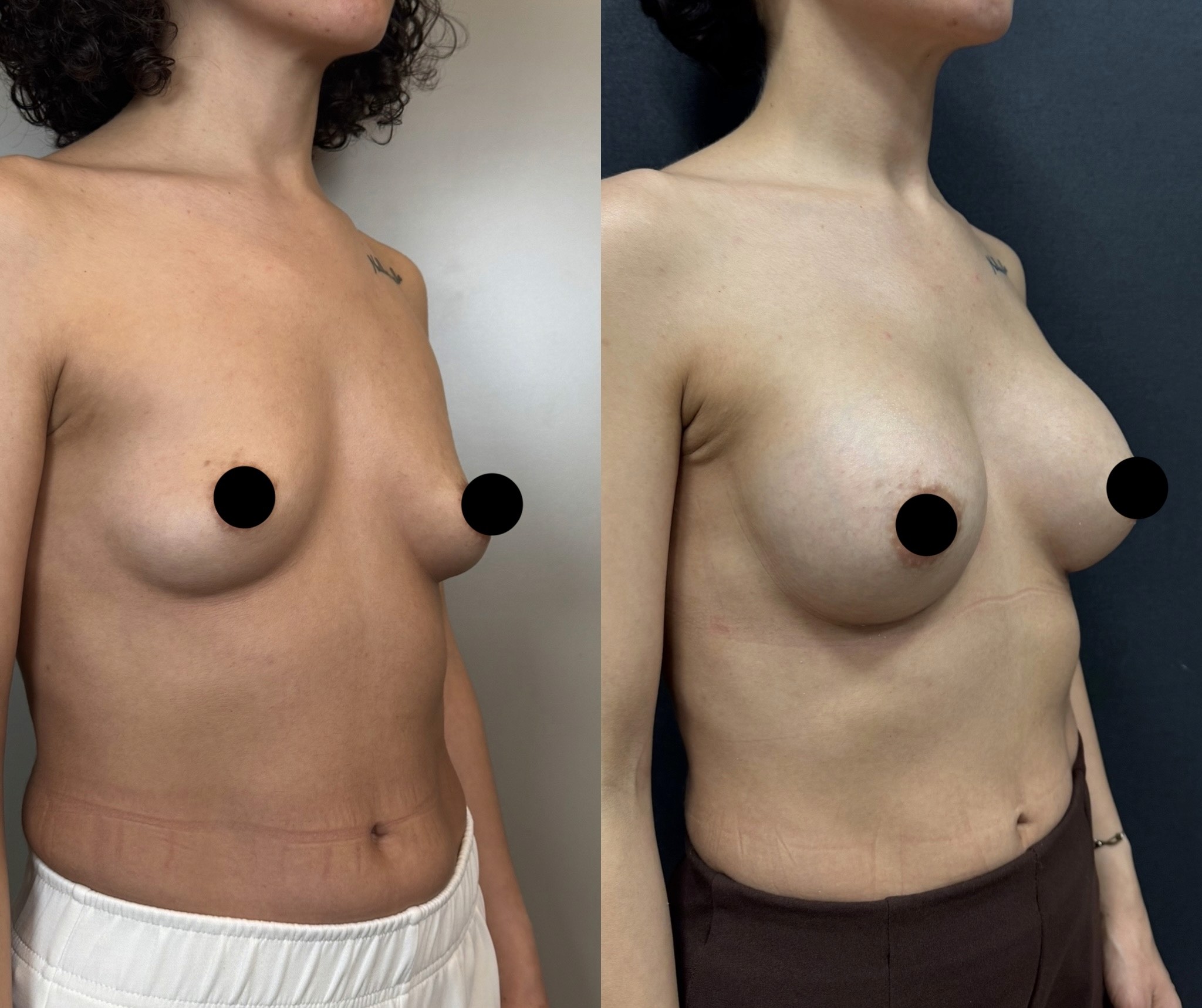
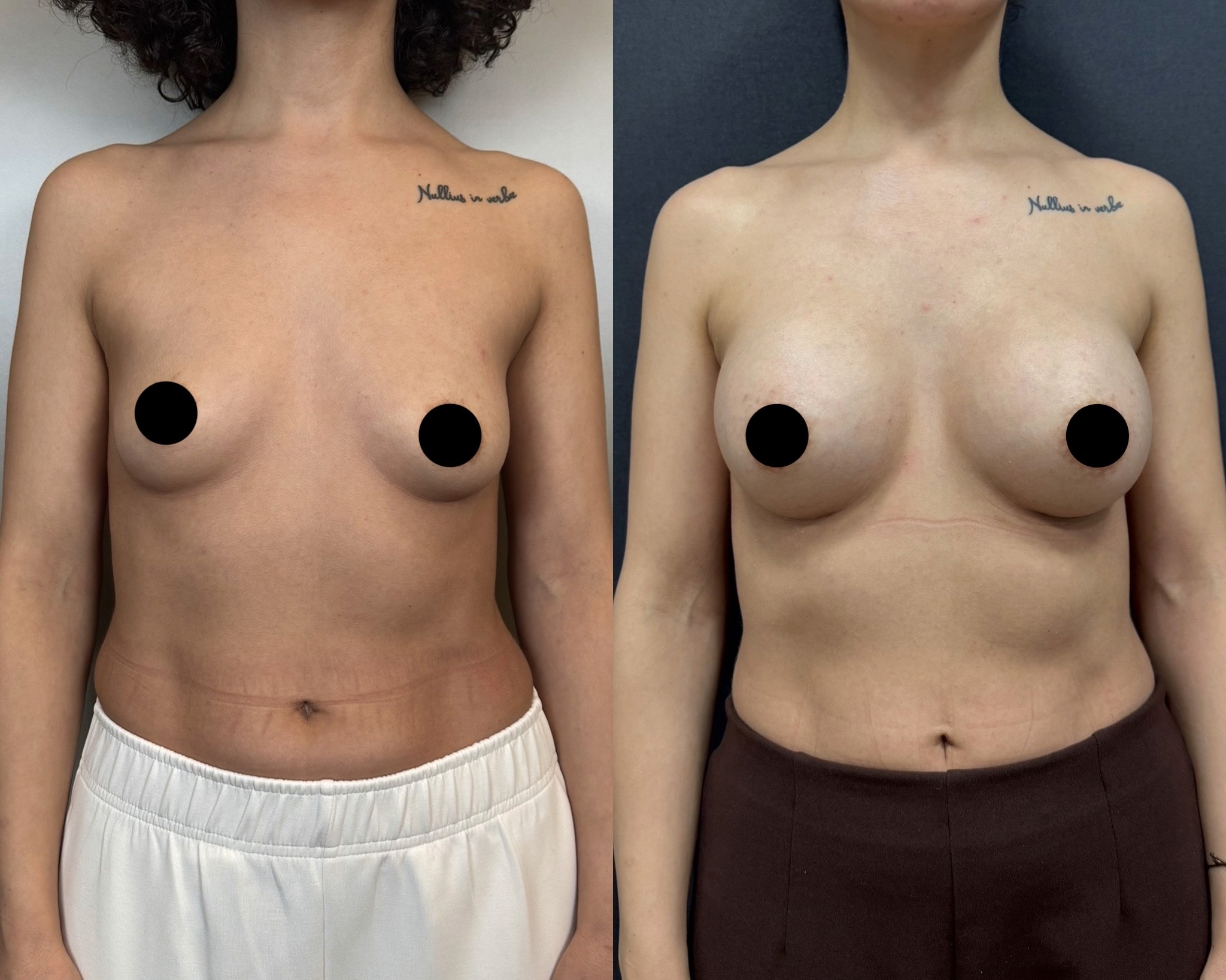
Tetianna's one-month photographs capture the breast augmentation result at a clinically meaningful checkpoint. By four weeks, the most significant post-operative changes have already occurred. The acute inflammatory swelling that characterises the first two weeks has largely resolved, and the tissues have begun adapting to the new implant volume. However, the final result has not yet been reached.
At one month, the implants are still in the process of settling. The pectoralis muscle and overlying soft tissue continue to relax and accommodate the round implants, allowing them to descend gradually from their initially elevated position into the natural breast contour. This process — commonly described as "drop and fluff" — progresses most visibly between weeks four and eight, with subtle refinement continuing through month three.
What Tetianna's photographs demonstrate at this stage is the emerging breast shape: fuller volume, improved projection, and the beginning of the soft, natural contour that will define the final outcome. The upper pole fullness that is still slightly pronounced will gently redistribute as the implant completes its descent over the coming weeks.
Round Implants and Natural-Looking Fullness
The round implant shape was chosen for Tetianna based on a specific aesthetic analysis during her preoperative consultation. Round implants distribute their cohesive silicone gel symmetrically within the shell, producing even volume across the upper and lower poles. When placed within the breast, gravity and tissue weight naturally shape the implant so that the lower pole carries slightly more projection than the upper pole — mimicking the contour of a youthful natural breast.
One practical advantage of round implants that is often underappreciated is rotational stability. Because the volume distribution is symmetric, a round implant produces the same breast shape regardless of any micro-rotation that may occur within the pocket over time. Anatomical implants, by contrast, have a directional shape that must remain precisely oriented; any rotation results in visible contour distortion. For patients seeking reliable, long-term aesthetic consistency, round implants offer an inherent advantage.
Dr. Sinaci's implant selection process, refined through his fellowship with the internationally renowned plastic surgeon Raul Gonzalez in Brazil, considers not only the immediate post-operative appearance but the decade-long behaviour of the implant within the patient's body. Brazilian aesthetic surgery training places exceptional emphasis on this longitudinal thinking — understanding how surgical decisions made today will manifest years into the future.
Individualised Planning for Each Patient's Anatomy
The phrase "customised for each patient" carries genuine clinical weight when it reflects the measurement-based approach Dr. Sinaci applies to every breast augmentation case. Tetianna's preoperative planning included precise measurements of her chest wall width, breast base diameter, nipple-to-fold distance, and tissue thickness — parameters that define the range of implant dimensions compatible with her frame.
Within that anatomically determined range, Tetianna's personal aesthetic preferences guided the final implant selection. Some patients prioritise maximum volume within safe limits; others, like Tetianna, prioritise proportion and natural appearance. The surgeon's role is to translate these subjective desires into objective implant specifications — profile, diameter, and volume — that will achieve the patient's vision while respecting the physical constraints of her anatomy.
This planning methodology is particularly important at age thirty-one, when the breast tissue retains good elasticity and the skin envelope has not yet undergone the changes associated with ageing or significant weight fluctuation. Tetianna's tissue quality allowed the selected implant to be fully supported by her natural soft tissue coverage, contributing to the natural-looking result visible even at this early stage.
The Incision and Scar at Four Weeks
By one month, the surgical incision has transitioned from its initial inflammatory phase into early scar maturation. The incision placement — chosen by Dr. Sinaci based on the patient's anatomy and implant characteristics — is designed to fall within natural anatomical landmarks where it will become progressively less visible over time.
At four weeks, the scar line may still appear pink or slightly raised, which is entirely normal. Scar maturation following breast augmentation typically requires twelve to eighteen months to reach its final appearance. During this period, a structured scar management protocol using silicone-based products and consistent sun protection helps optimise the outcome. Tetianna's incision at one month shows well-approximated wound edges and healthy healing — the clinical indicators of a scar that will mature favourably.
What the Coming Months Will Bring
Tetianna's breast augmentation result will continue to refine over the next two to five months. The implants will complete their descent into a fully natural position, residual tissue firmness will soften as the capsule matures, and the breast will achieve the relaxed, natural movement that defines a successful augmentation. By six months, the result is essentially final — a proportional enhancement achieved through precise implant selection, appropriate surface technology, and surgical planning tailored to Tetianna's individual anatomy. For patients considering breast augmentation in Istanbul with textured silicone implants, her case demonstrates how each technical decision contributes to the quality and longevity of the outcome.