
Subfascial Breast Augmentation to Avoid Waterfall
Subfascial breast augmentation with round implants avoids waterfall deformity in mildly saggy breasts. 9-month result by Dr. CBS in Istanbul, Turkey.
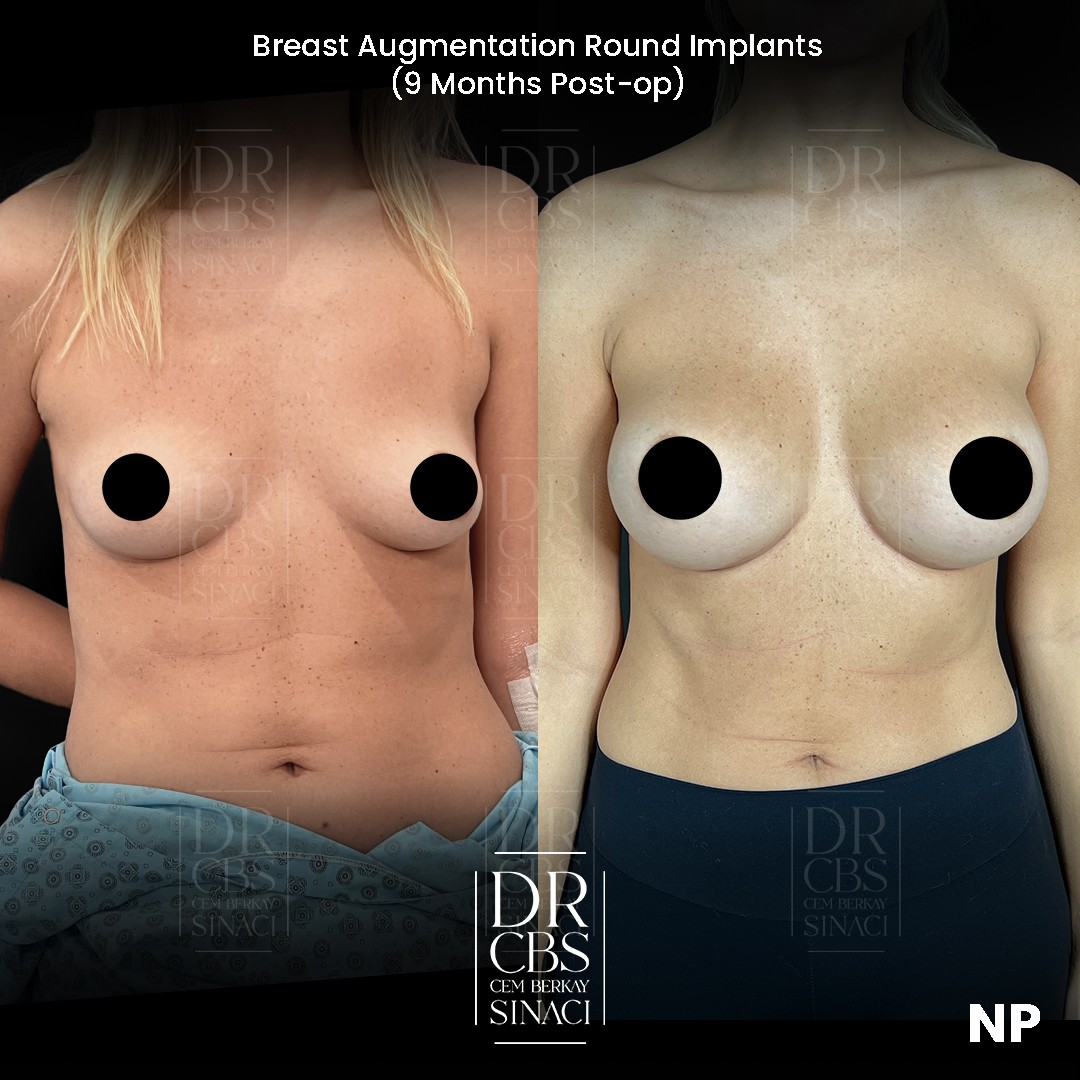


Patient Overview
Patient: Duygu
Age: 36 years old
Gender: Female
Procedures: Breast augmentation with round silicone implants (subfascial plane)
After photos taken at: 9 months post-surgery
Location: Istanbul, Turkey
When Mild Sagging Changes the Entire Surgical Plan
Breast augmentation is not a single operation with a single technique. It is a family of procedures, and the most consequential decision a surgeon makes — often more impactful than implant size or shape — is where to place the implant within the chest. For Duygu, a thirty-six-year-old patient with mild pre-existing breast ptosis, this decision determined not only the quality of her result but also the prevention of a complication that many patients have never heard of: waterfall deformity.
Dr. Cem Berkay Sinaci, a European board-certified plastic surgeon (FEBOPRAS) and active member of ISAPS and ASPS, identified during Duygu's preoperative assessment that her breast tissue had begun to descend slightly below its ideal position on the chest wall. This mild sagging — clinically classified as grade one ptosis — is extremely common in women in their mid-thirties and does not necessarily require a breast lift. However, it fundamentally changes which surgical plane will produce the best augmentation result.
What Is Waterfall Deformity and Why Does It Happen
Waterfall deformity is one of the most underrecognised complications in breast augmentation, yet it is entirely preventable with proper surgical planning. The condition occurs when a breast implant is placed beneath the pectoralis muscle in a patient whose native breast tissue has already begun to sag. The muscle holds the implant high and tight against the chest wall, but the natural breast tissue — which sits on top of the muscle — continues to hang below it.
The visual result is a breast that appears to have two distinct mounds: the implant projecting from the upper chest and the natural tissue drooping below it, creating a cascade or "waterfall" effect. The breast looks divided rather than unified, and the nipple points downward while the volume sits above it. Once established, waterfall deformity is difficult to correct without revision surgery that often involves changing the implant plane entirely.
Dr. Sinaci's decision to avoid the submuscular plane for Duygu was specifically designed to prevent this outcome. By recognising her mild ptosis preoperatively, he selected a surgical approach that would work with her existing anatomy rather than against it.
The Subfascial Plane: Precision Between Two Layers
The subfascial plane — also referred to as the over-muscle, under-fascia position — places the implant beneath the fascia of the pectoralis major muscle but above the muscle itself. The fascia is a thin but remarkably strong layer of connective tissue that envelops the muscle like a natural sleeve. While it measures only one to two millimetres in thickness, it provides meaningful structural support and an additional layer of soft tissue coverage over the implant.
For Duygu, the subfascial plane offered several distinct advantages. Because the implant sits above the muscle, it occupies the same anatomical compartment as the natural breast tissue. This means the implant and the breast move together as a single unit — there is no separation between implant volume and native tissue, eliminating any risk of the waterfall effect. The fascia provides a defined pocket that helps maintain implant position, while the overlying breast tissue adds natural coverage that softens the implant edges.
This technique requires precise surgical dissection to elevate the fascia cleanly from the underlying muscle without perforating it. Dr. Sinaci's training in this meticulous approach was refined during his fellowship with the internationally renowned plastic surgeon Raul Gonzalez in Brazil, where subfascial augmentation has been practised and perfected for decades as a primary technique for patients with adequate soft tissue coverage.
Why Round Implants Were the Right Choice
Implant shape is the second major decision in breast augmentation planning, and for Duygu, round silicone implants were selected over anatomical (teardrop) alternatives. Round implants distribute their gel fill symmetrically, meaning that regardless of how the implant rotates within the pocket — a natural micro-movement that occurs over time — the breast shape remains consistent.
Anatomical implants, by contrast, have a tapered upper pole and fuller lower pole. If an anatomical implant rotates, the breast shape becomes distorted, sometimes requiring revision surgery to correct. In the subfascial plane, where the pocket allows slightly more implant mobility than the tighter submuscular space, round implants offer a reliability advantage.
Additionally, round implants produce a gentle upper pole fullness that many patients find aesthetically desirable. When combined with Duygu's existing breast tissue volume, the round implant created the natural-looking enhancement she wanted — visible improvement without an obviously augmented appearance.
Reading the Nine-Month Result
Duygu's nine-month photographs represent an essentially final result. By this stage, all post-operative swelling has completely resolved, the implant pocket has fully matured, and the tissues have adapted to their new volume. The breast shape seen at nine months is the shape that will persist for years, barring significant weight fluctuations or future pregnancies.
Several features of Duygu's result merit attention. The breast contour flows as a single, unified curve from the upper pole to the inframammary fold — there is no visible separation between implant and tissue, confirming that the subfascial plane achieved its intended goal. The nipple sits at the point of maximum projection, which is the hallmark of a well-positioned augmentation. The lower pole has a natural, gentle convexity rather than the overly round "balloon" appearance that can result from oversized implants.
The Decision Framework: When to Go Under Muscle and When Not To
Not every patient benefits from the same surgical plane, and understanding Dr. Sinaci's decision-making framework helps clarify why Duygu's case required a different approach than a patient with no ptosis.
In patients with firm, non-ptotic breasts and thin soft tissue, submuscular placement provides excellent results because the muscle adds a layer of camouflage over the implant and the breast tissue sits naturally on top without any downward migration. There is no risk of waterfall deformity because the tissue and the implant remain aligned.
When mild sagging is present, however, the equation changes entirely. The breast tissue has already begun separating from the chest wall, and placing the implant behind the muscle forces the two structures into different anatomical compartments. The muscle pins the implant posteriorly while the tissue continues its anterior and inferior descent. The subfascial plane solves this by keeping implant and tissue in the same compartment, allowing them to age together as a unit.
Breast Augmentation Planning in Istanbul
Duygu's case illustrates why implant selection alone does not determine the quality of a breast augmentation result. The surgical plane — the precise anatomical layer where the implant is positioned — can be the difference between a harmonious outcome and a visible complication. For patients with even mild breast sagging, the subfascial approach offers a solution that respects the existing anatomy and prevents the waterfall deformity that submuscular placement can create. This level of individualised surgical planning, delivered by an internationally trained surgeon in Istanbul, reflects the standard of care that patients travelling for breast augmentation should expect.