
Double Chin Laser Liposuction 3 Week Results
Double chin laser liposuction before and after at 3 weeks. Jawline definition and neck contouring results by Dr. Cem Berkay Sinaci, Istanbul, Turkey.
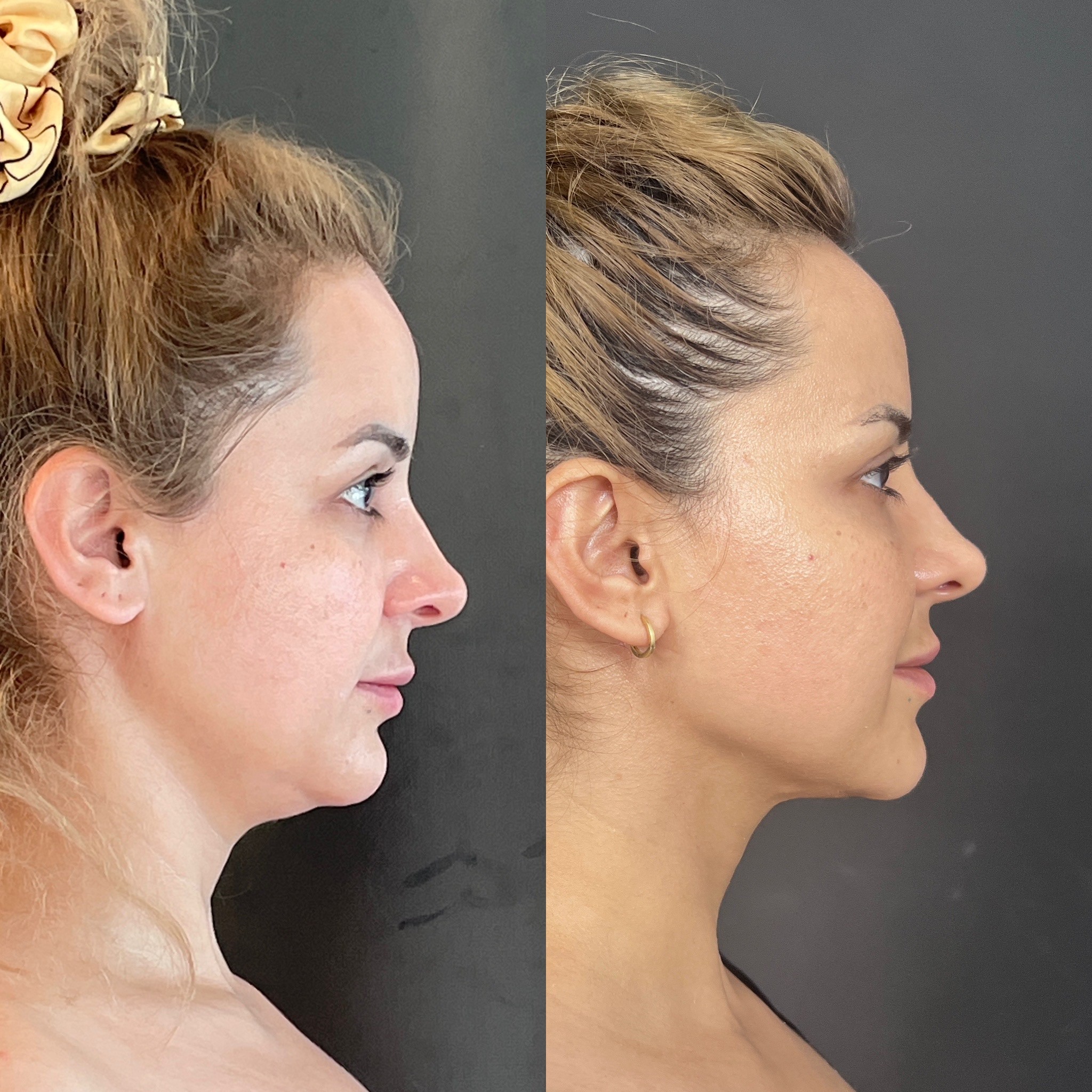
Patient Overview
Patient: Sevil
Age range: 40-45 years old
Gender: Female
Procedures: Laser liposuction of the submental area (double chin removal)
After photos taken at: 3 weeks post-procedure
Case Description
Sevil underwent laser liposuction to the submental area at our clinic in Istanbul to address a double chin that had been a long-standing concern. Unlike some of our combination cases, Sevil's procedure was a standalone treatment — no thread lift, no additional facial surgery. Her anatomy was well-suited to laser liposuction alone because her primary issue was a discrete fat deposit beneath the chin with minimal skin laxity. Her skin quality was good, her platysma muscle showed no significant banding, and her jawline had a naturally defined bone structure that was simply being obscured by the overlying fat. In cases like this, removing the fat and relying on the laser's skin-tightening effect plus the patient's own tissue elasticity is sufficient to produce a clean, defined result.
This distinction matters because not every double chin is the same, and the treatment approach should reflect the specific anatomy rather than follow a one-size-fits-all protocol. Sevil's case is a good example of when laser liposuction alone delivers an excellent outcome — and equally, of how important the preoperative assessment is in making that determination.
How Submental Fat Differs from General Body Fat
One of the reasons the double chin is such a common and frustrating concern is that submental fat behaves differently from fat elsewhere on the body. It is one of the first areas to accumulate fat in people who are genetically predisposed, and one of the last areas to respond to weight loss. Some patients develop a double chin even at a low body weight, while others lose significant weight and find that the submental fullness persists long after the rest of their body has leaned out.
This resistance to diet and exercise exists because the submental fat pad is a defined anatomical compartment. It sits between the skin and the platysma muscle, contained within its own fascial boundaries. Unlike the diffuse fat deposits across the abdomen or thighs, which expand and contract more responsively with caloric balance, the submental compartment tends to hold its volume stubbornly. Once it reaches a certain size, the only reliable method of permanent reduction is physical removal.
This is also why non-surgical fat reduction treatments — injectable deoxycholic acid, cryolipolysis, radiofrequency devices — produce inconsistent results in this area. They can reduce volume incrementally, but they cannot provide the precision or degree of reduction that direct liposuction offers. For patients like Sevil who want a definitive, one-session solution, laser liposuction remains the most reliable option.
The Standalone Laser Liposuction Procedure
Sevil's procedure was performed under local anesthesia, which means she was awake and comfortable throughout. A dilute anesthetic solution was infiltrated into the submental fat pad to numb the area and reduce bleeding. The laser fiber was then introduced through two to three tiny incisions — each approximately three millimeters — hidden beneath the chin and behind the earlobes.
The laser energy was delivered in a controlled, systematic pattern throughout the fat layer, liquefying the fat cells and simultaneously heating the undersurface of the skin. The liquefied fat was then aspirated through a fine cannula. The entire procedure took approximately 45 minutes to one hour.
What distinguishes laser liposuction from other double chin treatments is the precision the surgeon has over the contouring process. The cannula provides direct tactile feedback — the surgeon can feel exactly how much fat remains in each zone and adjust the removal in real time. This allows for graduated contouring: slightly more removal along the jawline to enhance definition, careful preservation of a thin fat layer directly beneath the skin to avoid irregularities, and symmetrical treatment from one side to the other. This level of control is not possible with any non-surgical alternative.
The 3-Week Result: What the Photographs Show
Three weeks is a revealing stage to document because it falls right at the point where the acute recovery is complete but the result is still maturing. At day four — as we showed in Mariana's case — the improvement is visible but partially obscured by swelling. At three weeks, the swelling has largely cleared and the true contour is emerging.
Sevil's three-week photographs demonstrate a markedly sharper jawline and a significantly reduced submental profile. The angle between the chin and the neck — the cervicomental angle — is visibly more acute and defined. The transition from chin to neck is smoother and cleaner, without the soft fullness that was present before the procedure.
At this stage, approximately 80 percent of the final result is visible. The remaining 20 percent consists of subtle continued skin retraction and softening of any residual firmness in the treated area. The collagen remodeling stimulated by the laser energy is still in its early phases at three weeks and continues for up to six months, progressively improving skin tightness and texture along the jawline and beneath the chin.
One detail worth noting is that the small incision sites are already nearly invisible at three weeks. Because the entry points are only a few millimeters in size and are placed in naturally concealed locations, they heal to become virtually undetectable within a few months. There is no visible scarring associated with this procedure — a meaningful advantage for patients who are concerned about any evidence of having had work done.
Skin Retraction After Submental Liposuction
A question that many patients ask during the consultation is what happens to the skin after the fat beneath it is removed. Will it hang loosely? Will it look wrinkled or deflated? The answer depends on two factors: the patient's baseline skin quality and whether laser energy is used.
In patients with good skin elasticity — generally those under 50 with minimal sun damage and no significant weight fluctuations — the skin contracts naturally around the reduced volume. The laser energy accelerates and amplifies this process by heating the dermal collagen, causing immediate contraction and triggering new collagen synthesis over the following months. This is why the result at three months looks tighter and more refined than the result at three weeks — the collagen remodeling is a gradual, ongoing process.
Sevil had good baseline skin quality, and her three-week result already shows smooth, even skin retraction without irregularities or loose folds. This will continue to improve subtly through the three- and six-month marks. For patients with compromised skin elasticity — significant sun damage, older age, or very thin dermis — the surgeon may recommend combining laser liposuction with a thread lift or even a mini neck lift to ensure the skin redrapes properly after fat removal. This decision is always made during the consultation based on clinical assessment, not guesswork.
Why Local Anesthesia Matters
Performing submental laser liposuction under local anesthesia rather than general anesthesia offers several practical advantages that international patients in particular appreciate. There is no need for fasting, intubation, or post-anesthetic recovery — the patient walks into the procedure room and walks out afterward. The risk profile is lower because general anesthesia, while very safe, carries its own set of potential complications that are eliminated entirely when the procedure is performed under local. Recovery begins immediately — there is no grogginess, nausea, or disorientation that can follow general anesthesia. And for patients traveling to Istanbul, it means the procedure can often be scheduled with less lead time and the recovery stay can be shorter since there is no anesthesia to recover from on top of the surgical healing.
Sevil was able to return to her accommodation immediately after the procedure and required only mild oral pain relief for the first two days. By day three, she described the treated area as feeling tight and slightly numb — not painful.
Surgeon's Note
Sevil's case is one I frequently reference during consultations because it shows what laser liposuction can achieve as a standalone procedure when the patient selection is right. There is often a temptation — both from patients researching online and from surgeons offering packages — to add procedures that are not strictly necessary. But sometimes the most effective plan is the simplest one.
Sevil had a well-defined problem: excess submental fat obscuring an otherwise defined jawline. Her skin was elastic enough to retract without mechanical assistance from threads or surgery. The fat deposit was contained and accessible. In this situation, laser liposuction alone was the correct choice, and the three-week result confirms that. The jawline definition that has emerged is a direct result of removing the fat that was hiding it — the underlying bone structure was always there, it just needed to be revealed.
What pleases me technically about this result is the smoothness of the skin retraction. Achieving even, natural-looking contours in the submental area requires careful, graduated fat removal — leaving too little fat creates visible irregularities and a skeletonized appearance, while leaving too much defeats the purpose. The three-week photographs show a natural, soft jawline with no contour irregularities, which tells me the fat removal was calibrated correctly. The ongoing collagen remodeling will only refine this further over the coming months.
Frequently Asked Questions
How is laser liposuction different from Kybella or CoolSculpting for double chin removal?
Kybella (deoxycholic acid injection) and CoolSculpting (cryolipolysis) are non-surgical treatments that destroy fat cells gradually over multiple sessions. They can reduce mild submental fullness but offer limited control over contouring, require two to four treatment sessions spaced weeks apart, and produce variable results depending on the patient's anatomy. Laser liposuction removes the fat directly in a single session, allows precise contouring under the surgeon's control, and includes the additional benefit of laser-induced skin tightening. For patients seeking a definitive, one-time result with predictable contouring, laser liposuction is consistently more reliable.
Will the double chin come back after laser liposuction?
The fat cells removed during liposuction are permanently eliminated — they do not regenerate. However, the remaining fat cells in the area can expand if the patient gains significant weight in the future. Maintaining a stable weight preserves the result long-term. The skin tightening effect from the laser is also durable, though the natural aging process will continue to affect skin laxity over the years, as it would regardless of whether the procedure was performed.
How soon can I go back to work after double chin laser liposuction?
Most patients return to desk-based work within two to three days. The primary visible sign of the procedure is mild swelling and possibly light bruising beneath the chin, which can typically be concealed with a scarf or high collar if desired. A chin strap or compression garment is worn for the first week to support the healing tissues. By ten days to two weeks, the swelling has diminished enough that the procedure is essentially undetectable to others.
Is there an age limit for double chin laser liposuction?
There is no strict age limit, but skin quality is more important than age as a selection criterion. A 55-year-old with good skin elasticity may be an excellent candidate for standalone laser liposuction, while a 40-year-old with sun-damaged, thin skin may need the procedure combined with a thread lift for optimal skin retraction. The consultation assessment evaluates the skin directly — its thickness, elasticity, and response to manual testing — rather than relying on age alone as a predictor.
How much fat can be removed from the double chin area?
The submental area typically contains between 20 and 80 milliliters of removable fat, though this varies considerably between patients. The goal is not maximum removal but optimal contouring — leaving a thin, even layer of fat beneath the skin to maintain a natural appearance while eliminating the visible fullness. Over-removal creates a hollowed, gaunt look that appears unnatural. The surgeon calibrates the removal in real time during the procedure based on tactile assessment and visual evaluation.