
Laser Lipo Double Chin & Thread Lift at Day 4 Results
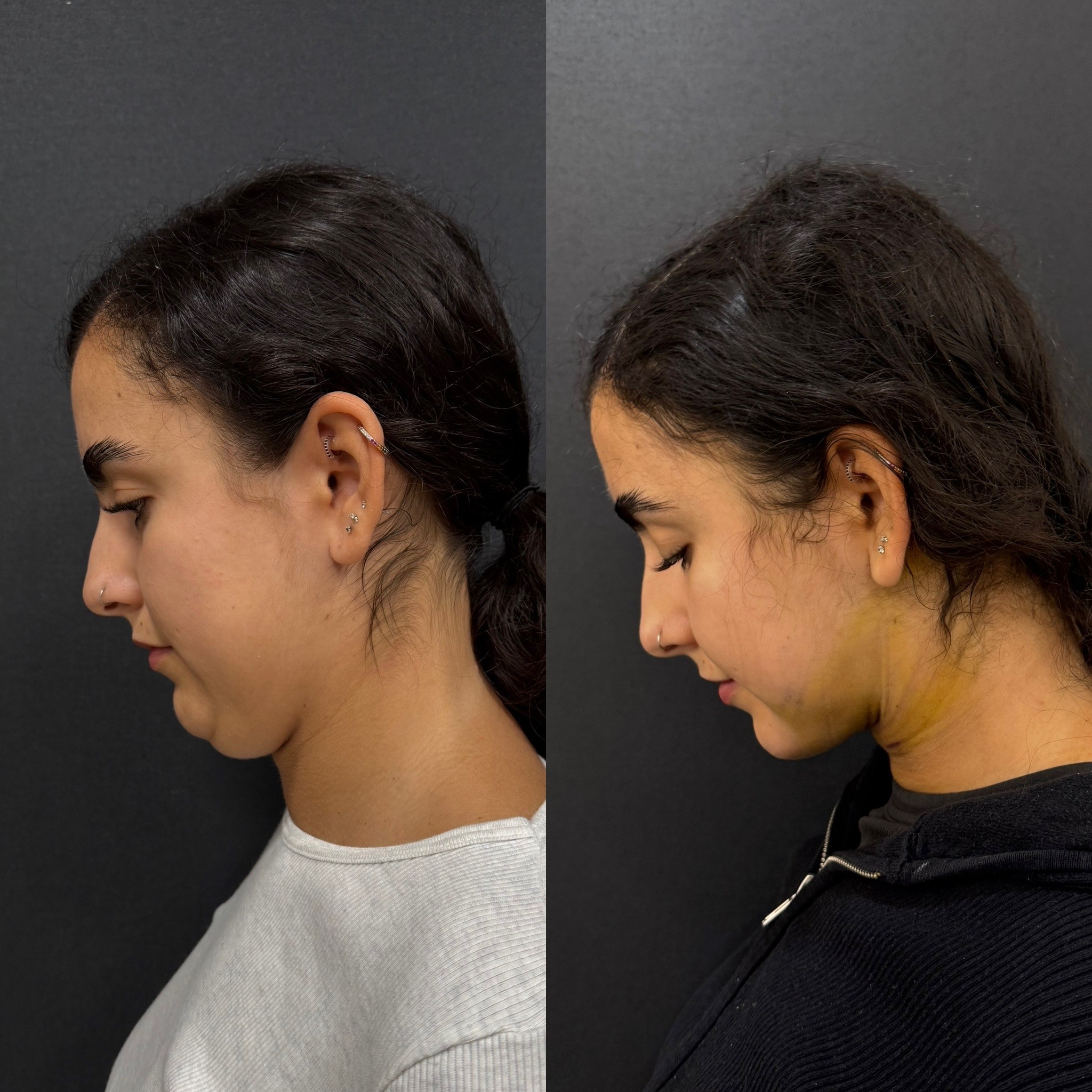
Double chin removal with laser liposuction and thread lift before and after at 4 days. Natural neck contouring by Dr. Cem Berkay Sinaci, Istanbul, Turkey.


Patient Overview
Patient: Mariana
Age range: 25-30 years old
Gender: Female
Procedures: Laser liposuction of the submental area (double chin), thread lift
After photos taken at: 4 days post-surgery
Case Description
Mariana came to our clinic in Istanbul with a concern that is among the most common we hear during consultations: a persistent double chin and lack of definition along the jawline. Despite being at a healthy weight, she felt that the fullness beneath her chin and the early softening of her lower face made her look heavier and older than she was. She had considered surgical options but was drawn to the possibility of achieving meaningful improvement without the downtime and scarring of a full surgical procedure.
After careful evaluation, a combination of laser liposuction to the submental area and a thread lift was recommended. This pairing represents a minimally invasive alternative to traditional neck and lower face surgery — not a replacement for a full facelift in patients who need one, but a powerful option for patients whose concerns are primarily localized to submental fat and mild to moderate jawline laxity.
Laser Liposuction for Double Chin Removal
The double chin is one of the most stubborn aesthetic concerns because the submental fat pad is largely genetically determined. Some people accumulate fat beneath the chin regardless of their overall body composition, and no amount of diet, exercise, or non-surgical treatments like cryolipolysis can fully eliminate it once it reaches a certain volume. Laser liposuction provides a direct, definitive solution.
The procedure differs from traditional liposuction in one important respect: the laser energy. A thin fiber-optic laser probe is introduced through a small incision — typically just a few millimeters, hidden beneath the chin or behind the earlobes — and delivers thermal energy directly into the fat layer. This energy serves a dual purpose. It liquefies the fat cells, making them easier to remove with less mechanical trauma than conventional liposuction, and it simultaneously heats the undersurface of the skin, stimulating collagen contraction and tightening.
This collagen-tightening effect is what makes laser liposuction particularly well-suited for the submental area. When fat is removed from beneath the chin, the overlying skin needs to contract and re-drape smoothly over the newly contoured jawline. In traditional liposuction, this skin retraction depends entirely on the patient's natural skin elasticity. With laser liposuction, the thermal effect actively promotes this retraction, reducing the risk of loose or irregular skin after fat removal.
For Mariana, the laser liposuction addressed the volume component of her double chin — physically removing the fat that was obscuring her jawline and creating the fullness beneath her chin.
Thread Lift: Adding Structure Without Surgery
While the laser liposuction addressed the fat, the thread lift addressed the soft tissue laxity. These are two different problems that often coexist, and treating only one leaves the other visible. Removing fat without lifting can reveal the underlying laxity that the fat was masking. Lifting without removing fat improves the contour but leaves the volume that was creating the heaviness.
A thread lift uses absorbable barbed sutures — typically made of polydioxanone (PDO) or polylactic acid (PLA) — that are inserted beneath the skin through tiny entry points and anchored to provide mechanical lifting of the tissue. The threads physically reposition the soft tissue upward and backward along the jawline, restoring definition and creating a tighter, more sculpted lower face contour.
Beyond the immediate lifting effect, the threads stimulate a biological response. As the body gradually absorbs the suture material over the following months, it deposits new collagen along the thread pathway. This collagen formation provides structural support that partially maintains the lifting effect even after the threads themselves have dissolved. The result is a combination of immediate mechanical improvement and ongoing biological reinforcement.
For Mariana, the threads were placed strategically along the jawline and upper neck to complement the fat reduction achieved by the liposuction. The two procedures together created a defined jawline and a cleaner cervicomental angle — the junction between the chin and the neck — without a single traditional surgical incision.
What Makes This Combination Different from a Facelift
It is important to be transparent about what this approach can and cannot achieve. Laser liposuction and thread lift is not a substitute for a face and neck lift in patients with significant skin excess, deep platysmal banding, or advanced facial descent. Those conditions require surgical correction of the deeper structures, and no minimally invasive technique can replicate those results.
Where this combination excels is in the patient population that falls between "not ready for surgery" and "does not need surgery." Patients like Mariana who have localized submental fat, mild to moderate jawline softening, and skin quality that still has reasonable elasticity are ideal candidates. The result is a noticeable, natural improvement achieved through tiny incisions, with dramatically less downtime than surgery and virtually no visible scarring.
The honest conversation during the consultation is critical. When a patient's anatomy is suited to this approach, the results can be striking. When the degree of aging exceeds what these techniques can address, recommending a surgical procedure is the responsible course — even if the patient initially prefers a minimally invasive option.
Results at 4 Days
Mariana's photographs were taken at just four days after the procedure, which makes them a realistic snapshot of the very early recovery period. At this stage, mild swelling is present beneath the chin and along the jawline — this is the body's natural response to both the liposuction and the thread insertion. Some patients also experience minor bruising, though this varies considerably.
Even through the early swelling, the improvement in Mariana's jawline definition is already visible. The submental fullness has been substantially reduced, and the jawline has a cleaner, more angular contour than it did preoperatively. As the swelling resolves over the next two to three weeks, this definition will become increasingly pronounced.
The thread lift effect is also partially visible at day four, though its full impact takes longer to appreciate. The initial lift provided by the threads is somewhat masked by the post-procedural swelling. As that swelling clears and the tissues settle around the threads, the lifting becomes more apparent. The collagen stimulation effect — the biological component that sustains the result — does not begin to manifest visibly until six to eight weeks after the procedure and continues to develop for several months.
Recovery from this combination is notably lighter than surgical alternatives. Mariana was able to resume her normal daily activities almost immediately, with the primary restrictions being avoidance of strenuous exercise for two weeks and sleeping with her head slightly elevated for the first week to minimize swelling.
Surgeon's Note
Mariana's case represents the type of result that makes minimally invasive facial contouring so satisfying to perform. She had a specific, well-defined concern — submental fullness and early jawline laxity — and the anatomy to respond well to a non-surgical approach. The combination of laser liposuction and thread lift addressed both the volume and the structural components of her concern in a single session lasting under two hours, with a recovery measured in days rather than weeks.
What I always emphasize to patients considering this approach is the importance of honest candidate selection. Not every patient who wants a non-surgical option is a good candidate for one. The consultation must evaluate the degree of fat accumulation, the quality and elasticity of the skin, the position of the platysma muscle, and the extent of any deeper structural descent. When all of these factors align favorably — as they did in Mariana's case — the minimally invasive approach delivers results that genuinely surprise patients with how much improvement is possible without surgery.
I also want to note that documenting results at four days is valuable specifically because it sets realistic expectations about the recovery timeline. The result at four days is promising. The result at three to four weeks, once swelling has fully cleared, is significantly better. And the result at three months, when the collagen stimulation from the threads has had time to develop, represents the true final outcome. Each stage brings visible improvement over the last.
Frequently Asked Questions
What is the difference between laser liposuction and regular liposuction for double chin removal?
Traditional liposuction uses mechanical suction to physically remove fat cells. Laser liposuction adds a thermal component — a fine laser fiber liquefies the fat before removal, which reduces tissue trauma and allows for more precise contouring. The laser energy also heats the undersurface of the skin, stimulating collagen production and promoting skin tightening. This dual effect makes laser liposuction particularly advantageous in the submental area, where skin retraction after fat removal is essential for a smooth result.
How long do thread lift results last?
The immediate mechanical lifting effect is visible right away. The absorbable threads dissolve gradually over six to twelve months, but the collagen they stimulate along their pathway provides ongoing structural support. Most patients enjoy noticeable improvement for 18 to 24 months after the procedure. The longevity depends on individual factors including skin quality, age, and the natural pace of aging. Some patients choose to have a maintenance thread lift after two years to sustain the result.
Is double chin laser liposuction painful?
The procedure is performed under local anesthesia, so the treatment area is completely numb during the process. Most patients describe the experience as feeling pressure and vibration rather than pain. Afterward, the area feels sore and tight for the first few days — similar to the sensation after an intense workout in muscles you have not used recently. Over-the-counter pain relief is typically sufficient, and most patients report that any discomfort is easily manageable.
Who is a good candidate for laser lipo and thread lift instead of a facelift?
Ideal candidates are patients with localized submental fat (double chin), mild to moderate jawline laxity, and skin that still has reasonable elasticity. This combination works best for patients in their 30s to early 50s whose concerns are primarily in the lower face and neck rather than involving the midface, cheeks, or periorbital area. Patients with significant skin excess, deep neck bands, or advanced facial sagging will achieve better results with a surgical face and neck lift. The consultation is the appropriate setting to determine which approach best matches your anatomy and goals.
Can laser liposuction under the chin be combined with other procedures?
Yes. Beyond thread lifting, submental laser liposuction can be combined with chin augmentation for patients who would benefit from improved chin projection, with buccal fat removal for enhanced facial slimming, or with skin resurfacing treatments for overall facial rejuvenation. It can also be performed as a standalone procedure for patients whose only concern is isolated submental fat with good skin elasticity. The choice of combination depends entirely on the individual patient's anatomy and aesthetic goals.