
Lip Lift Two-Month Result: Scar and Shape Update
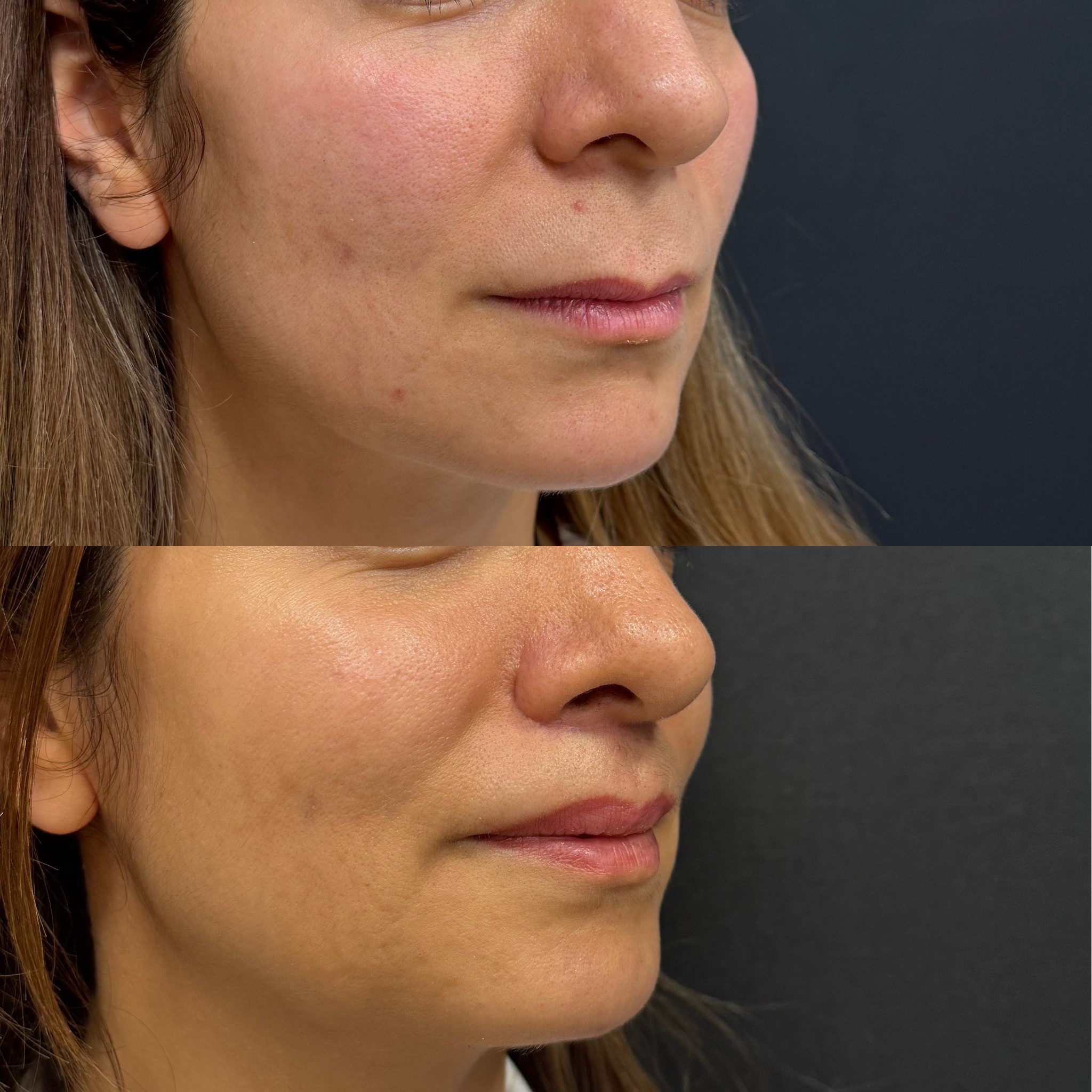
Before and after bullhorn lip lift at two months showing faded scar and defined Cupid's bow. Dr. Cem Berkay Sinaci upper lip shortening in Istanbul, Turkey.


Patient Overview
Patient: Selin
Age: 36 years old
Gender: Female
Procedures: Bullhorn lip lift
After photos taken at: 2 months post-surgery
Location: Istanbul, Turkey
What a Lip Lift Result Looks Like at Two Months
Two months is the stage where a lip lift patient stops thinking about her surgery and starts simply living with her new lip. The recovery is complete. The tissue has softened. The scar has faded from its early redness into a progressively paler line. And the proportional correction that felt new and unfamiliar during the first weeks now looks like it was always there. Selin's two-month photographs capture this settled, natural-appearing result — far enough from surgery that the healing is essentially finished, close enough that the scar is still actively maturing toward its final invisible state.
At thirty-six, Selin underwent a bullhorn lip lift with Dr. Cem Berkay Sinaci, a European board-certified plastic surgeon (FEBOPRAS) and member of ISAPS and ASPS. Her two-month result demonstrates two things that prospective lip lift patients search for most frequently: what the scar actually looks like once early healing is over, and how the enhanced lip shape integrates with the rest of the face.
The Scar at Two Months: Honest Assessment
The lip lift scar is the primary concern that prevents many patients from proceeding with surgery. Online forums are filled with anxiety about a visible line beneath the nose, and this concern deserves an honest, non-dismissive response.
At two months, Selin's subnasial scar has progressed substantially from its three-week appearance. The intense pink-red colour of early healing has faded to a softer tone that blends more readily with the surrounding skin. The slight elevation that fresh scars often display has flattened. The line is narrower than it was at one month and sits within the natural crease where the columella meets the upper lip skin — a location that catches shadow rather than light.
Is it invisible at two months? Not under deliberate close inspection. But it has reached the stage where casual social interaction does not reveal it. Conversational distance — the arm's length at which most human interaction occurs — is sufficient for the scar to disappear into the natural nasal base anatomy. Light makeup conceals it completely for situations where the patient wants additional assurance.
The scar will continue improving beyond two months. Between months three and twelve, the remaining pigmentation fades, the collagen fibres within the scar reorganise into a flatter configuration, and the line becomes progressively more difficult to identify even at close range. By one year, most bullhorn lip lift scars are detectable only if someone knows exactly where to look and examines the area from centimetres away.
How a Lip Lift Enhances the Cupid's Bow
One aesthetic benefit of the bullhorn lip lift that receives insufficient attention is its effect on the Cupid's bow — the double curve at the centre of the upper vermilion border that defines the lip's most recognisable feature. A well-defined Cupid's bow is one of the hallmarks of an attractive lip, and the lip lift enhances it through a mechanism that filler cannot replicate.
When the upper lip skin is shortened, the vermilion border is elevated and slightly everted — rolled gently outward. This eversion accentuates the peaks and valley of the Cupid's bow, making the natural curvature more defined and more visible. The effect is subtle but meaningful: the central lip takes on a sculpted, dimensional quality that a long upper lip obscures by stretching the vermilion flat.
Selin's two-month result shows this enhanced Cupid's bow definition clearly. The central upper lip has a shapeliness that was diminished when the longer skin above it pulled the vermilion taut. The lip lift did not create a new Cupid's bow — it revealed the one that was always there, hidden by excess vertical skin length.
Upper Lip to Lower Lip Ratio
Lip aesthetics are governed by proportional relationships, and one of the most important is the ratio between the upper and lower lip. In the classically proportioned face, the lower lip is approximately one-and-a-half to two times the height of the upper lip when viewed from the front. This ratio creates the fullness and balance that the eye registers as attractive.
When the upper lip skin is long, it compresses the visible vermilion, making the upper lip appear disproportionately thin relative to the lower lip. The ratio shifts — the lower lip dominates, and the upper lip seems to retreat. This imbalance can make the lower lip look overly prominent or even heavy, when in reality the problem is not lower lip excess but upper lip deficiency.
By shortening the skin and increasing vermilion show, the bullhorn lip lift restores the upper-to-lower lip ratio toward its ideal range. In Selin's case, the two-month result shows a harmonious relationship between upper and lower lip — neither dominates, neither recedes, and the overall lip complex reads as balanced and naturally proportioned.
The Mid-Thirties: A Common Age for Lip Lift
Thirty-six is a frequent age for lip lift consultations because it sits at the intersection of two motivations. Some patients at this age, like younger patients, have always had a congenitally long upper lip and have simply reached the point of decision. Others are noticing the earliest signs of age-related upper lip elongation — the very beginning of the lengthening process that accelerates through the forties and fifties.
Regardless of which motivation applies, the mid-thirties offer excellent conditions for the procedure. Skin quality is still strong, healing capacity remains robust, and collagen production supports optimal scar maturation. The result achieved at thirty-six will carry the patient through decades of natural ageing from a corrected starting point, meaning the lip will always appear proportionally shorter than it would have without intervention.
Selin's tissue quality at thirty-six contributes to the scar trajectory visible at two months. Her skin is healing efficiently, the scar is maturing on a favourable timeline, and the tissue surrounding the incision has regained its full softness and mobility — all indicators that the final scar appearance will be excellent.
Life After Lip Lift: What Changes
Patients who undergo lip lift often report changes in daily experience that go beyond what they expected from a procedure measured in millimetres of skin excision. Lipstick application changes — the increased vermilion show means more visible lip surface to work with, and colours that previously seemed to disappear on a thin upper lip now have a canvas to display on. Photographs change — the balanced lower facial proportion photographs differently, and patients frequently report that they look more alert, more approachable, and more expressive in images.
Smiling changes subtly as well. The shortened upper lip reveals slightly more of the upper teeth at rest and during gentle smiling, creating a more youthful dental show that many patients find particularly gratifying. This is not the excessive gummy smile of overcorrection — it is the natural, appealing tooth show that a proportionally correct upper lip produces.
These practical, lived improvements are what transform a lip lift from an abstract surgical concept into a procedure that affects daily life in tangible, positive ways. Selin's two-month experience reflects this transition — the surgery is behind her, the scar is fading, and the enhanced lip has become simply part of how she looks and how she engages with the world.
Bullhorn Lip Lift Results in Istanbul
Selin's two-month before and after demonstrates the bullhorn lip lift at the stage where the result speaks for itself — proportionally balanced, naturally enhanced, with a scar that has already faded past the point of social visibility and will continue improving for months to come. For patients researching permanent upper lip enhancement in Istanbul, her case provides the realistic two-month reference point that bridges the gap between early post-operative images and the polished final results that galleries typically display.