
Lip Lift vs Lip Filler vs Lip Flip: Which Lasts?
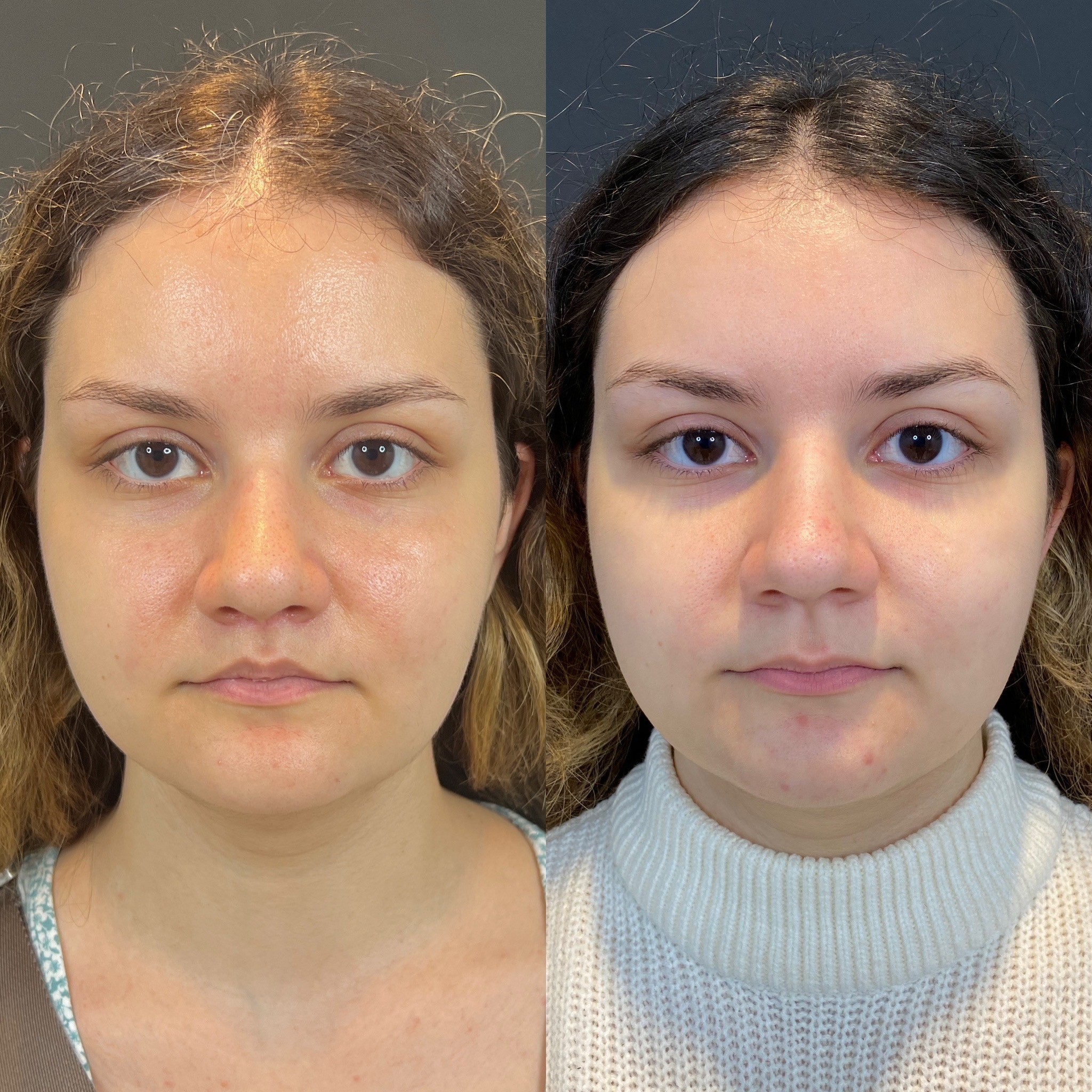
Before and after subnasal bullhorn lip lift at three weeks. Dr. CBS compares permanent lip lift surgery to lip filler and lip flip in Istanbul, Turkey.
Patient Overview
Patient: Idil
Age: 26 years old
Gender: Female
Procedures: Bullhorn lip lift (subnasal lip lift)
After photos taken at: 3 weeks post-surgery
Location: Istanbul, Turkey
Three Options for Upper Lip Enhancement — Only One Is Permanent
Anyone searching for upper lip enhancement in 2026 encounters three options repeatedly: lip filler, lip flip, and lip lift. Social media treats them as interchangeable solutions on a spectrum of intensity, but they address fundamentally different problems through fundamentally different mechanisms. Understanding which does what — and which result actually lasts — is the single most important piece of research a patient can do before spending money on any of them.
Idil, a twenty-six-year-old patient of Dr. Cem Berkay Sinaci, chose the bullhorn lip lift after evaluating all three options against her specific anatomy and goals. Dr. Sinaci, a European board-certified plastic surgeon (FEBOPRAS) and member of ISAPS and ASPS, helped her understand why her particular concern — a long upper lip with insufficient vermilion show — could only be solved permanently by one of the three.
Lip Filler: What It Does and What It Cannot Do
Hyaluronic acid lip filler is the most accessible and widely marketed option. A practitioner injects gel into the lip body, adding volume that makes the lips appear fuller and more projected. The procedure takes fifteen to thirty minutes, requires no downtime, and produces an immediately visible result.
For patients whose primary concern is lip volume — thin lips that lack body and projection — filler can be an appropriate solution. But filler has clear limitations. It does not shorten a long upper lip. It does not reposition the vermilion border. It does not change the proportional relationship between the nose and the lip. And it is temporary — lasting six to twelve months before the body metabolises the hyaluronic acid and the lip returns to its baseline appearance.
Patients who receive filler for a proportional problem — a long upper lip rather than a thin one — often find themselves in a cycle of repeat injections that add volume without addressing the underlying issue. The lip becomes fuller but the skin above it remains the same length, and the proportional imbalance persists regardless of how much product is injected.
Lip Flip: The Most Misunderstood Option
The lip flip uses botulinum toxin — the same product used for forehead wrinkles — injected into the orbicularis oris muscle along the upper lip border. The toxin relaxes the muscle fibres that pull the upper lip inward, allowing the vermilion to roll slightly outward and reveal more pink lip surface.
The lip flip produces a subtle effect that some patients appreciate for its simplicity. But the result is minimal — a few millimetres of additional lip show at best — and it is the most temporary of all three options, lasting only two to four months before the muscle regains its full function and the lip returns to its original position.
For patients with a genuinely long upper lip, the lip flip does almost nothing. It does not change the skin length, does not elevate the vermilion border, and does not alter facial proportions. It simply relaxes the muscle that curls the lip edge inward, producing a marginal increase in visible pink that disappears within weeks.
Subnasal Lip Lift: The Permanent Solution
The bullhorn lip lift — also called the subnasal lip lift — is the only option that permanently changes upper lip proportion. A precisely calculated strip of skin is removed along the base of the nose, physically shortening the distance between the nasal base and the vermilion border. The lip is elevated to its ideal position, more pink vermilion is permanently visible, and the proportional relationship between the upper lip and the rest of the lower face is corrected for life.
The result does not dissolve after six months. It does not wear off after eight weeks. It does not require maintenance appointments. The structural correction is permanent because the excess skin has been removed — it cannot grow back, and the lip cannot return to its previous length.
For Idil at twenty-six, this permanence was the deciding factor. Rather than committing to a lifetime of repeat filler appointments or quarterly lip flip sessions — each producing temporary results that required ongoing investment — she chose a single surgical procedure that would resolve her proportional concern permanently.
Idil's Three-Week Recovery
Three weeks after her subnasal lip lift, Idil's result shows the corrected upper lip proportion with natural-looking vermilion show. The upper lip is shorter, the pink lip border is more visible, and the lower third of her face has shifted into the balanced proportion that the long upper lip previously disrupted.
The incision at the base of the nose is still in its early healing phase at three weeks — slightly pink and visible on close inspection. This is the stage where the scar looks its most noticeable. Over the next three to six months, the incision line will flatten and fade progressively, eventually settling into a fine pale line within the natural shadow where the nose meets the upper lip. By twelve months, the scar in most patients is undetectable without deliberate close examination.
The upper lip at three weeks has regained most of its natural mobility. Any residual stiffness from the early healing phase resolves fully by six weeks, after which the lip moves, smiles, and expresses with completely natural range — no frozen appearance, no restricted movement, no visible evidence that surgery was performed.
How Long Does a Lip Lift Last?
This is one of the most frequently searched questions about the procedure, and the answer is straightforward: a lip lift lasts permanently. The skin that was removed does not regenerate. The shortened distance between nose and lip border is a structural change that persists for life.
As the patient ages, the upper lip will undergo the same gradual lengthening that affects all facial skin — but it is lengthening from a shorter starting point. A patient who has a lip lift at twenty-six will still have a proportionally shorter upper lip at fifty-six, sixty-six, and beyond. The ageing process does not reverse the surgical correction; it simply applies its effects to the corrected anatomy rather than the original.
This longevity is what makes the lip lift uniquely cost-effective compared to temporary alternatives. A patient who chooses filler twice yearly for twenty years will undergo approximately forty injection sessions at cumulative cost and inconvenience that far exceeds a single surgical procedure. A patient who chooses the lip lift undergoes one recovery period and carries the result indefinitely.
Lip Lift Recovery Timeline: What to Expect
The recovery after a bullhorn lip lift follows a predictable timeline that most patients find manageable. Days one through three involve mild swelling and moderate tightness in the upper lip, controlled with standard pain medication. Most patients feel comfortable returning to non-strenuous daily activities within three to five days.
By one week, the initial swelling has largely resolved and the lip shape is clearly visible. Sutures are typically removed between days five and seven. The incision line is pink and visible but easily concealed with makeup if desired.
By three weeks — Idil's current stage — the lip feels natural, moves normally, and the proportional correction is clearly established. The scar is the only remaining sign of surgery, and it is actively fading.
By three months, the scar has matured significantly and the result is near-final. By six to twelve months, the scar reaches its ultimate appearance — a faint line hidden in the nasal base that is virtually undetectable.
Permanent Lip Enhancement in Istanbul
Idil's three-week before and after result illustrates what a bullhorn lip lift achieves that no temporary treatment can replicate: a permanent change in upper lip proportion that eliminates the need for ongoing maintenance, repeat appointments, and recurring expense. For patients comparing lip lift versus lip filler versus lip flip, her case clarifies that each option serves a different purpose — and for the patient whose concern is a long upper lip rather than a thin one, the subnasal lip lift is the only solution that solves the problem once and for all.
Thought process
Thought process
Patient Overview
Patient: Idil
Age: 26 years old
Gender: Female
Procedures: Bullhorn lip lift (subnasal lip lift)
After photos taken at: 3 weeks post-surgery
Location: Istanbul, Turkey
H1: Lip Lift vs Lip Filler vs Lip Flip: Which Lasts?
Meta SEO Description: Before and after subnasal bullhorn lip lift at three weeks. Dr. CBS compares permanent lip lift surgery to lip filler and lip flip in Istanbul, Turkey.
Three Options for Upper Lip Enhancement — Only One Is Permanent
Anyone searching for upper lip enhancement in 2026 encounters three options repeatedly: lip filler, lip flip, and lip lift. Social media treats them as interchangeable solutions on a spectrum of intensity, but they address fundamentally different problems through fundamentally different mechanisms. Understanding which does what — and which result actually lasts — is the single most important piece of research a patient can do before spending money on any of them.
Idil, a twenty-six-year-old patient of Dr. Cem Berkay Sinaci, chose the bullhorn lip lift after evaluating all three options against her specific anatomy and goals. Dr. Sinaci, a European board-certified plastic surgeon (FEBOPRAS) and member of ISAPS and ASPS, helped her understand why her particular concern — a long upper lip with insufficient vermilion show — could only be solved permanently by one of the three.
Lip Filler: What It Does and What It Cannot Do
Hyaluronic acid lip filler is the most accessible and widely marketed option. A practitioner injects gel into the lip body, adding volume that makes the lips appear fuller and more projected. The procedure takes fifteen to thirty minutes, requires no downtime, and produces an immediately visible result.
For patients whose primary concern is lip volume — thin lips that lack body and projection — filler can be an appropriate solution. But filler has clear limitations. It does not shorten a long upper lip. It does not reposition the vermilion border. It does not change the proportional relationship between the nose and the lip. And it is temporary — lasting six to twelve months before the body metabolises the hyaluronic acid and the lip returns to its baseline appearance.
Patients who receive filler for a proportional problem — a long upper lip rather than a thin one — often find themselves in a cycle of repeat injections that add volume without addressing the underlying issue. The lip becomes fuller but the skin above it remains the same length, and the proportional imbalance persists regardless of how much product is injected.
Lip Flip: The Most Misunderstood Option
The lip flip uses botulinum toxin — the same product used for forehead wrinkles — injected into the orbicularis oris muscle along the upper lip border. The toxin relaxes the muscle fibres that pull the upper lip inward, allowing the vermilion to roll slightly outward and reveal more pink lip surface.
The lip flip produces a subtle effect that some patients appreciate for its simplicity. But the result is minimal — a few millimetres of additional lip show at best — and it is the most temporary of all three options, lasting only two to four months before the muscle regains its full function and the lip returns to its original position.
For patients with a genuinely long upper lip, the lip flip does almost nothing. It does not change the skin length, does not elevate the vermilion border, and does not alter facial proportions. It simply relaxes the muscle that curls the lip edge inward, producing a marginal increase in visible pink that disappears within weeks.
Subnasal Lip Lift: The Permanent Solution
The bullhorn lip lift — also called the subnasal lip lift — is the only option that permanently changes upper lip proportion. A precisely calculated strip of skin is removed along the base of the nose, physically shortening the distance between the nasal base and the vermilion border. The lip is elevated to its ideal position, more pink vermilion is permanently visible, and the proportional relationship between the upper lip and the rest of the lower face is corrected for life.
The result does not dissolve after six months. It does not wear off after eight weeks. It does not require maintenance appointments. The structural correction is permanent because the excess skin has been removed — it cannot grow back, and the lip cannot return to its previous length.
For Idil at twenty-six, this permanence was the deciding factor. Rather than committing to a lifetime of repeat filler appointments or quarterly lip flip sessions — each producing temporary results that required ongoing investment — she chose a single surgical procedure that would resolve her proportional concern permanently.
Idil's Three-Week Recovery
Three weeks after her subnasal lip lift, Idil's result shows the corrected upper lip proportion with natural-looking vermilion show. The upper lip is shorter, the pink lip border is more visible, and the lower third of her face has shifted into the balanced proportion that the long upper lip previously disrupted.
The incision at the base of the nose is still in its early healing phase at three weeks — slightly pink and visible on close inspection. This is the stage where the scar looks its most noticeable. Over the next three to six months, the incision line will flatten and fade progressively, eventually settling into a fine pale line within the natural shadow where the nose meets the upper lip. By twelve months, the scar in most patients is undetectable without deliberate close examination.
The upper lip at three weeks has regained most of its natural mobility. Any residual stiffness from the early healing phase resolves fully by six weeks, after which the lip moves, smiles, and expresses with completely natural range — no frozen appearance, no restricted movement, no visible evidence that surgery was performed.
How Long Does a Lip Lift Last?
This is one of the most frequently searched questions about the procedure, and the answer is straightforward: a lip lift lasts permanently. The skin that was removed does not regenerate. The shortened distance between nose and lip border is a structural change that persists for life.
As the patient ages, the upper lip will undergo the same gradual lengthening that affects all facial skin — but it is lengthening from a shorter starting point. A patient who has a lip lift at twenty-six will still have a proportionally shorter upper lip at fifty-six, sixty-six, and beyond. The ageing process does not reverse the surgical correction; it simply applies its effects to the corrected anatomy rather than the original.
This longevity is what makes the lip lift uniquely cost-effective compared to temporary alternatives. A patient who chooses filler twice yearly for twenty years will undergo approximately forty injection sessions at cumulative cost and inconvenience that far exceeds a single surgical procedure. A patient who chooses the lip lift undergoes one recovery period and carries the result indefinitely.
Lip Lift Recovery Timeline: What to Expect
The recovery after a bullhorn lip lift follows a predictable timeline that most patients find manageable. Days one through three involve mild swelling and moderate tightness in the upper lip, controlled with standard pain medication. Most patients feel comfortable returning to non-strenuous daily activities within three to five days.
By one week, the initial swelling has largely resolved and the lip shape is clearly visible. Sutures are typically removed between days five and seven. The incision line is pink and visible but easily concealed with makeup if desired.
By three weeks — Idil's current stage — the lip feels natural, moves normally, and the proportional correction is clearly established. The scar is the only remaining sign of surgery, and it is actively fading.
By three months, the scar has matured significantly and the result is near-final. By six to twelve months, the scar reaches its ultimate appearance — a faint line hidden in the nasal base that is virtually undetectable.
Permanent Lip Enhancement in Istanbul
Idil's three-week before and after result illustrates what a bullhorn lip lift achieves that no temporary treatment can replicate: a permanent change in upper lip proportion that eliminates the need for ongoing maintenance, repeat appointments, and recurring expense. For patients comparing lip lift versus lip filler versus lip flip, her case clarifies that each option serves a different purpose — and for the patient whose concern is a long upper lip rather than a thin one, the subnasal lip lift is the only solution that solves the problem once and for all.