
Hybrid Breast Augmentation with Upper Pole Fat
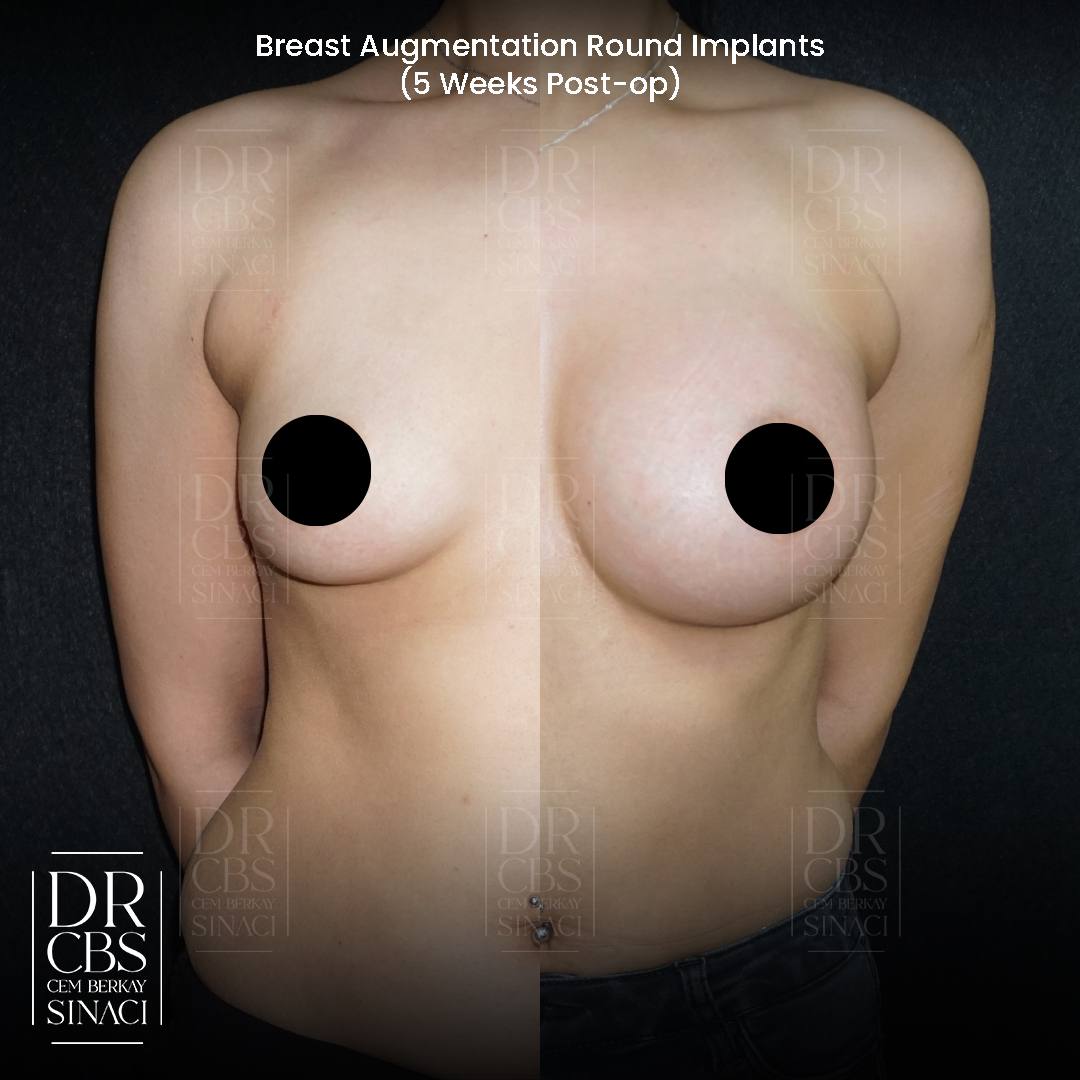
Before and after hybrid breast augmentation with subfascial implants and upper pole fat grafting at five weeks. Dr. CBS corrects mild ptosis in Istanbul.


Patient Overview
Patient: Natalie
Age: 35 years old
Gender: Female
Procedures: Hybrid breast augmentation (subfascial silicone implants with fat grafting to upper pole)
After photos taken at: 5 weeks post-surgery
Location: Istanbul, Turkey
Why the Upper Pole Is Where Augmentation Gets Exposed
The upper pole of the breast — the region between the nipple and the clavicle — is where breast augmentation either succeeds as invisible or fails as obvious. This is the zone where tissue coverage is naturally thinnest, where the implant edge sits closest to the skin surface, and where any abrupt transition between the device and the chest wall becomes visible to even the untrained eye. In patients with mild breast ptosis, the upper pole challenge is compounded: the natural tissue has descended, leaving even less native coverage in the area where it matters most.
Natalie, a thirty-five-year-old patient of Dr. Cem Berkay Sinaci, presented with mild breast ptosis and thin upper pole tissue — a combination that made standard implant-only augmentation insufficient for achieving the naturally undetectable result she wanted. Dr. Sinaci's solution was hybrid breast augmentation: subfascial silicone implants for core volume and structural support, combined with targeted fat grafting to the upper pole to create the soft tissue layer that nature had not provided in adequate thickness.
Dr. Sinaci, a European board-certified plastic surgeon (FEBOPRAS) and active member of ISAPS and ASPS, uses the hybrid breast augmentation technique selectively for patients whose anatomy presents this specific combination of challenges — where the implant alone would be palpable or visible in the upper breast, and where the patient's own harvested fat can provide the missing coverage.
The Ptosis Problem and the Subfascial Solution
Natalie's mild breast ptosis — a degree of glandular descent where the nipple remains near the inframammary fold but the breast tissue has shifted downward — directly influenced the choice of surgical plane. Under muscle or dual plane placement in a breast with existing ptosis creates the conditions for waterfall deformity, where the muscle pins the implant high while the natural tissue continues to hang below it, producing a divided, double-contour appearance.
The subfascial plane eliminates this risk by keeping the implant in the same anatomical compartment as the breast gland. Positioned above the muscle but beneath the pectoralis fascia, the implant and the breast tissue move and age as a single unit. The implant's volume pushes the mildly ptotic gland upward and forward, producing an internal lifting effect that restores upper pole fullness and improves breast position without the additional scars of a formal mastopexy.
For Natalie, the subfascial plane solved the ptosis equation. But it introduced the coverage equation: without the pectoralis muscle draping over the upper implant, the soft tissue between the implant and the skin in the upper pole consisted only of the thin fascia, a modest layer of breast tissue, and subcutaneous fat. In a patient with already thin upper pole coverage, this was not enough to fully camouflage the implant's superior edge.
Targeted Fat Grafting: Solving the Coverage Gap
This is where the hybrid component of Natalie's procedure transformed a good result into an exceptional one. Rather than accepting visible implant edges in the upper pole as an unavoidable trade-off of subfascial placement, Dr. Sinaci added a precisely placed layer of the patient's own fat over the upper portion of the implant.
The fat was harvested from a donor site using gentle liposuction, processed to isolate viable adipocytes, and injected in thin, carefully distributed layers across the upper pole. This grafted fat sits between the implant and the skin, functioning as a biological cushion that softens the transition from chest wall to implant to breast surface. The result is an upper pole that slopes gently from the clavicle into the breast mound — the smooth, gradual curve that characterises a natural breast — rather than showing the abrupt step-off that a visible implant edge creates.
The precision of upper pole fat grafting demands a surgeon's understanding of exactly where and how much fat to place. Too little grafting fails to adequately camouflage the implant. Too much can create an unnaturally full upper breast or produce palpable irregularities if the fat is deposited in large boluses rather than fine layers. Dr. Sinaci's technique for fat placement was refined during his fellowship with the internationally renowned plastic surgeon Raul Gonzalez in Brazil, where fat grafting is considered a fundamental surgical skill and its application in breast surgery has been developed to an extraordinary level of precision.
Five Weeks: Where Both Components Meet Their Milestone
Natalie's five-week photographs capture a moment where both elements of the hybrid augmentation have reached significant maturity. The timing is particularly informative because the implant settling and the fat graft stabilisation follow overlapping but distinct biological timelines.
The subfascial implant at five weeks has completed the majority of its settling. Without the muscular accommodation that dual plane or submuscular placement requires, subfascial implants typically reach near-final position earlier in the recovery timeline. The pocket has stabilised, the fascia has adapted to the implant volume, and the breast shape closely approximates the final contour. The mild lifting effect on Natalie's ptotic tissue is well established — the breast sits higher and fuller on the chest wall than it did preoperatively.
The fat graft at five weeks has passed through the critical survival phase. The transferred fat cells have either established their vascular connections and integrated into the upper pole tissue, or failed to revascularise and been reabsorbed. The volume that Natalie's upper pole shows at five weeks is very close to the permanent volume — the biological selection process is essentially complete, and what remains is living tissue that will persist indefinitely.
The combined effect is visible in how the upper pole presents. There is no palpable implant edge, no visible step-off at the superior border of the device, and no abrupt transition from chest wall to breast. The fat layer creates a smooth, natural slope that reads as entirely biological — because it is. The implant provides the volume; the fat provides the disguise.
Hybrid Augmentation Versus Implant-Only: When Each Is Appropriate
Not every breast augmentation patient needs hybrid technique. Women with adequate native soft tissue coverage — generous subcutaneous fat and breast tissue thickness throughout the breast — can achieve excellent results with implants alone. The additional step of fat harvesting, processing, and grafting introduces operative time, a donor site with its own recovery, and the biological variability of fat graft survival. These are justified only when the clinical benefit is clear.
The patients who benefit most from hybrid breast augmentation share characteristics that Natalie exemplifies: thin soft tissue coverage in the upper pole, a desire for maximally natural results where implant detection is unacceptable, and adequate fat stores at a donor site to provide the grafting material. The mild ptosis that necessitated subfascial rather than submuscular placement further strengthened the indication, as the absence of muscle coverage made the upper pole fat grafting even more valuable.
Conversely, a patient with thick tissue, no ptosis, and submuscular placement has three layers of natural camouflage — muscle, fascia, and breast tissue — making additional fat grafting redundant. The surgical decision tree must evaluate each patient individually, matching technique complexity to anatomical need.
The Donor Site Benefit
Natalie's fat harvesting site provides a secondary aesthetic benefit that contributes to overall body harmony. The liposuction required to collect the grafting material removes unwanted fat from an area of excess, producing a contouring effect at the donor site that complements the breast enhancement. By five weeks, the donor site has healed, any localised swelling from the liposuction has largely resolved, and the slimmer contour is beginning to show.
This dual benefit — enhanced breasts and a refined donor area — means that hybrid breast augmentation delivers body-wide improvement through a single recovery period. The fat that was contributing to an unwanted contour in one location has been relocated to serve a functional and aesthetic purpose in another.
Hybrid Breast Augmentation in Istanbul
Natalie's five-week before and after result demonstrates the refinement that hybrid breast augmentation brings to cases where implants alone would leave a detectable trace. The subfascial plane addresses her mild ptosis by keeping implant and tissue unified, while the targeted upper pole fat grafting solves the coverage deficit that subfascial placement exposes. For patients researching breast augmentation in Istanbul who are concerned about implant visibility or who have been told their tissue is too thin for a natural-looking result, understanding that hybrid breast augmentation exists as a solution — combining the reliable volume of silicone implants with the biological camouflage of the patient's own fat — may change the conversation entirely.