
Tummy Tuck Using C-Section Scar at 5 Weeks | Kelly
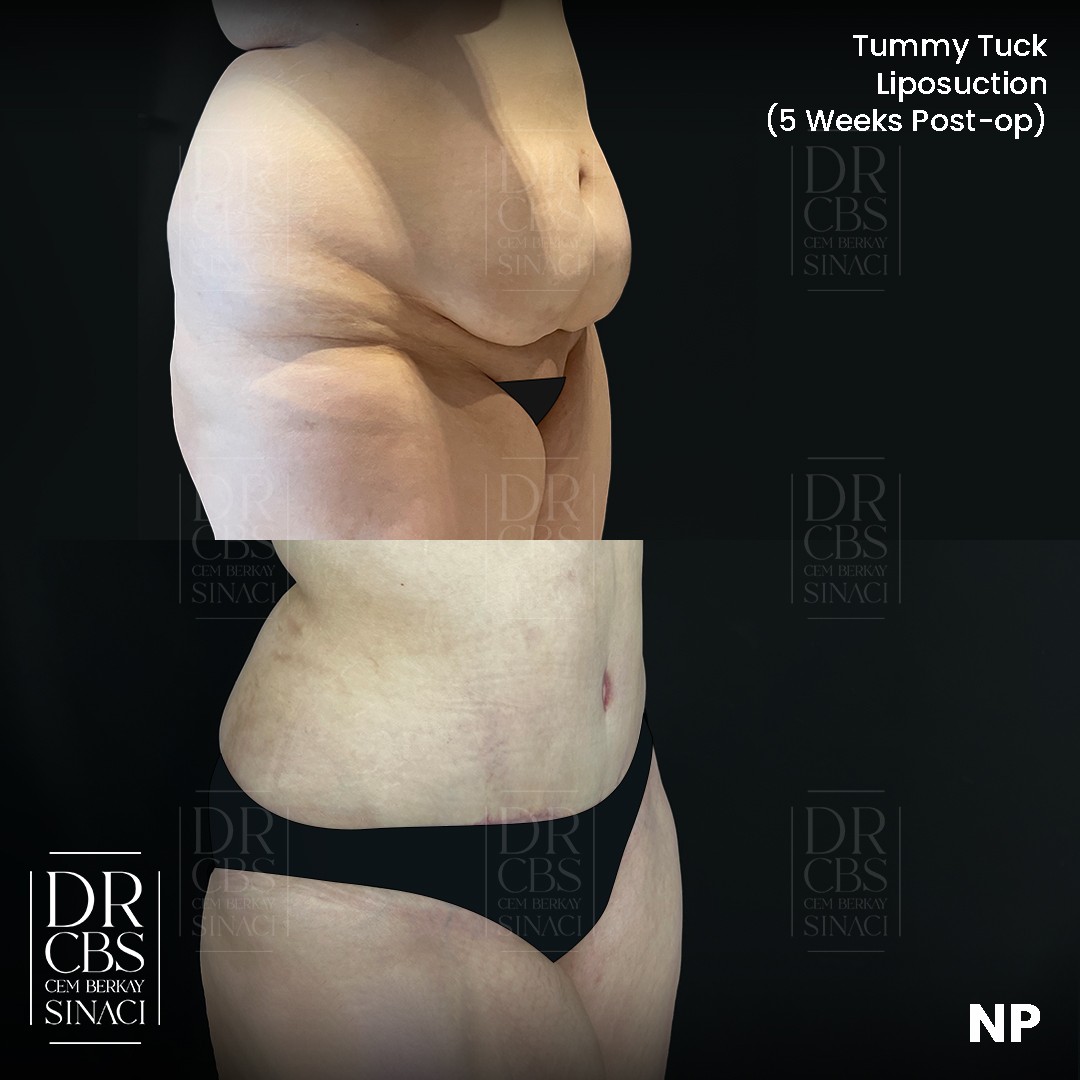
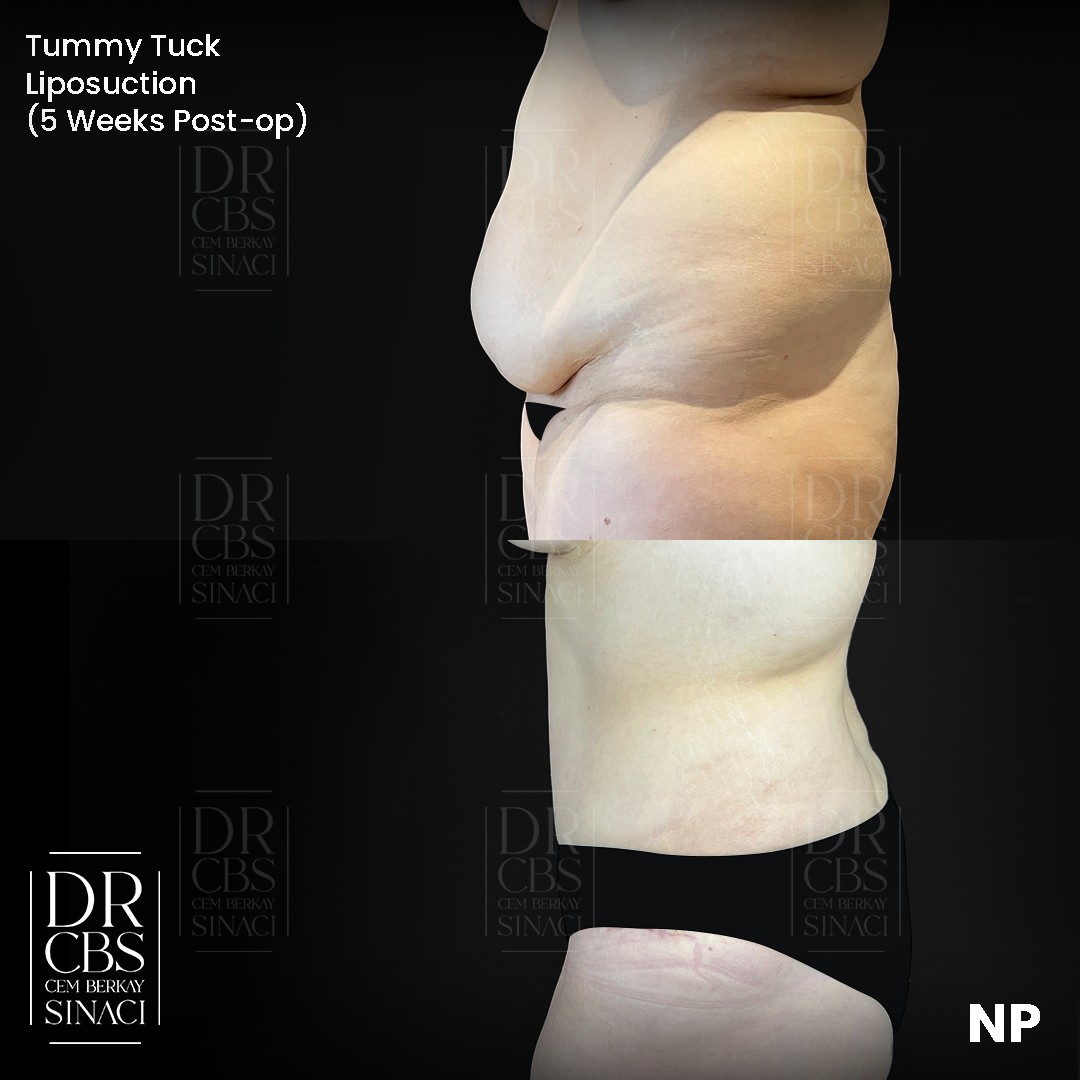
Tummy tuck and liposuction before and after at 5 weeks. Previous C-section scar used for abdominoplasty incision. Dr. Cem Berkay Sinaci, Istanbul, Turkey.

Patient Overview
Age range: 40–45 years old
Gender: Female
Procedures: Full abdominoplasty with liposuction (lipo-abdominoplasty)
After photos taken at: 5 weeks post-surgery
Previous surgical history: Cesarean section
Case Description
Kelly traveled to Istanbul for lipo-abdominoplasty to address the abdominal changes left behind after pregnancy and cesarean delivery. Beyond the typical concerns of loose skin and resistant fat deposits, she carried an additional consideration that many mothers in her situation share: an existing C-section scar. One of her first questions during the consultation was whether the tummy tuck would add a second scar to her abdomen. The answer — and this is something many prospective patients are relieved to learn — is no.
Using the C-Section Scar for Abdominoplasty
A cesarean section leaves a horizontal scar in the lower abdomen, typically sitting just above the pubic area. A tummy tuck incision follows a very similar path along the lower abdomen. In patients who have a previous C-section scar, the abdominoplasty incision is designed to incorporate and replace it entirely.
Here is how this works in practice. The tummy tuck incision is placed along the same horizontal plane as the existing C-section scar, extending further laterally toward the hips to allow adequate skin removal and contouring. The old scar tissue — along with all the excess skin above it — is excised as part of the procedure. When the remaining skin is redraped and the incision is closed, the result is a single, clean scar line in place of the old one. The patient does not walk away with two scars. She walks away with one that is typically longer than the original C-section scar but sits in the same concealed position and is closed under far more controlled surgical conditions.
In many cases, the new scar actually heals better than the original cesarean scar did. C-section closures are performed at the end of a delivery — a setting where the priority is the baby, not the aesthetics of the incision. The closure is often done quickly and under suboptimal conditions. A tummy tuck closure, by contrast, is performed with meticulous attention to tension distribution, layered suturing, and precise skin alignment. The result is often a thinner, flatter scar than the one it replaced.
What a C-Section Does to the Abdominal Wall
The cesarean incision cuts through multiple layers of tissue: skin, subcutaneous fat, fascia, and the muscle layer itself. While these layers heal, they often do so with internal scar tissue (adhesions) that tethers the skin to the deeper structures. This is what creates the characteristic C-section shelf — that indentation or ledge above the scar where the skin is pulled inward and a roll of tissue sits above it.
This shelf is not simply excess fat. It is a structural problem caused by the adhesion of skin to the underlying fascia. Diet and exercise cannot release these adhesions, which is why the shelf persists regardless of how much weight a patient loses. During lipo-abdominoplasty, these adhesions are released as part of the surgical dissection, the tethered skin is freed, and the entire lower abdominal skin is removed. The result eliminates both the shelf and the scar in one step.
Kelly had this characteristic C-section shelf, and its resolution is clearly visible when comparing her before and after photographs. The indentation is gone, replaced by a smooth, continuous abdominal contour.
Results at 5 Weeks
At five weeks post-surgery, Kelly's result shows the emerging final shape. The abdominal profile is flat and the waistline is defined. The C-section shelf has been completely eliminated. The new scar sits low and is still in its early healing phase — pink and slightly raised — but is already cleaner and more uniform than the original cesarean scar was.
Five weeks falls in the transitional zone between the early recovery period and the return to full activity. Most of the pronounced swelling from the first month has subsided, and the contour of the liposuction is becoming visible along the flanks. The lower abdomen still carries some residual firmness and mild swelling that fluctuates throughout the day, and this will continue to diminish over the next two to three months.
At this stage, Kelly had resumed all normal daily activities and was preparing to begin a gradual return to exercise. The tissues feel noticeably more comfortable and flexible than they did at the three- and four-week marks, and most patients report that this is the period where the recovery starts to feel genuinely easy rather than something they are managing.
Surgeon's Note
Kelly's case highlights a question I hear in nearly every consultation with mothers who have had a cesarean delivery: will I have another scar? It is one of the most common anxieties, and one of the easiest to resolve. Not only does the tummy tuck not add a second scar — it actively improves the existing one. The old C-section scar, often wide, irregular, or depressed, is completely excised and replaced with a carefully closed surgical incision that is designed to heal as inconspicuously as possible.
The other aspect of this case that I find worth emphasizing is the C-section shelf. Many women do not realize that the persistent bulge above their cesarean scar is caused by internal adhesions rather than fat. They assume they need to lose more weight or do more exercise, and they become frustrated when nothing changes. Understanding that this is a structural issue — scar tissue binding the skin to the fascia — helps explain why surgery is the only effective solution and why the improvement after release is so immediate and visible.
Technically, operating on a patient with a previous C-section requires careful attention during the dissection phase. The adhesions between the skin and the fascia must be released methodically to avoid damaging the blood supply to the remaining skin flap. Once these adhesions are freed, the surgery proceeds as a standard lipo-abdominoplasty, with the advantage that the old scar has already marked the path for the new incision.
Frequently Asked Questions
Will a tummy tuck give me a second scar on top of my C-section scar?
No. The tummy tuck incision is placed along the same line as the existing C-section scar. The old scar is removed along with the excess lower abdominal skin, and the new incision is closed in its place. You end up with one scar, not two. The new scar extends further toward the hips than the original cesarean scar, but it sits in the same low position and is designed to be hidden by underwear and swimwear.
What is the C-section shelf and can it be removed?
The C-section shelf is the bulge or ledge of tissue that sits just above a cesarean scar. It is caused by internal scar tissue (adhesions) that tethers the skin to the deeper abdominal structures, creating an indentation at the scar line with tissue protruding above it. Diet and exercise cannot correct this because the cause is structural, not related to body fat. During a tummy tuck, these adhesions are surgically released and the overlying skin is removed, completely eliminating the shelf.
Is a tummy tuck more complicated if I have had a C-section?
A previous C-section does not significantly increase the complexity or risk of a tummy tuck. The surgeon must carefully release the adhesions left by the cesarean incision during the dissection, which adds a small amount of time but is a routine part of the procedure for any experienced abdominoplasty surgeon. In fact, having a prior C-section can be considered an advantage in one respect: the scar pathway is already established, and the patient is already familiar with the general location and appearance of a low abdominal incision.
How long after a C-section can I have a tummy tuck?
Most surgeons recommend waiting a minimum of 12 months after a cesarean delivery, and ideally until you have finished breastfeeding and your weight has stabilized. This ensures that the abdominal tissues have fully healed from the delivery, hormonal changes have normalized, and you are at a stable baseline weight — all of which contribute to the best possible surgical result and recovery.
Will the tummy tuck scar look better than my C-section scar?
In most cases, yes. A C-section closure is performed in a delivery setting where cosmetic precision is not the priority. A tummy tuck closure is performed under controlled surgical conditions with meticulous attention to tension, layered suturing, and skin edge alignment. Many patients find that their abdominoplasty scar heals thinner, flatter, and more uniform than their original cesarean scar ever was.