
Face & Neck Aesthetics
Breast & Body Aesthetics
Nose Job
Non-surgical
Patient Resources

Chin Lipo & Thread Lift Day 1 | Healing Guide, Age 33
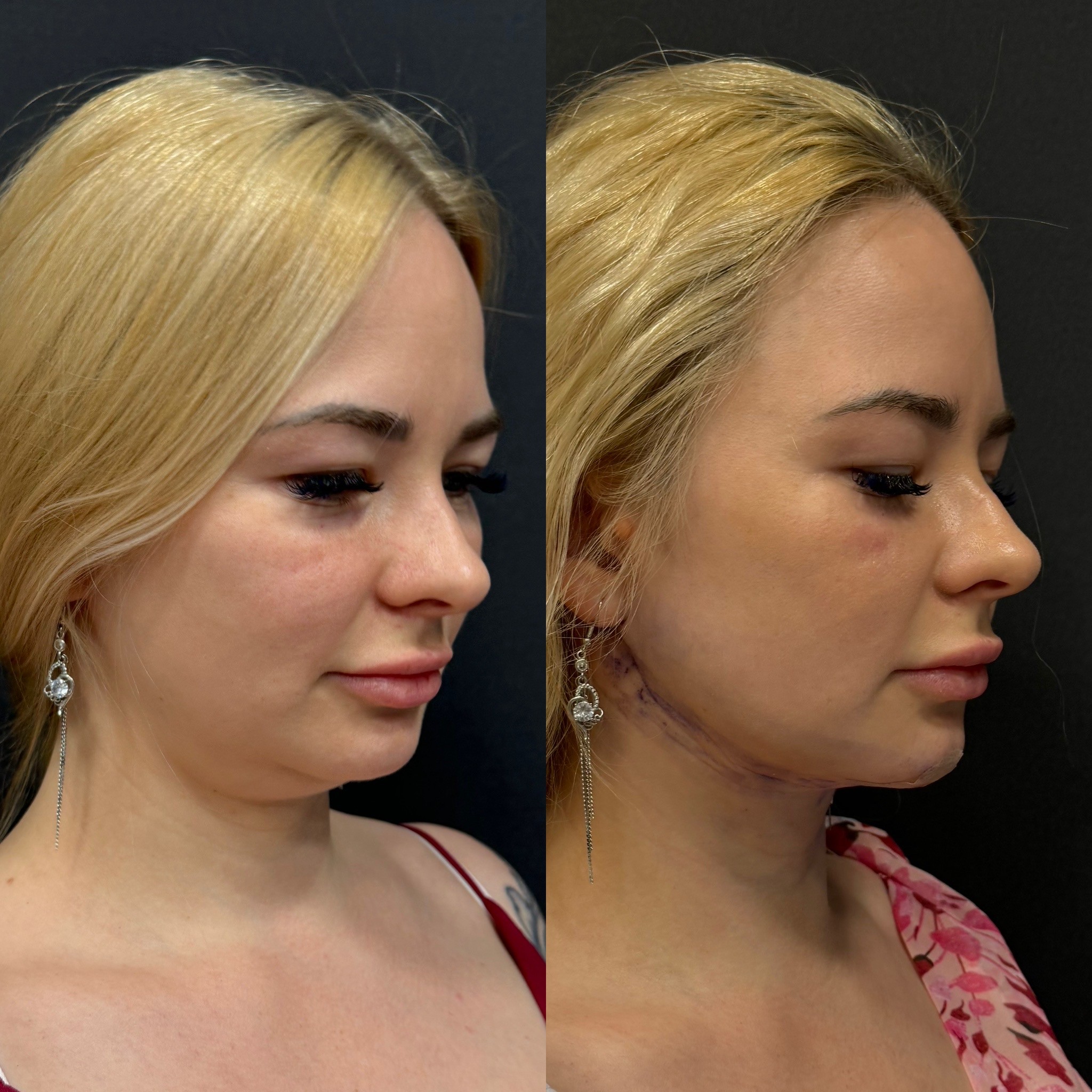
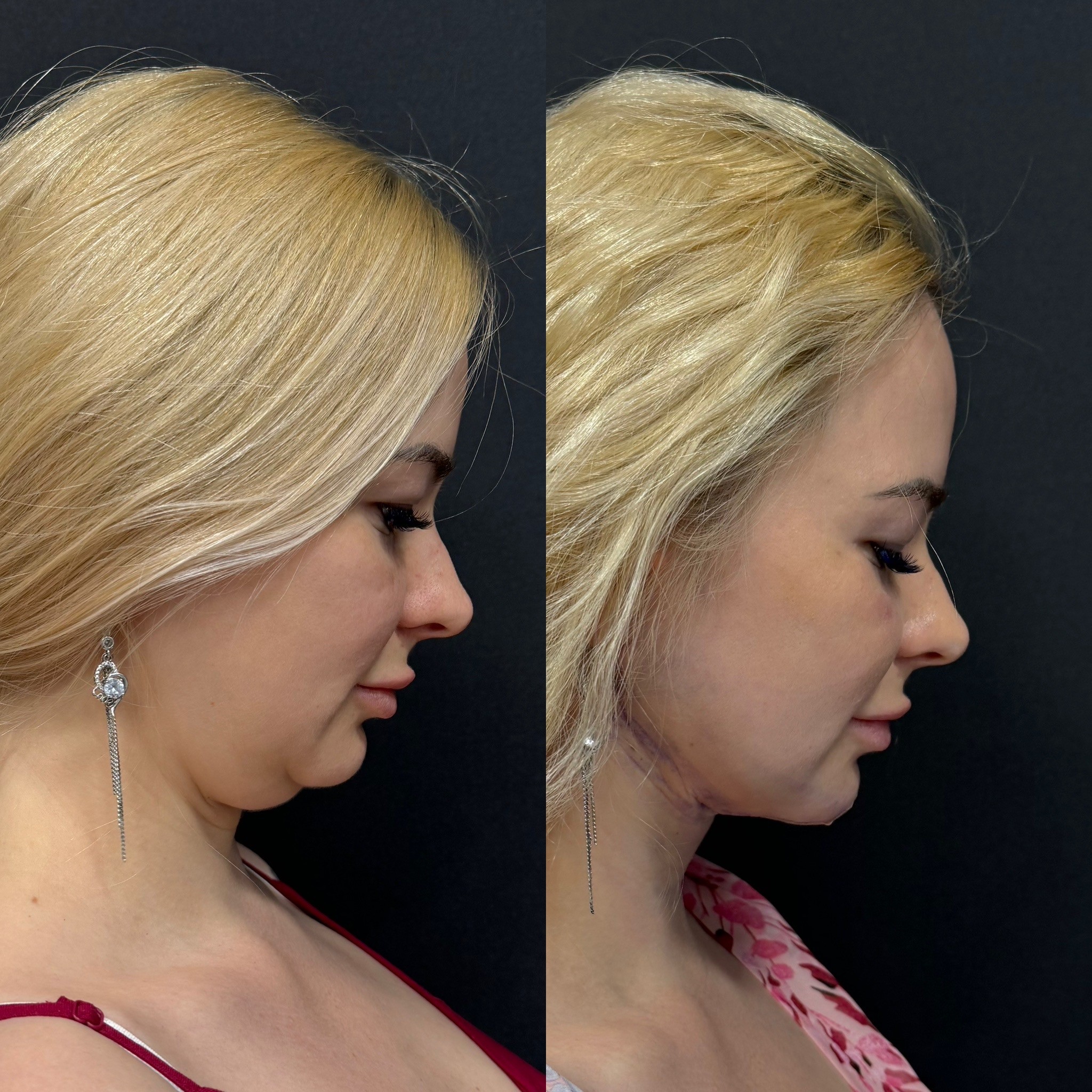
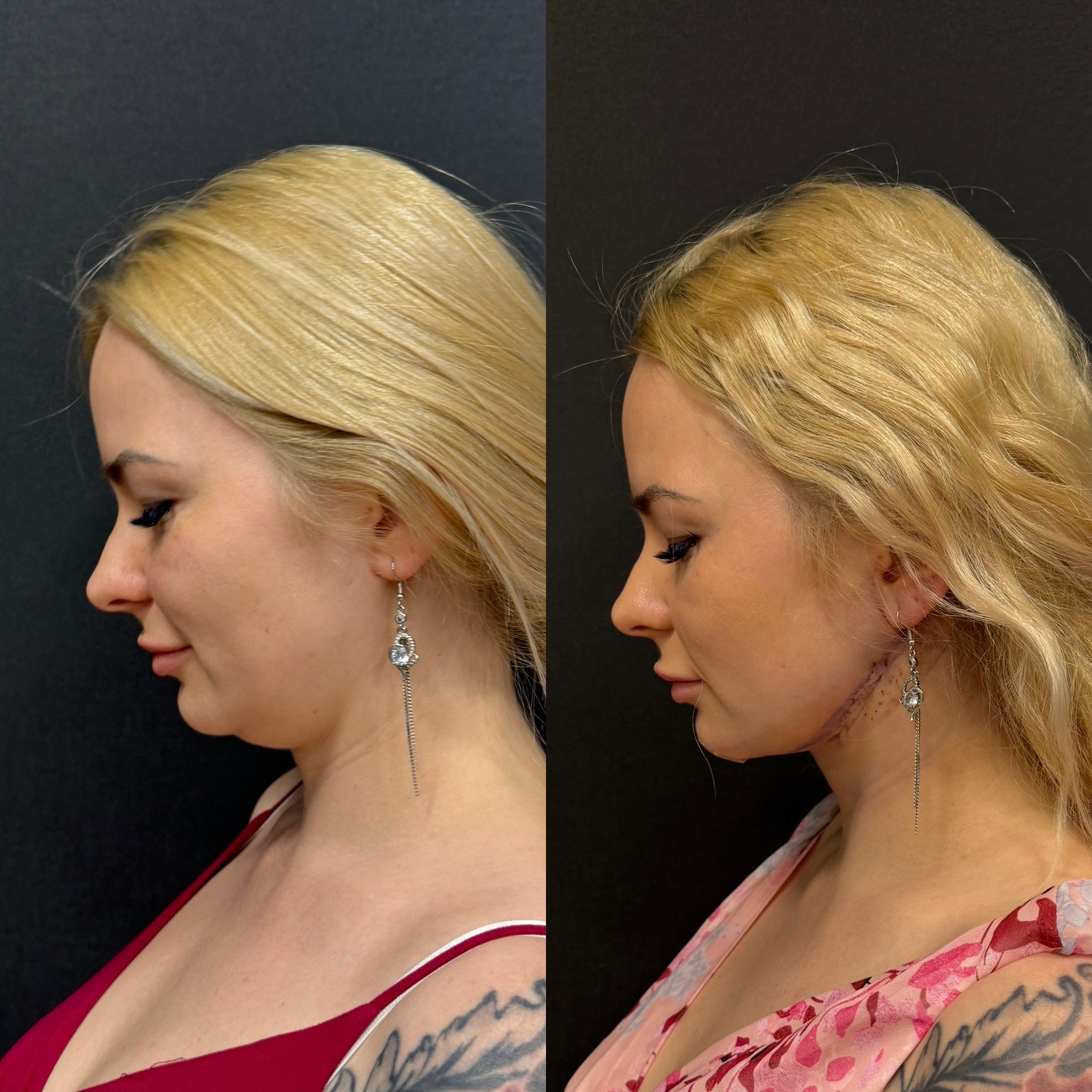
Chin liposuction with thread lift day 1 before and after. Dimpling and surgical markings are normal and temporary. Neck rejuvenation by Dr. Sinaci, Istanbul.
Patient Overview
Patient: Ingrid
Age: 33 years old
Gender: Female
Procedures: Laser liposuction of the submental area, thread lift of the jawline and neck
After photos taken at: 1 day post-procedure
Case Description
Ingrid's case is documented at day one — the earliest post-procedure point in our chin liposuction and thread lift gallery. Her photographs show the treated area approximately 24 hours after the procedure was completed, capturing a stage that looks clinical, raw, and unfamiliar. Blue surgical markings are still visible on the skin. Thread-related dimpling is present along the jawline. Mild swelling has begun to develop. To someone unfamiliar with the procedure, these photographs might look concerning. To someone who understands what they are seeing, they look exactly right.
We include this case for the same reason we include all of our early recovery documentation: because what patients experience in the first 48 hours shapes their emotional relationship with the entire recovery. Patients who recognize these early findings as normal feel confident. Patients who do not recognize them feel afraid. The difference between those two experiences is information.
The Blue Surgical Markings
The most visually striking feature of Ingrid's day-one photographs — and often the first thing patients notice in their own mirror the morning after the procedure — are the blue or purple lines drawn on the skin. These are surgical planning markings applied before the procedure begins, and they serve a critical purpose during the operation.
Before any anesthesia is administered, the surgeon marks the treatment area with the patient sitting upright. This is essential because the anatomy shifts when the patient lies down — fat redistributes, skin drapes differently, and the jawline contour changes under the influence of gravity. Marking while the patient is seated captures the true anatomical landmarks: the mandibular border, the extent of the submental fat pad, the planned vectors for thread placement, and the locations of the access incisions.
During the procedure itself, these markings serve as a roadmap. They guide the liposuction cannula to ensure even fat removal across the entire treatment area. They define the thread insertion trajectories to ensure symmetrical lifting. They mark anatomical danger zones — the path of the marginal mandibular nerve, the position of the submandibular glands — that must be avoided.
The markings are made with a surgical skin marker designed to be semi-permanent — it needs to survive the application of antiseptic solution and the procedure itself without rubbing off. This durability means the marks do not wash away easily after the procedure either. They typically fade over two to four days with normal washing. Gentle cleansing with soap and water during showers gradually removes them. Some patients find that micellar water or oil-based makeup remover accelerates the process.
The markings have zero effect on healing, leave no permanent marks on the skin, and are purely superficial. But seeing blue lines on your neck the morning after a cosmetic procedure can be psychologically jarring if you were not expecting them — which is precisely why we document them.
Day 1 Dimpling: Even Earlier Than Evelyn's Day 2
We documented dimpling in detail in Evelyn's day-two case. Ingrid's day-one photographs show dimpling at an even earlier stage — when the thread barbs are at their firmest initial engagement with the tissue and the surrounding soft tissue has had the least time to adapt.
At day one, the dimpling may appear more pronounced than it will at day two or three. This seems counterintuitive, but there is a logical explanation. In the first 24 hours, swelling has not yet fully developed. The tissue around the threads has not yet begun to accumulate the mild edema that naturally fills in the surface depressions. By days two to three, the developing swelling actually softens the appearance of the dimples even before the tissue accommodation process begins. So the visual trajectory of dimpling is often: most visible at day one, slightly softened by days two to three as swelling fills in around them, then progressively resolving from day four onward as true tissue accommodation takes over.
Ingrid at 33 has excellent tissue thickness and skin quality, which predicts rapid dimpling resolution. The thicker the soft tissue between the thread and the skin surface, the faster the surface irregularities smooth out. In patients with Ingrid's tissue characteristics, complete dimpling resolution typically occurs within five to seven days rather than the full seven to ten day window.
A Complete Day-One Inventory: What Is Normal
For patients waking up the morning after chin liposuction with thread lift, Ingrid's case provides a comprehensive visual checklist of normal day-one findings. Each of the following is present in her photographs and is entirely expected.
Surgical markings on the skin — blue or purple lines mapping the treatment plan. These are cosmetic, superficial, and fade within two to four days with normal washing.
Thread-related dimpling — small puckers or depressions along the jawline and neck where the thread barbs are engaging the tissue. These resolve within seven to ten days without any intervention.
Mild swelling — a subtle puffiness developing beneath the chin and along the jawline. This will increase slightly over days two to three before beginning to subside. It is the body's normal inflammatory response to tissue manipulation.
Tightness — the neck feels stiff and restricted, particularly when turning the head or looking upward. This is caused by the combination of swelling, the compression garment, and the tissue adjusting to the threads and the liposuction. It eases progressively over the first week.
Slight bruising — if present, it typically appears as faint discoloration along the jawline or beneath the chin. Not all patients bruise visibly. When bruising does occur, it transitions through color changes over seven to fourteen days and resolves completely.
Numbness or altered sensation — the treated area may feel partially numb, tingly, or hypersensitive. This is caused by temporary disruption of the fine sensory nerves during liposuction and thread insertion. Normal sensation returns gradually over four to eight weeks.
Small adhesive strips or sutures at the access points — the tiny incision sites beneath the chin or behind the earlobes will have closures in place. These are removed or fall off naturally within five to seven days.
None of these findings requires treatment. None indicates a problem. All are temporary. Having this inventory before the procedure allows patients to check off each finding they observe rather than worrying about each one individually.
Why 33 Is an Excellent Age for This Combination
Ingrid at 33 is among the younger patients in our neck contouring gallery, and her age works strongly in her favor for several reasons.
Collagen production at 33 is still robust. The body's ability to produce new collagen begins to decline around age 25 and accelerates after 40. At 33, Ingrid's collagen synthesis is active enough that both the laser-stimulated skin tightening and the thread-stimulated collagen deposition along the suture pathways will produce a strong biological response. This means more durable skin tightening and longer-lasting structural support from the threads compared to the same procedures performed fifteen or twenty years later.
Skin elasticity at 33 is still high. The elastic fiber network in the dermis — the component responsible for the skin's ability to snap back after stretching — remains largely intact at this age. This means the skin will retract smoothly and completely after the submental fat is removed, with the laser energy providing supplementary tightening on top of an already favorable baseline.
Tissue healing at 33 is efficient. The inflammatory phase is appropriately brisk, the proliferative phase is robust, and the remodeling phase produces well-organized collagen. Practically, this translates to faster resolution of swelling, faster dimpling resolution, and a faster timeline to the final result.
These biological advantages do not mean every 33-year-old needs or should seek neck contouring. They mean that when a genuine anatomical concern exists — as it did in Ingrid's case — addressing it at this age produces optimal tissue response and the longest-lasting result.
What Happens Between Day 1 and Day 7
For patients looking at Ingrid's photographs and wondering what the coming week holds, here is the day-by-day evolution they can expect.
Day one is what Ingrid's photographs show — surgical markings, early dimpling, the beginning of swelling, and a neck that feels tight and unfamiliar. The structural improvement is already present beneath these temporary findings.
Day two brings increased swelling — this is typically the point where patients feel most swollen and notice the most puffiness. The dimpling may appear slightly softer as the edema fills in around the thread points. Bruising, if it will develop, usually becomes visible.
Day three is often the peak of swelling. The neck may feel at its tightest. Paradoxically, this is also the day many patients begin to relax emotionally, because they can feel that the worst of the acute phase has arrived and understand that improvement begins from here.
Day four marks the turning point. Swelling begins to decrease noticeably. Dimpling continues to soften. Bruising starts its color transition. Movement becomes more comfortable.
Day five to six brings visible daily improvement. Patients notice the neck looking different — better — each morning. The surgical markings, if any remnants remain, are nearly gone. The jawline is starting to show through the diminishing swelling.
Day seven feels like a new baseline. Most of the acute recovery is behind the patient. The dimpling has resolved or is minimal. Swelling has reduced substantially. The chin strap transitions to nighttime wear. Most patients feel confident appearing in public without concealment.
Surgeon's Note
Ingrid's day-one documentation fills the earliest slot in our thread lift recovery timeline. Together with Evelyn's day two and Ribak's same-day result, we now have the first 48 hours covered from three different perspectives. Each case shows the same normal findings — markings, dimpling, early swelling — in a slightly different patient and at a slightly different moment, reinforcing that these findings are universal rather than individual.
At 33, Ingrid represents the younger end of our thread lift patient population, and her tissue quality at day one already suggests an excellent trajectory. The dimpling, while visible, is shallow — consistent with thick, well-vascularized tissue that will accommodate the threads quickly. The swelling is mild and well-distributed, without any localized fluid collections. The access points are clean. Everything about her day-one presentation is consistent with uneventful, textbook healing.
What I want prospective patients to understand from this case is that day one does not look glamorous, and it is not supposed to. The blue markings, the dimples, the swelling — they are the evidence of a procedure that was planned meticulously, executed carefully, and is now healing normally. The result emerges over the following weeks as each of these temporary features resolves. By the time the last trace of swelling clears and the collagen remodeling matures, what remains is the clean, defined jawline and neck contour that the procedure was designed to create.
Frequently Asked Questions
How long do the blue surgical markings last after a neck procedure?
Surgical markings typically fade within two to four days with normal daily washing. They are made with semi-permanent surgical markers designed to survive the antiseptic preparation and the procedure itself, which means they are intentionally resistant to quick removal. Gentle cleansing with soap and water is usually sufficient. Oil-based makeup removers or micellar water can help remove stubborn marks more quickly. The markings are completely superficial and leave no lasting marks on the skin.
What should I avoid doing on day 1 after chin lipo and thread lift?
On day one, avoid touching, pressing, or massaging the treated area. Do not remove or adjust the compression chin strap unless instructed by your surgeon. Avoid bending forward or looking down for extended periods, as this increases blood flow to the treated area and can worsen swelling. Sleep with your head elevated on two to three pillows. Avoid hot beverages and hot foods for the first 24 hours, as heat can increase swelling. Do not take aspirin or anti-inflammatory medications unless specifically approved by your surgeon, as they can increase bruising risk.
Is it normal to feel anxious when looking at my neck on day 1?
Completely normal. The combination of surgical markings, dimpling, swelling, and unfamiliar tightness makes the treated area look and feel nothing like the result you are expecting. This visual disconnect between what you see and what you were hoping for is a nearly universal experience in the first two days. Understanding that every finding you are observing is temporary and expected is the most effective way to manage this anxiety. Comparing your appearance to documented day-one cases like this one can provide reassurance that your healing is on track.
When should I contact my surgeon after the procedure?
Routine day-one findings — swelling, dimpling, tightness, mild bruising, surgical markings, and altered sensation — do not require contacting the surgeon. You should contact the clinic if you experience severe or rapidly increasing pain that is not controlled by the prescribed medication, significant asymmetric swelling where one side is markedly more swollen than the other, fever above 38 degrees Celsius, active bleeding from the incision sites that does not stop with gentle pressure, or any finding that feels distinctly different from what was described during your preoperative instructions. When in doubt, contacting the clinic is always appropriate — the surgical team would rather reassure you unnecessarily than have you worry silently about something that concerns you.
Patient Overview
Patient: Ingrid
Age: 33 years old
Gender: Female
Procedures: Laser liposuction of the submental area, thread lift of the jawline and neck
After photos taken at: 1 day post-procedure
Case Description
Ingrid's case is documented at day one — the earliest post-procedure point in our chin liposuction and thread lift gallery. Her photographs show the treated area approximately 24 hours after the procedure was completed, capturing a stage that looks clinical, raw, and unfamiliar. Blue surgical markings are still visible on the skin. Thread-related dimpling is present along the jawline. Mild swelling has begun to develop. To someone unfamiliar with the procedure, these photographs might look concerning. To someone who understands what they are seeing, they look exactly right.
We include this case for the same reason we include all of our early recovery documentation: because what patients experience in the first 48 hours shapes their emotional relationship with the entire recovery. Patients who recognize these early findings as normal feel confident. Patients who do not recognize them feel afraid. The difference between those two experiences is information.
The Blue Surgical Markings
The most visually striking feature of Ingrid's day-one photographs — and often the first thing patients notice in their own mirror the morning after the procedure — are the blue or purple lines drawn on the skin. These are surgical planning markings applied before the procedure begins, and they serve a critical purpose during the operation.
Before any anesthesia is administered, the surgeon marks the treatment area with the patient sitting upright. This is essential because the anatomy shifts when the patient lies down — fat redistributes, skin drapes differently, and the jawline contour changes under the influence of gravity. Marking while the patient is seated captures the true anatomical landmarks: the mandibular border, the extent of the submental fat pad, the planned vectors for thread placement, and the locations of the access incisions.
During the procedure itself, these markings serve as a roadmap. They guide the liposuction cannula to ensure even fat removal across the entire treatment area. They define the thread insertion trajectories to ensure symmetrical lifting. They mark anatomical danger zones — the path of the marginal mandibular nerve, the position of the submandibular glands — that must be avoided.
The markings are made with a surgical skin marker designed to be semi-permanent — it needs to survive the application of antiseptic solution and the procedure itself without rubbing off. This durability means the marks do not wash away easily after the procedure either. They typically fade over two to four days with normal washing. Gentle cleansing with soap and water during showers gradually removes them. Some patients find that micellar water or oil-based makeup remover accelerates the process.
The markings have zero effect on healing, leave no permanent marks on the skin, and are purely superficial. But seeing blue lines on your neck the morning after a cosmetic procedure can be psychologically jarring if you were not expecting them — which is precisely why we document them.
Day 1 Dimpling: Even Earlier Than Evelyn's Day 2
We documented dimpling in detail in Evelyn's day-two case. Ingrid's day-one photographs show dimpling at an even earlier stage — when the thread barbs are at their firmest initial engagement with the tissue and the surrounding soft tissue has had the least time to adapt.
At day one, the dimpling may appear more pronounced than it will at day two or three. This seems counterintuitive, but there is a logical explanation. In the first 24 hours, swelling has not yet fully developed. The tissue around the threads has not yet begun to accumulate the mild edema that naturally fills in the surface depressions. By days two to three, the developing swelling actually softens the appearance of the dimples even before the tissue accommodation process begins. So the visual trajectory of dimpling is often: most visible at day one, slightly softened by days two to three as swelling fills in around them, then progressively resolving from day four onward as true tissue accommodation takes over.
Ingrid at 33 has excellent tissue thickness and skin quality, which predicts rapid dimpling resolution. The thicker the soft tissue between the thread and the skin surface, the faster the surface irregularities smooth out. In patients with Ingrid's tissue characteristics, complete dimpling resolution typically occurs within five to seven days rather than the full seven to ten day window.
A Complete Day-One Inventory: What Is Normal
For patients waking up the morning after chin liposuction with thread lift, Ingrid's case provides a comprehensive visual checklist of normal day-one findings. Each of the following is present in her photographs and is entirely expected.
Surgical markings on the skin — blue or purple lines mapping the treatment plan. These are cosmetic, superficial, and fade within two to four days with normal washing.
Thread-related dimpling — small puckers or depressions along the jawline and neck where the thread barbs are engaging the tissue. These resolve within seven to ten days without any intervention.
Mild swelling — a subtle puffiness developing beneath the chin and along the jawline. This will increase slightly over days two to three before beginning to subside. It is the body's normal inflammatory response to tissue manipulation.
Tightness — the neck feels stiff and restricted, particularly when turning the head or looking upward. This is caused by the combination of swelling, the compression garment, and the tissue adjusting to the threads and the liposuction. It eases progressively over the first week.
Slight bruising — if present, it typically appears as faint discoloration along the jawline or beneath the chin. Not all patients bruise visibly. When bruising does occur, it transitions through color changes over seven to fourteen days and resolves completely.
Numbness or altered sensation — the treated area may feel partially numb, tingly, or hypersensitive. This is caused by temporary disruption of the fine sensory nerves during liposuction and thread insertion. Normal sensation returns gradually over four to eight weeks.
Small adhesive strips or sutures at the access points — the tiny incision sites beneath the chin or behind the earlobes will have closures in place. These are removed or fall off naturally within five to seven days.
None of these findings requires treatment. None indicates a problem. All are temporary. Having this inventory before the procedure allows patients to check off each finding they observe rather than worrying about each one individually.
Why 33 Is an Excellent Age for This Combination
Ingrid at 33 is among the younger patients in our neck contouring gallery, and her age works strongly in her favor for several reasons.
Collagen production at 33 is still robust. The body's ability to produce new collagen begins to decline around age 25 and accelerates after 40. At 33, Ingrid's collagen synthesis is active enough that both the laser-stimulated skin tightening and the thread-stimulated collagen deposition along the suture pathways will produce a strong biological response. This means more durable skin tightening and longer-lasting structural support from the threads compared to the same procedures performed fifteen or twenty years later.
Skin elasticity at 33 is still high. The elastic fiber network in the dermis — the component responsible for the skin's ability to snap back after stretching — remains largely intact at this age. This means the skin will retract smoothly and completely after the submental fat is removed, with the laser energy providing supplementary tightening on top of an already favorable baseline.
Tissue healing at 33 is efficient. The inflammatory phase is appropriately brisk, the proliferative phase is robust, and the remodeling phase produces well-organized collagen. Practically, this translates to faster resolution of swelling, faster dimpling resolution, and a faster timeline to the final result.
These biological advantages do not mean every 33-year-old needs or should seek neck contouring. They mean that when a genuine anatomical concern exists — as it did in Ingrid's case — addressing it at this age produces optimal tissue response and the longest-lasting result.
What Happens Between Day 1 and Day 7
For patients looking at Ingrid's photographs and wondering what the coming week holds, here is the day-by-day evolution they can expect.
Day one is what Ingrid's photographs show — surgical markings, early dimpling, the beginning of swelling, and a neck that feels tight and unfamiliar. The structural improvement is already present beneath these temporary findings.
Day two brings increased swelling — this is typically the point where patients feel most swollen and notice the most puffiness. The dimpling may appear slightly softer as the edema fills in around the thread points. Bruising, if it will develop, usually becomes visible.
Day three is often the peak of swelling. The neck may feel at its tightest. Paradoxically, this is also the day many patients begin to relax emotionally, because they can feel that the worst of the acute phase has arrived and understand that improvement begins from here.
Day four marks the turning point. Swelling begins to decrease noticeably. Dimpling continues to soften. Bruising starts its color transition. Movement becomes more comfortable.
Day five to six brings visible daily improvement. Patients notice the neck looking different — better — each morning. The surgical markings, if any remnants remain, are nearly gone. The jawline is starting to show through the diminishing swelling.
Day seven feels like a new baseline. Most of the acute recovery is behind the patient. The dimpling has resolved or is minimal. Swelling has reduced substantially. The chin strap transitions to nighttime wear. Most patients feel confident appearing in public without concealment.
Surgeon's Note
Ingrid's day-one documentation fills the earliest slot in our thread lift recovery timeline. Together with Evelyn's day two and Ribak's same-day result, we now have the first 48 hours covered from three different perspectives. Each case shows the same normal findings — markings, dimpling, early swelling — in a slightly different patient and at a slightly different moment, reinforcing that these findings are universal rather than individual.
At 33, Ingrid represents the younger end of our thread lift patient population, and her tissue quality at day one already suggests an excellent trajectory. The dimpling, while visible, is shallow — consistent with thick, well-vascularized tissue that will accommodate the threads quickly. The swelling is mild and well-distributed, without any localized fluid collections. The access points are clean. Everything about her day-one presentation is consistent with uneventful, textbook healing.
What I want prospective patients to understand from this case is that day one does not look glamorous, and it is not supposed to. The blue markings, the dimples, the swelling — they are the evidence of a procedure that was planned meticulously, executed carefully, and is now healing normally. The result emerges over the following weeks as each of these temporary features resolves. By the time the last trace of swelling clears and the collagen remodeling matures, what remains is the clean, defined jawline and neck contour that the procedure was designed to create.
Frequently Asked Questions
How long do the blue surgical markings last after a neck procedure?
Surgical markings typically fade within two to four days with normal daily washing. They are made with semi-permanent surgical markers designed to survive the antiseptic preparation and the procedure itself, which means they are intentionally resistant to quick removal. Gentle cleansing with soap and water is usually sufficient. Oil-based makeup removers or micellar water can help remove stubborn marks more quickly. The markings are completely superficial and leave no lasting marks on the skin.
What should I avoid doing on day 1 after chin lipo and thread lift?
On day one, avoid touching, pressing, or massaging the treated area. Do not remove or adjust the compression chin strap unless instructed by your surgeon. Avoid bending forward or looking down for extended periods, as this increases blood flow to the treated area and can worsen swelling. Sleep with your head elevated on two to three pillows. Avoid hot beverages and hot foods for the first 24 hours, as heat can increase swelling. Do not take aspirin or anti-inflammatory medications unless specifically approved by your surgeon, as they can increase bruising risk.
Is it normal to feel anxious when looking at my neck on day 1?
Completely normal. The combination of surgical markings, dimpling, swelling, and unfamiliar tightness makes the treated area look and feel nothing like the result you are expecting. This visual disconnect between what you see and what you were hoping for is a nearly universal experience in the first two days. Understanding that every finding you are observing is temporary and expected is the most effective way to manage this anxiety. Comparing your appearance to documented day-one cases like this one can provide reassurance that your healing is on track.
When should I contact my surgeon after the procedure?
Routine day-one findings — swelling, dimpling, tightness, mild bruising, surgical markings, and altered sensation — do not require contacting the surgeon. You should contact the clinic if you experience severe or rapidly increasing pain that is not controlled by the prescribed medication, significant asymmetric swelling where one side is markedly more swollen than the other, fever above 38 degrees Celsius, active bleeding from the incision sites that does not stop with gentle pressure, or any finding that feels distinctly different from what was described during your preoperative instructions. When in doubt, contacting the clinic is always appropriate — the surgical team would rather reassure you unnecessarily than have you worry silently about something that concerns you.
For International Patients
You can read our details who will come from abroad

For International Patients
You can read our details who will come from abroad
For International Patients
You can read our details who will come from abroad
Schedule Your Consultation
Begin your journey to a more confident you.
Schedule Your Consultation
Begin your journey to a more confident you.
Schedule Your Consultation
Begin your journey to a more confident you.
Dr. CBS, European and Turkish Board-certified plastic, reconstructive, and aesthetic surgeon in Istanbul
Face & Neck
Breast & Body
Non-surgical
Copyright © 2026 Dr. Cem Berkay Sınacı. All Rights Reserved
Dr. CBS, European and Turkish Board-certified plastic, reconstructive, and aesthetic surgeon in Istanbul
Face & Neck
Breast & Body
Non-surgical
Copyright © 2026 Dr. Cem Berkay Sınacı. All Rights Reserved
Dr. CBS, European and Turkish Board-certified plastic, reconstructive, and aesthetic surgeon in Istanbul
Face & Neck
Breast & Body
Non-surgical
Copyright © 2026 Dr. Cem Berkay Sınacı. All Rights Reserved