
Tuberous Breast Correction & Lift with Implant | Day 5
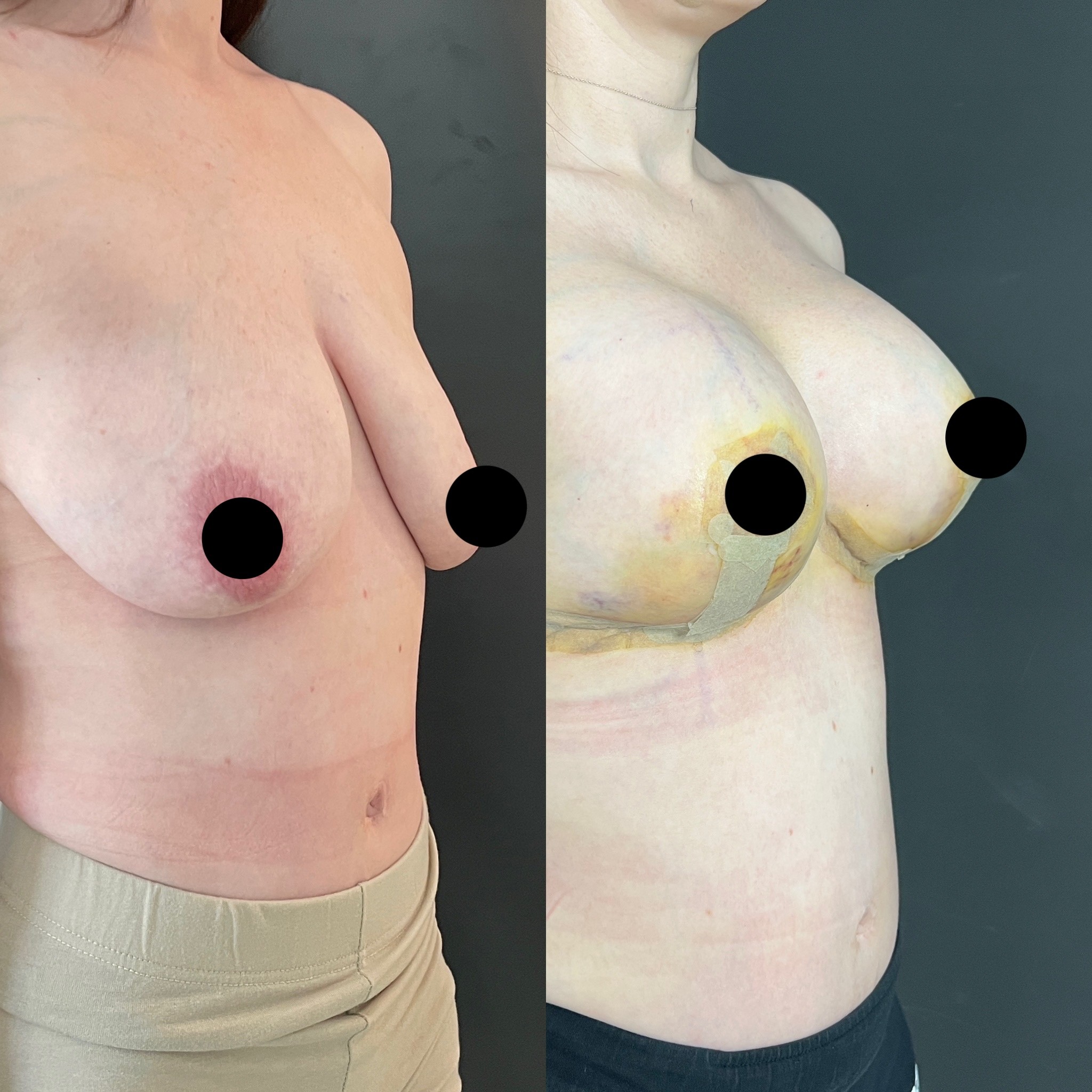
Tuberous breast deformity correction with breast lift and implants at 5 days. Tubular breast before and after by Dr. Cem Berkay Sinaci, Istanbul, Turkey.


Patient Overview
Patient: Elizabeth
Age: 34 years old
Gender: Female
Procedures: Breast lift (mastopexy) with implant augmentation, tuberous breast deformity correction
After photos taken at: 5 days post-surgery
Case Description
Elizabeth is our third tuberous breast correction case in the gallery, joining Elbas (documented at 15 days within a mommy makeover) and Ainur (documented at 6 days at age 42). At 34 with no prior surgery, Elizabeth's case shows tuberous correction as a standalone breast procedure in a younger patient with tissue that has not yet been affected by significant aging or prior surgical intervention. This makes her case a useful reference for younger women who recognize the tuberous shape in their own breasts and want to understand what correction looks like at the earliest postoperative stage.
Elizabeth had known something was different about her breasts since puberty but had never been given a name for it until she began researching online in her late twenties. Finding the term "tuberous breast" — and seeing photographs that matched her own anatomy — was both validating and overwhelming. She spent several years considering surgery before deciding to proceed.
Grades of Tuberous Deformity: Not All Cases Are the Same
One reason we include multiple tuberous correction cases in our gallery is that the condition exists on a spectrum. The classification system most surgeons use divides tuberous deformity into three grades based on severity, and the surgical approach differs for each.
Grade I involves a mild deficiency in the lower medial quadrant of the breast — the inner lower portion. The breast base is only slightly constricted, and the areola may be mildly enlarged. Correction typically requires the least extensive tissue release and may sometimes be addressed with augmentation alone or with minimal lifting.
Grade II shows deficiency in both lower quadrants — the entire lower pole is constricted, with the breast appearing to sit on a narrow base. The areola is more noticeably enlarged and may show herniation. Correction requires a more thorough lower pole release plus augmentation and often a lift.
Grade III is the most severe form, with constriction affecting the entire breast. The breast has a very narrow, tubular shape, a severely enlarged and projecting areola, and minimal breast tissue that is concentrated behind the areola rather than distributed across the mound. Correction requires the most extensive tissue release, reshaping, areolar reduction, augmentation, and lift.
Each of our three tuberous cases represents a different point on this spectrum, which is why the surgical approach and the early results look different despite sharing the same diagnosis. Elizabeth's specific grade and the corresponding surgical decisions were determined during her consultation based on clinical examination — an assessment that cannot be accurately made from photographs alone.
What Distinguishes Elizabeth's Correction at 34
Elizabeth's age gives her two significant advantages over older tuberous correction patients. Her skin elasticity is excellent, meaning the released tissue can stretch and adapt to the implant more readily. And her tissue has not yet undergone the volume loss and ptosis that accumulate with age and breastfeeding, which means the correction is addressing the congenital deformity in relative isolation — without needing to simultaneously compensate for acquired changes.
This simplicity is reflected in the surgical plan. The procedure focused on releasing the constricted lower pole, reshaping the breast tissue, reducing the areola, and placing an implant to establish volume and projection. The lift component was present but less extensive than what was required for Ainur at 42, whose two decades of additional ptosis demanded more skin excision and tissue repositioning.
The practical implication for younger patients is that earlier correction typically means a less complex procedure. This does not mean every 20- or 30-year-old with tuberous breasts should rush to surgery — the timing is a personal decision. But from a purely technical standpoint, the surgical task is more straightforward when performed before aging has layered additional changes on top of the congenital deformity.
The Day-5 Appearance
At five days, Elizabeth's breasts show the expected early postoperative findings. The implants are elevated and have not yet begun their descent into the lower pole. The released tissue is in the earliest phase of its adaptation — wider than its preoperative constriction but not yet at its final expanded shape. The areolae are reduced and repositioned, with the incision lines still fresh and visible. Mild swelling is present throughout.
Comparing Elizabeth's day-five appearance to Ainur's day-six photographs reveals the subtle differences that age and tissue quality create even at the same healing stage. Elizabeth's tissue at 34 appears slightly less edematous, and the skin envelope sits more smoothly over the implant — both reflecting her stronger baseline elasticity. These are minor differences that have no bearing on the final outcome but illustrate how individual tissue characteristics influence the early recovery appearance.
The critical observation at day five is whether the lower pole release has created a wider breast footprint than the preoperative tuberous shape. In Elizabeth's case, it has — the breast base is visibly broader, confirming that the fascial bands have been effectively divided. The full expansion of this released space will develop over the coming months as the implant settles downward and the tissue stretches to accommodate it.
Surgeon's Note
Elizabeth's case completes a three-patient series of tuberous corrections that spans different ages, different severity grades, and different documentation stages. Together, they provide prospective patients with a comprehensive understanding of what this correction involves and how it heals.
At 34 with no prior surgery, Elizabeth's tissue was the most cooperative I have worked with across these three cases. The fascial release proceeded cleanly, the tissue responded well to reshaping, and the skin envelope adapted smoothly to the implant. These are the advantages of younger tissue — not that the surgery is easy, but that the tissue participates actively in the correction rather than resisting it.
What I want younger patients reading this case to understand is that tuberous breast deformity is not something you must live with. It is a well-understood congenital condition with reliable surgical correction. The result will not be a modified version of the tuberous shape — it will be a fundamentally different breast contour that most patients describe as the shape they always felt they should have had. Elizabeth's five-day photographs are the beginning of that transformation, and the coming months will bring the softening, settling, and refinement that turn this early result into the natural, rounded breast shape she has been waiting for.
Frequently Asked Questions
How do I know if I have tuberous breasts or just small breasts?
Small breasts have a normal rounded or teardrop shape with a proportionate areola — they are simply lower in volume. Tuberous breasts have a distinctly different shape: a narrow, constricted base, a tubular or elongated form, and often a puffy or enlarged areola where breast tissue pushes through. The lower portion of the breast appears underdeveloped or missing entirely. If your breasts look more cylindrical than round, if there is a visible crease where the base meets the chest wall, or if the areola seems disproportionately large for the breast size, a consultation can determine whether tuberous deformity is present.
Is tuberous breast correction more painful than standard breast augmentation?
The postoperative discomfort is comparable. The internal tissue release adds some additional soreness in the lower breast during the first week, but this is well-managed with standard pain medication. Most patients describe the discomfort as moderate and significantly improved by day five to seven. The recovery timeline is similar to standard mastopexy-augmentation.
What is the best age to correct tuberous breast deformity?
There is no single best age — the right time is whenever the patient is ready and breast development is complete (typically after 18). However, correcting in the twenties or thirties offers technical advantages: the tissue is more elastic, the surgical approach is typically less complex due to the absence of age-related changes, and the patient benefits from the correction for more years. Correction remains fully viable at any adult age.
Can tuberous breasts affect breastfeeding?
Tuberous breast deformity can affect breastfeeding because the glandular tissue may be underdeveloped or abnormally distributed. Some women with tuberous breasts breastfeed successfully, while others experience reduced milk production. The surgical correction reshapes and redistributes the tissue but does not add glandular tissue. If breastfeeding is a concern, discussing it during the consultation allows the surgeon to assess the glandular tissue and provide realistic expectations.