
Crooked Nose Correction Ultrasonic Rhinoplasty Results
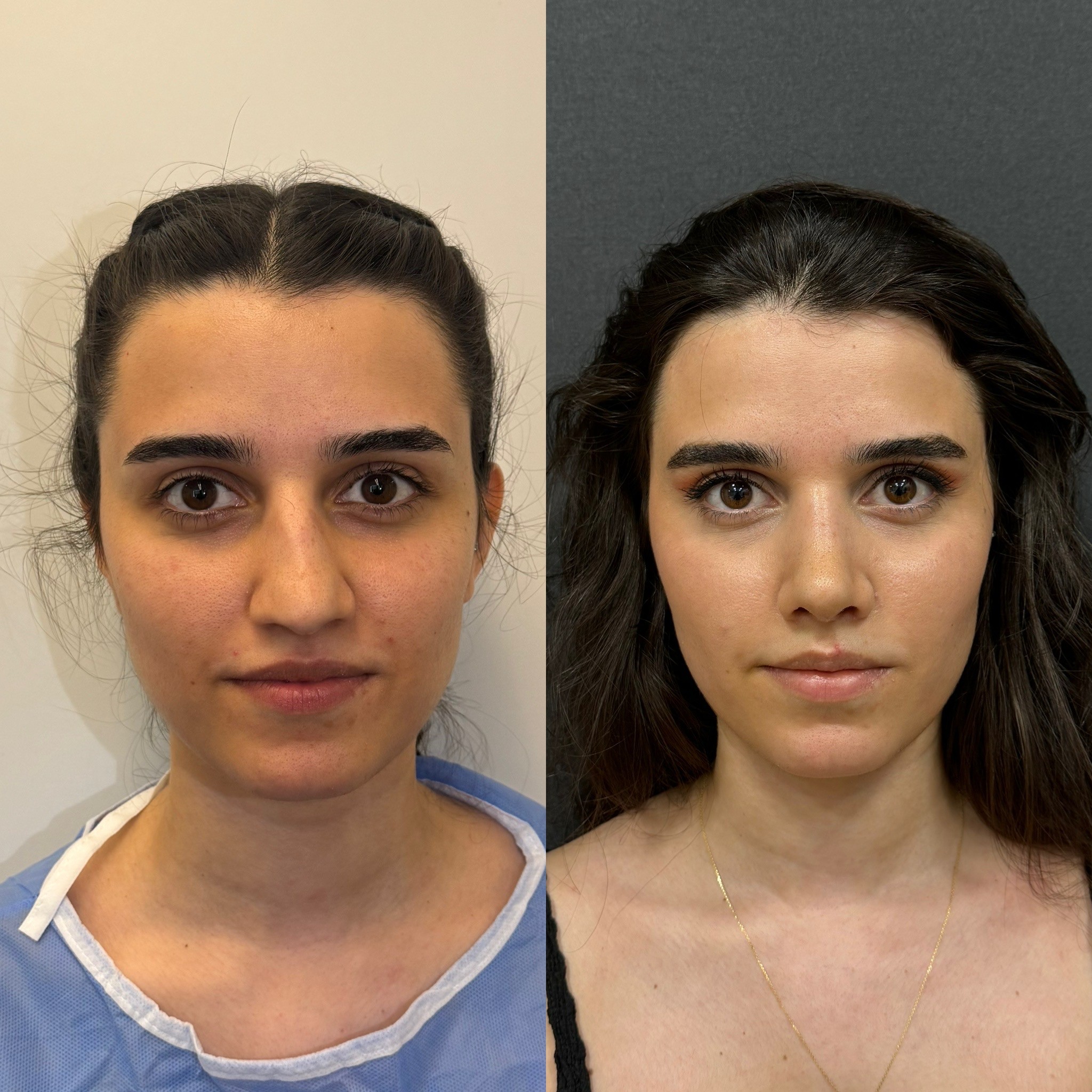
20-day before after of crooked nose and deviation correction with ultrasonic piezo rhinoplasty by board-certified surgeon Dr. Sinaci in Istanbul, Turkey.


Patient Overview
Patient: Edanur
Age: 25 years old
Gender: Female
Procedures: Ultrasonic piezo rhinoplasty (deviation and crooked nose correction)
After photos taken at: 20 days post-surgery
Location: Istanbul, Turkey
Why a Crooked Nose Is One of the Most Challenging Rhinoplasty Problems
Among all the concerns that bring patients to a rhinoplasty consultation, a crooked or deviated nose is consistently the most difficult to correct and the most likely to produce dissatisfied patients when performed by a surgeon without specific expertise in this area. The reason is structural. A crooked nose is not simply a cosmetic issue where the external appearance needs adjusting. It involves deviation of the internal framework — the nasal septum, the upper lateral cartilages, the nasal bones, or frequently all three — meaning the entire architecture of the nose is asymmetric. Straightening this architecture requires working at every structural level simultaneously, anticipating how each correction will interact with the others, and accounting for the cartilage's natural memory that tends to pull it back toward its deviated position over time. For Edanur, a 25-year-old woman whose crooked nose had affected both her appearance and her confidence, Dr. Cem Berkay Sinaci, a Fellow of the European Board of Plastic Reconstructive and Aesthetic Surgery (FEBOPRAS) and member of ISAPS and ASPS, used ultrasonic piezo rhinoplasty to achieve a straight, refined result visible just 20 days after surgery.
Understanding What Causes a Nose to Become Crooked
A deviated nose can result from several causes, and identifying the origin helps determine the surgical strategy. Congenital deviation occurs when the nasal structures develop asymmetrically during growth, producing a nose that has been crooked for as long as the patient can remember. Traumatic deviation results from an injury — a sports impact, a fall, or an accident — that fractures or displaces the nasal bones or bends the septal cartilage. Some patients have a combination of both, where a congenitally mild deviation was worsened by a later injury.
The deviation can involve the bony upper third of the nose, the cartilaginous middle third, the septal cartilage that divides the nasal cavity, or the tip and lower third. In many crooked noses, the deviation is not a simple uniform bend in one direction but an S-shaped or C-shaped curve where different segments lean in different directions. This complexity is what makes straightening a crooked nose technically demanding. Each segment must be independently addressed and then reassembled into a straight, stable midline structure.
How Ultrasonic Piezo Technology Benefits Crooked Nose Correction
The piezo device is particularly valuable in deviated nose correction because the precision of its bone cuts directly influences the surgeon's ability to straighten and reposition the nasal bones accurately. In a crooked nose, the bony pyramid is asymmetric. One nasal bone may be longer, wider, or more prominently angled than the other. Straightening this asymmetry requires osteotomies that are precisely placed on each side to allow the bones to be mobilised and repositioned into a symmetric configuration.
With traditional chisels, the osteotomy creates a fracture line that the surgeon guides but cannot perfectly control. Micro-fractures can extend beyond the intended path, and the force required to complete the bone cut transmits into the surrounding soft tissue, causing bruising and swelling that obscures the surgical result for weeks. The piezo instrument eliminates both of these limitations. The ultrasonic vibration cuts bone along an exact, surgeon-defined path with no uncontrolled fracture propagation and no collateral soft tissue damage. For crooked nose correction, where the difference between symmetric and asymmetric often comes down to a millimetre of bone position, this precision is not a luxury but a necessity.
Edanur's 20-day photographs demonstrate the clinical benefit. Minimal swelling is present despite the fact that significant bony work was required to straighten her deviation, a recovery profile that reflects the tissue-preserving nature of the piezo approach.
Correcting the Septum Alongside the External Deviation
A crooked nose is rarely just an external problem. In most cases, the nasal septum — the cartilage and bone partition that divides the nasal cavity into left and right sides — is deviated as well. A deviated septum can obstruct airflow on one or both sides, contributing to difficulty breathing through the nose, chronic congestion, and disrupted sleep. Even when a patient presents primarily with cosmetic concerns about the crooked appearance, the septum almost always requires correction to achieve a straight external result and to ensure that the functional airway is optimised.
Septoplasty, the surgical straightening of the deviated septum, is performed through the same internal nasal incisions used for rhinoplasty. The deviated portions of septal cartilage and bone are removed, repositioned, or reshaped to create a straight, stable midline partition. In severe deviations, the septum may be partially reconstructed using grafts from the removed cartilage to reinforce the corrected structure and prevent re-deviation. This septal work forms the internal foundation upon which the external straightening rests. Without a straight septum, the external nose has no stable midline reference and is prone to shifting back toward its deviated position over the months following surgery.
Cartilage Memory and Why Crooked Noses Tend to Relapse
One of the unique challenges of crooked nose rhinoplasty is the concept of cartilage memory. Nasal cartilage that has been bent or deviated for years develops an intrinsic tendency to return to its original curved shape, even after it has been surgically straightened. This is why simple scoring or weakening of the cartilage, while temporarily effective, often fails to maintain correction over time. The cartilage slowly springs back toward its pre-surgical position, and the nose gradually returns to a crooked alignment.
Dr. Sinaci addresses this challenge through structural grafting and suture techniques that physically counteract the cartilage memory. Spreader grafts placed along the dorsal septum provide lateral support that prevents the midline cartilage from rebending. Suture techniques that fix the repositioned cartilage in its corrected position add additional stability. The piezo osteotomies contribute to long-term stability as well, because the precisely cut bone edges heal in their new position with greater accuracy than the irregular fracture surfaces left by traditional instruments. Together, these techniques work to ensure that Edanur's straight result at 20 days remains straight at 20 months and beyond.
Twenty Days After Crooked Nose Correction — What the Photos Show
Edanur's before and after photographs at 20 days reveal how much visible improvement ultrasonic rhinoplasty can deliver within the first three weeks. The nasal deviation that was clearly visible in her pre-operative images has been corrected, and the nose now sits in the facial midline with symmetric proportions on both sides. The dorsal profile is smooth and refined, and the tip shows early definition that will continue to sharpen as residual deep swelling resolves over the coming months.
The minimal swelling at 20 days is a direct result of the piezo approach. In a conventional rhinoplasty involving the degree of bony work required for deviation correction, a patient at day 20 would typically still carry noticeable bridge swelling and periorbital puffiness. Edanur's photographs show a nose that is remarkably close to its projected final shape at a stage where conventional patients are still waiting for their early swelling to resolve. The tip will continue to refine for 12 to 18 months as it does with any rhinoplasty, but the overall nasal shape and straightness are already clearly established.
Crooked Nose Rhinoplasty in Istanbul With Advanced Piezo Technology
Deviation correction demands a surgeon who combines structural rhinoplasty expertise with an understanding of the forces that cause crooked noses to relapse. Dr. Sinaci's practice in Istanbul offers this combination through advanced piezo technology, comprehensive structural grafting techniques, and the deep anatomical knowledge developed through fellowship training with world-renowned surgeon Raul Gonzalez in Brazil and facial anatomy courses in Bangkok. For patients like Edanur whose crooked nose involves multiple structural levels requiring simultaneous correction, the precision of piezo rhinoplasty paired with experienced surgical planning produces results that are both immediately visible and built to last.