
Breast Lift Internal Bra Auto-Augmentation Day 3 | 54y
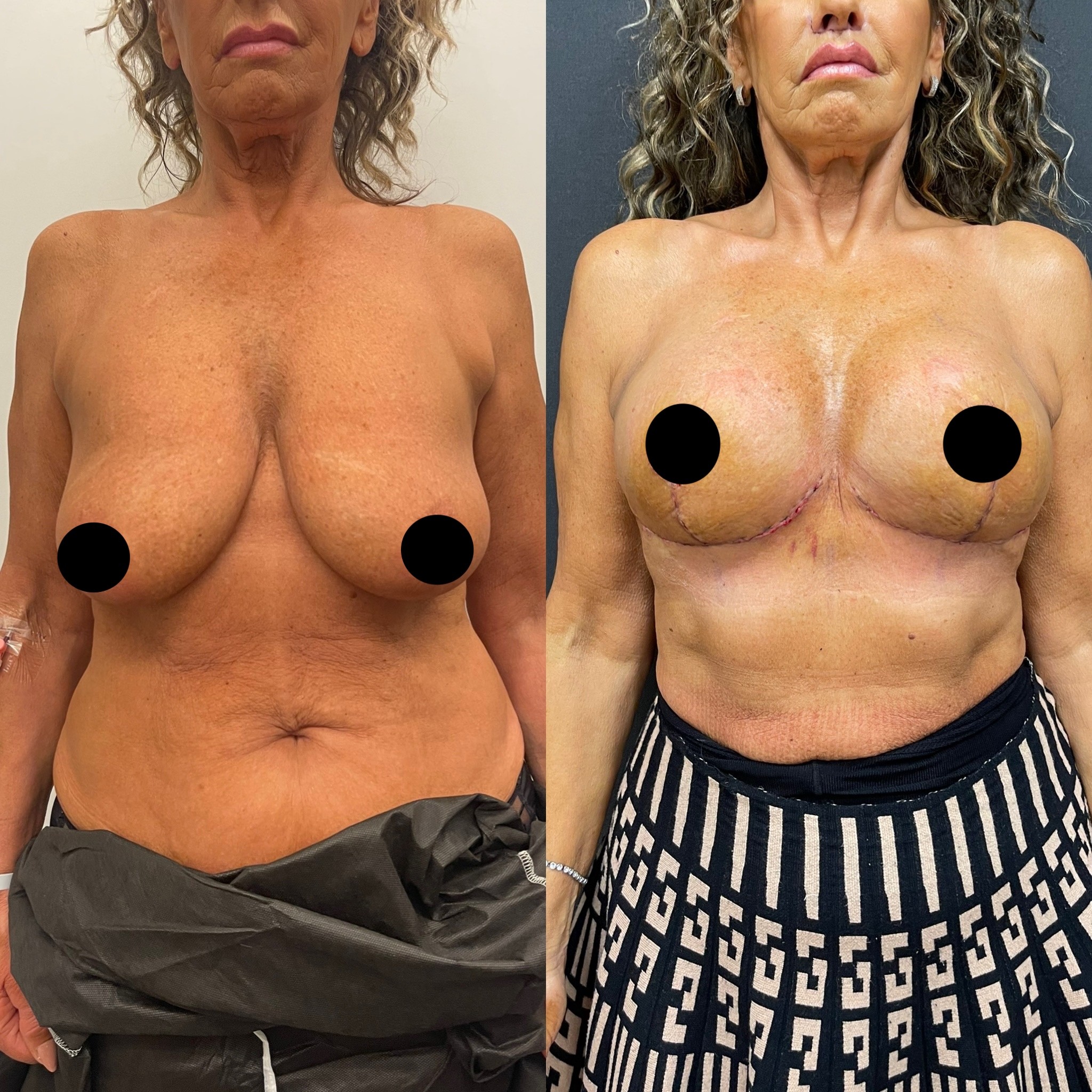
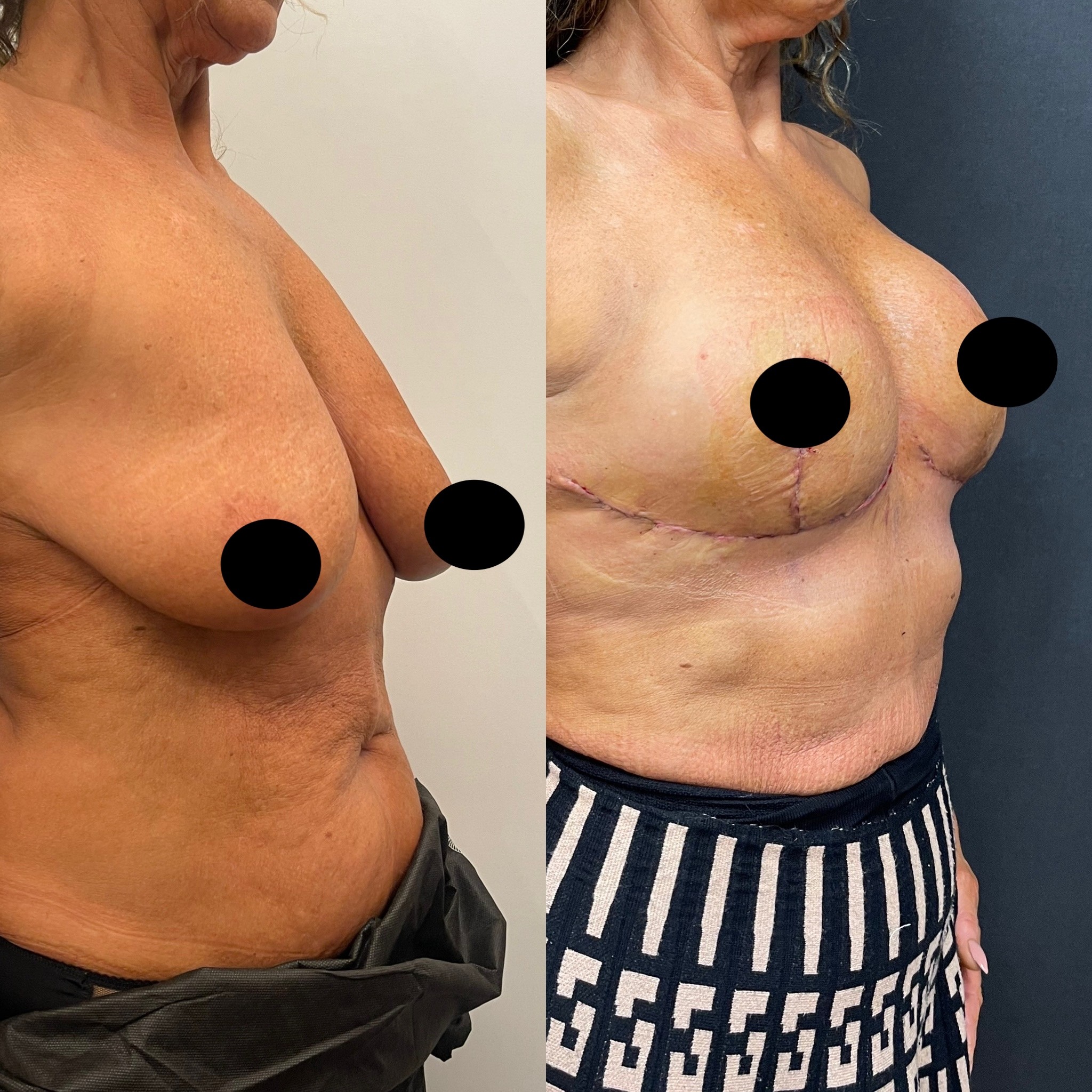
Breast lift with auto-augmentation and internal bra at 3 days, age 54. No implants. Before and after by European board-certified Dr. Sinaci, Istanbul.

Patient Overview
Patient: Sharon
Age: 54 years old
Gender: Female
Procedures: Breast lift (mastopexy) with internal bra technique and auto-augmentation (no implant)
After photos taken at: 3 days post-surgery
Case Description
Sharon is the oldest patient across our entire breast gallery. At 54, she had lived with progressively worsening breast ptosis for over a decade, watching her breasts descend further each year while debating whether surgery was worth it "at her age." That hesitation — the feeling that there is an expiration date on eligibility for breast surgery — is something we hear regularly from women in their fifties, and Sharon's case exists in our gallery partly to challenge it.
Her goals were uncomplicated: she wanted her breasts back where they used to be, with a natural shape and no foreign material inside her body. The internal bra with auto-augmentation delivered exactly that.
Severe Ptosis at 54: When There Is More to Work With
Counterintuitively, advanced ptosis can be an advantage for auto-augmentation. The very tissue that has descended — creating the sagging, elongated breast shape — is the raw material the surgeon uses to build the new, projected mound. The more tissue available for redistribution, the more dramatic the reshaping can be.
Sharon had Grade III ptosis — her nipples sat well below the inframammary fold, and the breast tissue had descended to the point where the upper pole was essentially empty while the lower pole carried all the volume. In a standard lift, this tissue would be repositioned and the excess skin removed. With auto-augmentation, the descended tissue was mobilized, rotated superiorly, and sculpted into a compact, projected breast mound before the skin envelope was tightened around it. The result is not merely a lifted version of the ptotic breast — it is a fundamentally reshaped breast with better projection and upper pole fullness than the original had, even in its youthful state.
The internal bra provides the structural insurance that this reshaping demands. At 54, Sharon's skin has minimal residual elasticity. Without internal support, gravity would immediately begin working against the lift, pulling the repositioned tissue back toward its pre-surgical position. The dermal flap hammock holds the auto-augmented mound in place from beneath, creating a support structure that does not depend on skin tension to maintain the result.
Day 3 at 54: Reading the Early Result Correctly
Three days after surgery, Sharon's breasts are swollen, firm, and show the fresh incision lines of the mastopexy. At this stage, it is easy to focus on the surgical details — the sutures, the tape strips, the discoloration — and miss the transformation underneath. But even through the acute postoperative findings, the change in breast position and shape is already unmistakable. Breasts that sat at the level of the upper abdomen are now positioned on the chest where they belong. The empty upper pole has been filled by the auto-augmented tissue. The overall breast footprint has changed from elongated and narrow to compact and projected.
At 54, the swelling at day three may appear more diffuse than in younger patients. Mature tissue tends to hold edema more broadly rather than concentrating it, which can make the entire breast and surrounding chest appear puffy. The skin may also show more surface irregularity — texture changes, visible veins, crepe-like quality — that are pre-existing age-related characteristics, not surgical effects. These features become less prominent as the swelling resolves and the skin settles against the reshaped mound.
The bruising pattern at 54 can also differ from younger patients. Mature skin bruises more easily due to thinner dermis and more fragile capillaries, and bruises tend to take longer to resolve — sometimes three weeks rather than two. This is a cosmetic nuisance, not a clinical concern, and has no impact on the final result.
The Question of Age in Breast Surgery
Sharon's case confronts directly the assumption that breast surgery is a younger woman's procedure. There is no clinical upper age limit for mastopexy. The relevant criteria are overall health, anesthetic fitness, and realistic expectations — not the number on a birth certificate.
What does change with age is the tissue environment, and the surgical plan must adapt accordingly. At 54, the surgeon must account for thinner skin that requires gentler handling and more conservative tension, reduced vascularity that demands careful preservation of blood supply to the skin flaps, lower collagen density that makes internal support structures like the internal bra essential rather than optional, and a longer overall healing timeline that requires adjusted follow-up scheduling.
None of these adaptations make the surgery inadvisable — they make it different. A surgeon experienced with mature tissue adjusts technique instinctively, the way a carpenter adjusts approach based on whether the wood is oak or pine. The material requires different handling, but the craftsmanship produces an excellent result regardless.
No Implant at 54: The Practical Argument
Beyond personal preference, there is a strong practical case for avoiding implants at 54. An implant placed at 54 may require revision or replacement in the patient's late sixties or early seventies — an age where elective surgery becomes less appealing and the risks of anesthesia gradually increase. The internal bra and auto-augmentation approach eliminates this future obligation entirely. The result is maintenance-free from the day it heals.
There is also the question of tissue coverage. At 54, the breast tissue is thinner and less dense, which means an implant has less natural cushioning above it. Thinner coverage increases the risk of visible implant edges, palpable rippling, and an obviously augmented appearance — the opposite of what most women in their fifties want. Auto-augmentation avoids this entirely because the projection comes from the patient's own tissue, which by definition blends seamlessly with the surrounding breast.
Surgeon's Note
Sharon at 54 is proof that excellent breast surgery outcomes are not age-dependent. Her day-three result already shows the dramatic positional change that the lift achieved, and the auto-augmented tissue is creating upper pole fullness that her breasts had not had in years. The internal bra is doing its job — holding the reshaped mound securely in its lifted position while the early biological integration begins.
What I want women in their fifties reading this case to understand is simple: if your breasts bother you, your age is not a reason to accept it. The techniques available today — particularly the internal bra and auto-augmentation — are specifically well-suited to mature tissue. They work with the tissue you have rather than asking it to accommodate something foreign. They provide structural support where your skin can no longer provide it on its own. And they produce results that look natural precisely because they are natural.
Sharon waited years before deciding to proceed, wondering whether she had "missed her window." She had not. There is no window. There is only readiness — and when she was ready, the surgery was ready for her.