
Male Facelift, Rhinoplasty and Blepharoplasty Combined
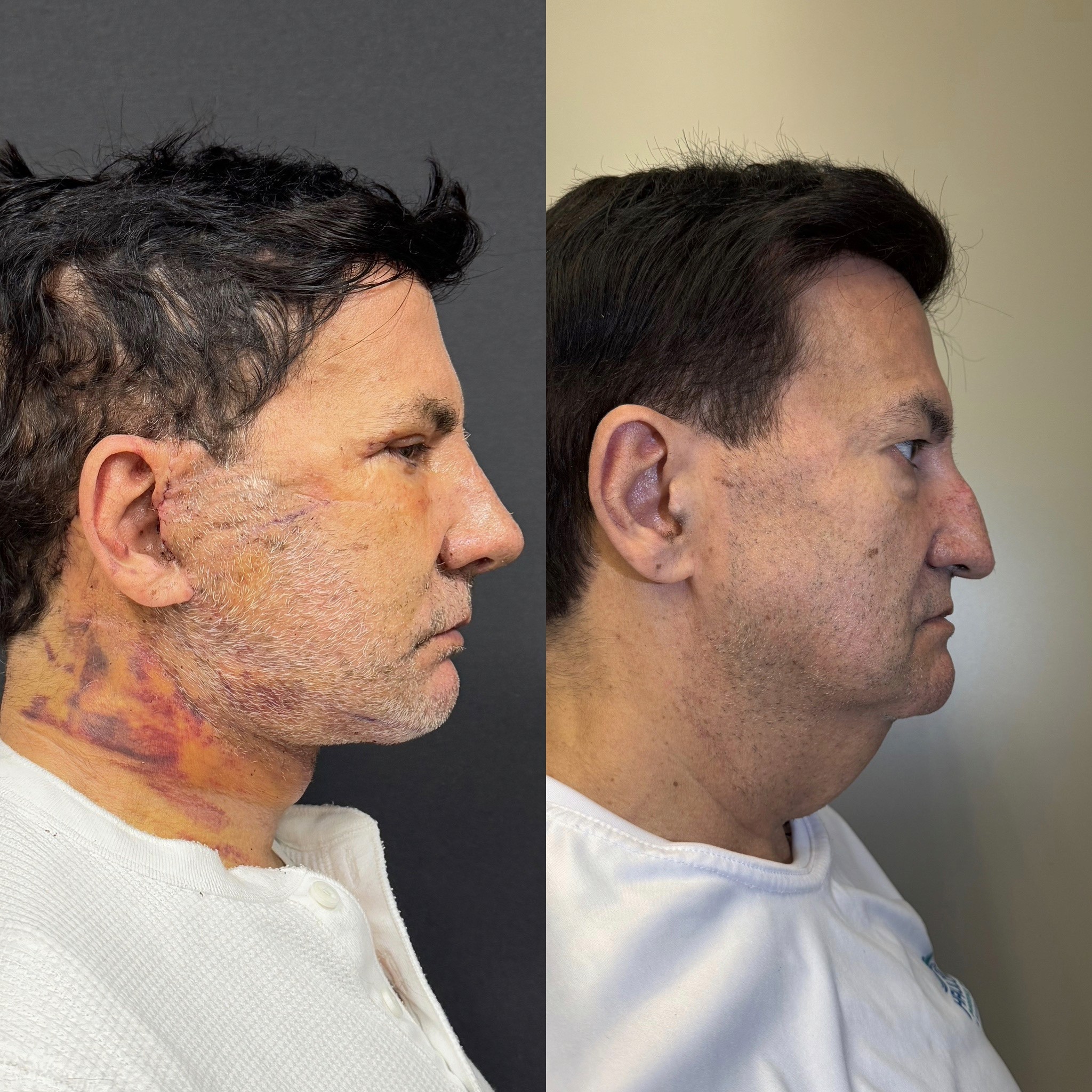
Before & after lower facelift with neck lift, rhinoplasty and blepharoplasty in a 61-year-old American male. 5-day early result from plastic surgeon in Istanbul
Patient Overview
Patient: Scott
Age: 61
Gender: Male
Procedures: Lower face and neck lift with platysmaplasty, rhinoplasty, blepharoplasty
After photos taken at: 5 days post-op
Origin: United States
Location: Istanbul, Turkey
Combining Facelift, Rhinoplasty and Blepharoplasty in One Session
When a patient presents with ageing concerns across multiple facial zones alongside a long-standing dissatisfaction with nasal shape, combining these corrections into a single surgical session offers a compelling advantage: one anaesthesia, one recovery period, and a result where every element heals and settles together. Scott, a 61-year-old male patient from the United States, sought correction of lower facial and neck laxity, under-eye ageing, and nasal refinement simultaneously. Rather than staging these as three separate operations over a year or more, Dr. Cem Berkay Sinaci, a fellow of the European Board of Plastic Reconstructive and Aesthetic Surgery (FEBOPRAS) and member of ISAPS and ASPS, planned a comprehensive approach: lower face and neck lift with platysmaplasty, blepharoplasty, and rhinoplasty — all performed in a single session.
Lower Face and Neck Lift with Platysmaplasty
Scott's primary concern was the turkey neck deformity that had developed progressively over the preceding decade — platysmal banding, submental laxity, loss of the cervicomental angle, and jowling along the mandibular border. These changes are driven by the separation of the platysma muscle in the midline, the loosening of the SMAS layer in the lower face, and the gravitational descent of the jowl fat pad below the jawline.
The surgical correction addressed each layer. The platysma muscle edges were sutured together in the midline through a submental incision — the platysmaplasty component — recreating the continuous muscular sling that defines a taut anterior neck. The lateral platysma was tightened through the facelift incisions. The SMAS was repositioned to lift the jowl tissue back above the mandibular border, and the excess skin was redraped and removed.
For male patients, the facelift incision design must account for the beard-bearing skin, the masculine hairline pattern, and the thicker, more vascular male skin. These anatomical differences influence not only where the incisions are placed but how the flap is dissected and how the closure is managed. Having trained in advanced facial rejuvenation through fellowship with Raul Gonzalez in Brazil and cadaver dissection courses in Bangkok, Dr. Sinaci adapts every technical detail to the specific requirements of male facial anatomy. For more on this topic, read: Male Facelift: Understanding the Unique Aspects for Men.
For a deeper understanding of the neck's role in facial rejuvenation: The Secret to a Youthful Face: Why Your Neck Holds the Key.
Rhinoplasty: Refining the Nose Within the Context of a Rejuvenated Face
Adding rhinoplasty to a facelift is not simply performing two unrelated procedures in the same sitting — it requires understanding how changes to the nose interact visually with the changes being made to the lower face and neck. A nose that appeared proportionate before a facelift may look different once the jawline is sharpened and the neck is tightened, because facial proportions are relational. Conversely, refining the nose simultaneously with the lower face rejuvenation allows the surgeon to calibrate both results against each other, creating a harmonious facial profile rather than two independently planned corrections.
For Scott, the rhinoplasty addressed structural and aesthetic concerns that he had carried long before age-related changes became his primary motivation for surgery. The nasal refinement was designed to complement his masculine facial proportions — maintaining a strong, natural profile while correcting the specific features he wished to change. The procedure was performed using structural techniques that respect the functional anatomy of the nose, ensuring that breathing was preserved or improved alongside the aesthetic correction.
Blepharoplasty: Completing the Periorbital Zone
Scott's eyelids showed the excess skin and fat herniation — both upper and lower — that contributes to a tired, aged appearance around the eyes. Left untreated while the lower face and neck were rejuvenated, the eyes would have remained the most visibly aged feature, drawing attention away from the improvement achieved below.
The upper blepharoplasty removed redundant skin through an incision within the natural eyelid crease. The lower blepharoplasty addressed herniated fat pads and skin excess through a subciliary approach. Non-dissolvable sutures were used for all eyelid closures — these sutures generate minimal inflammatory reaction in the thin eyelid skin and are removed at four to six days, producing finer scars than dissolvable alternatives.
Five Days: The Rawest Possible Before and After
Scott's photographs at five days post-surgery show the combined result at its most unfinished. This is an honest, early snapshot — sutures recently removed or still present in some areas, residual bruising likely visible, and tissues in the acute phase of healing. Sharing a five-day result from a four-procedure facial surgery session is a deliberate choice in transparency.
Even at this early stage, the structural changes are already unmistakable. The turkey neck is corrected — the platysmal bands are gone and the cervicomental angle is restored. The jawline is significantly more defined than preoperatively. The eyelids appear cleaner and more rested. The nasal refinement is visible though partially obscured by early swelling.
Every element of this result will improve substantially over the coming weeks and months. Bruising will resolve within two weeks. The major swelling will subside over four to six weeks, with subtler refinement continuing for up to twelve months — particularly in the nose, where rhinoplasty swelling is the slowest to resolve completely. The scars around the ears, beneath the chin, and along the eyelid creases will mature from their early pink healing phase to fine, inconspicuous lines over three to twelve months.
The Logic of Combining Multiple Facial Procedures
For a patient travelling internationally for surgery, the practical advantage of combining procedures into a single session is substantial. A single trip, a single recovery period, and a synchronised result. But the benefits extend beyond logistics. When the facelift, rhinoplasty, and blepharoplasty heal together, the patient transitions from their preoperative appearance to their final result in one continuous process. There is no awkward intermediate stage where one area looks rejuvenated while another still shows the changes of ageing or the healing from a subsequent procedure.
The surgical safety of combining these procedures is well established, provided the total operative time remains within appropriate limits and the patient's overall health supports a longer session under anaesthesia. Scott's preoperative medical evaluation confirmed his fitness for the combined approach, and the procedural sequencing was planned to optimise both efficiency and safety.
American Male Patients Choosing Facial Surgery in Istanbul
Scott's decision to travel from the United States to Istanbul for a multi-procedure facial surgery reflects both thorough research and clear priorities. For male patients in particular, finding a surgeon who understands the specific requirements of masculine facial aesthetics — from incision placement around the male hairline to nasal proportions that suit a male profile to eyelid surgery that avoids feminisation — is essential. Scott's five-day result demonstrates that even at the earliest stage of recovery, the combined approach can deliver a visible transformation that respects and enhances the patient's natural masculine features.