
Turkey Neck Correction with Chin Laser Lipo | Age 34
Turkey neck deformity treated with chin laser liposuction. Before and after at 1 month. Neck rejuvenation and jawline contouring by Dr. Sinaci, Istanbul.
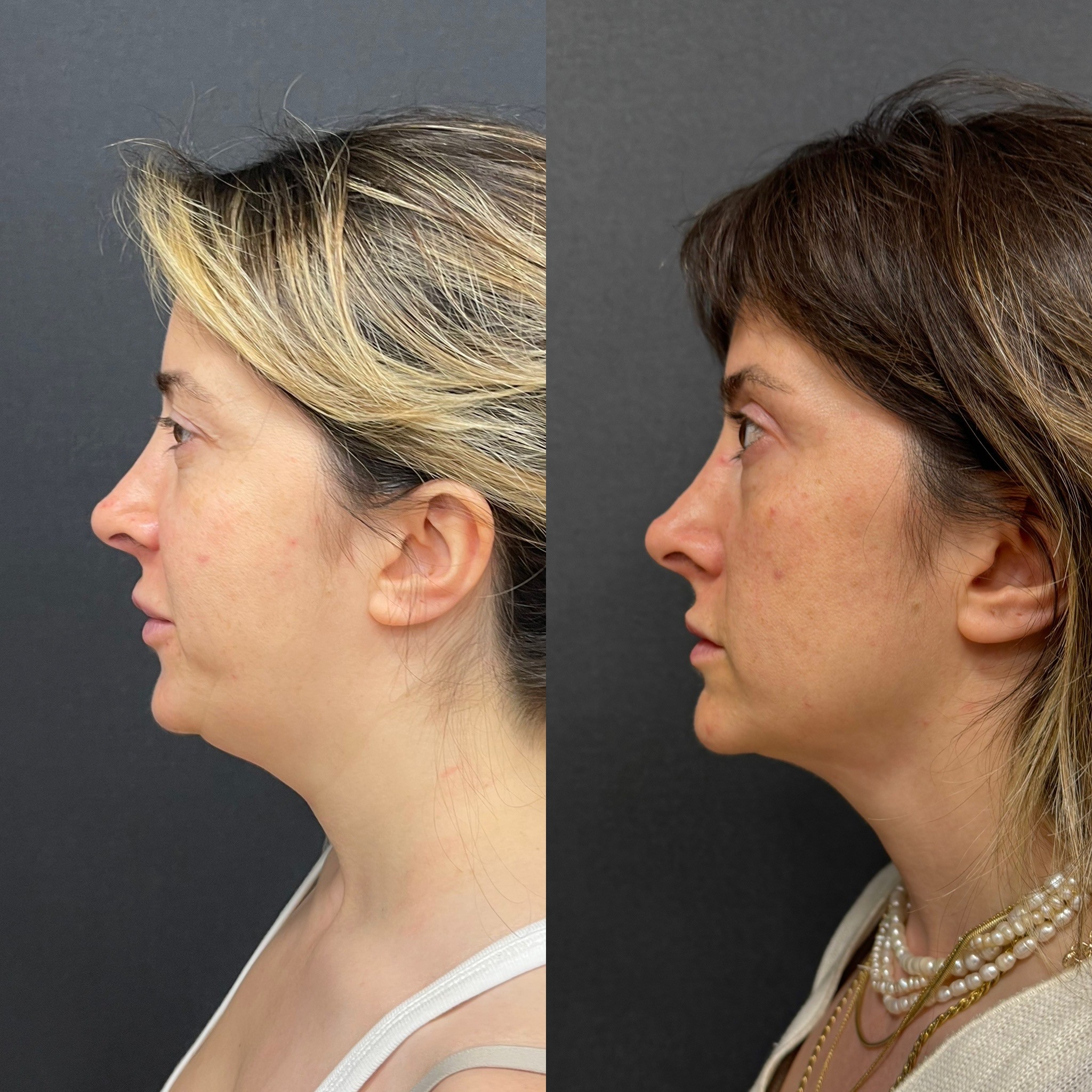


Patient Overview
Patient: Nebia
Age: 34 years old
Gender: Female
Procedures: Laser liposuction of the submental area (chin and neck contouring)
After photos taken at: 1 month post-procedure
Case Description
Nebia, at 34 years old, is among the younger patients in our double chin liposuction gallery — and her case challenges a widespread assumption that neck contouring procedures are only for patients in their late forties or fifties. She presented with what is colloquially known as a "turkey neck" — a combination of submental fullness and early skin laxity along the anterior neck that created an aged, heavy appearance completely inconsistent with her actual age.
Her frustration was understandable. At 34, she felt that her face looked years older than it should because of a neck contour that belonged on someone two decades her senior. The condition was not caused by weight gain, poor posture, or lifestyle factors. It was an anatomical predisposition — a combination of fat distribution, skin characteristics, and structural geometry that produced premature aging in one specific area while the rest of her face remained youthful.
What Is "Turkey Neck" and Why Does It Affect Younger Patients?
The term "turkey neck" is informal but widely understood. It describes a neck contour characterized by loss of the clean angle between chin and throat, fullness or sagging beneath the chin, visible skin laxity along the anterior neck that can include fine wrinkling or crepiness, and in more advanced cases, visible vertical bands created by the platysma muscle edges separating at the midline.
Most people associate turkey neck with aging — and in the majority of cases, it does develop gradually as the skin loses elasticity, the fat pads shift, and the platysma muscle weakens over decades. But a subset of patients develop these changes much earlier, sometimes in their twenties or thirties. The causes in younger patients are typically different from those in older ones.
In younger patients like Nebia, the primary driver is usually a disproportionately large or anteriorly positioned submental fat pad combined with naturally thinner or less elastic skin in the neck region. The fat creates the fullness, and the skin quality means that even moderate fat accumulation produces visible contour changes that would be masked by thicker, more elastic skin in other patients. Genetics play the dominant role — many younger patients with turkey neck report that a parent or grandparent had the same feature.
Less commonly, rapid weight fluctuations, hormonal changes, or prolonged sun exposure to the neck can accelerate the development of turkey neck appearance in younger patients. But in Nebia's case, the cause was straightforward: an anatomical pattern she inherited, not a consequence of any behavior.
Why Laser Liposuction Was the Right Choice at 34
Nebia's age was actually an advantage in treatment planning. At 34, her skin retained excellent baseline elasticity — the collagen and elastin network was still dense and responsive. This meant that after fat removal, her skin had a strong natural capacity to retract and conform to the new contour. The laser energy supplemented this already-favorable biology, stimulating additional collagen contraction and remodeling that will continue to improve the result for months.
Had Nebia waited another fifteen or twenty years to address this concern, the calculus might have been different. By the late forties or fifties, skin elasticity diminishes significantly, and standalone liposuction may not provide enough skin retraction to produce a smooth result. At that point, a surgical neck lift or the addition of threads might become necessary. By addressing the problem now — while her tissue quality is optimal — Nebia achieved an excellent result with the least invasive approach possible.
This is a broader principle worth emphasizing: minimally invasive procedures tend to produce their best results in younger patients with good tissue quality. This does not mean younger patients should rush into procedures they do not need. It means that when a genuine anatomical concern exists — as it clearly did in Nebia's case — treating it earlier rather than later often allows for a simpler procedure with better outcomes than waiting until the problem has progressed and the tissue has deteriorated.
Addressing Turkey Neck Without Surgery: Where Is the Line?
Patients researching turkey neck correction online encounter a wide spectrum of treatment options, from topical creams and facial exercises to radiofrequency devices, injectable fat dissolvers, and ultimately surgical intervention. Understanding where each option fits helps patients make informed decisions.
Topical treatments and exercises have essentially no evidence base for correcting established turkey neck. Creams cannot penetrate deep enough to affect the fat pad or change the skin's structural protein network in a meaningful way. Neck exercises can improve muscle tone but cannot reduce fat volume or reverse skin laxity.
Non-invasive devices — radiofrequency, ultrasound, and microfocused ultrasound — can produce modest skin tightening in patients with very mild laxity and no significant fat excess. They work by heating the dermal collagen to stimulate contraction and remodeling. However, their results are subtle, require multiple sessions, and are insufficient for patients with a defined fat pad or moderate laxity.
Laser liposuction occupies the middle ground — a minimally invasive procedure that directly removes fat and actively tightens skin, performed under local anesthesia with minimal downtime. It is the appropriate intervention for patients like Nebia who have a genuine structural issue that non-invasive treatments cannot resolve, but who do not have the degree of skin excess or platysmal banding that requires open surgery.
Surgical neck lift — either standalone or as part of a face and neck lift — remains the gold standard for patients with significant skin excess, prominent platysmal bands, or advanced aging changes. It provides the most dramatic and durable result but involves incisions, general anesthesia, and a longer recovery.
Nebia's anatomy placed her squarely in the laser liposuction category: meaningful fat excess, minimal skin redundancy, good tissue elasticity, and no platysmal banding. The procedure addressed her concern completely without the recovery burden of surgery.
Results at 1 Month
At one month post-procedure, Nebia's transformation is clearly evident. The submental fullness that created the turkey neck appearance has been eliminated. The jawline — which was always well-defined at the skeletal level but obscured by the overlying fat — is now sharply visible. The cervicomental angle has improved dramatically, creating a clean, youthful transition from chin to neck. The skin has retracted smoothly with no irregularities, laxity, or visible evidence of intervention.
At one month, the result is approximately 85 percent of its final form. The remaining improvement will come from ongoing collagen remodeling — the laser-stimulated process that continues to firm and tighten the skin for up to six months after the procedure. Nebia can expect her neck contour to continue refining subtly through months two, three, and beyond, with the skin becoming progressively firmer and the jawline definition increasing incrementally.
The incision points — tiny access sites beneath the chin and behind the earlobes — are already nearly imperceptible at one month. By three months they will be virtually invisible.
Surgeon's Note
Nebia's case is one I reference frequently when younger patients ask whether they are "too young" for a neck procedure. The answer is that age is not the determining factor — anatomy is. A 34-year-old with a genuine turkey neck deformity is a better candidate for treatment now, while her tissue quality is optimal, than the same patient at 50 when the skin has lost much of its retractile capacity and a more invasive procedure may be required.
What I find particularly satisfying about this result is the dramatic impact that a single, relatively brief procedure had on her overall facial appearance. The face looks younger, more defined, and more balanced — not because we changed any of her facial features, but because we removed the element that was creating visual age dissonance. Her face now matches her actual age, which is exactly what she wanted.
Technically, Nebia's case was straightforward in the best sense. Good tissue quality, a well-defined fat deposit, favorable bone structure, and an appropriate hyoid position all contributed to an outcome where the procedure could do exactly what it is designed to do without complicating factors. Not every case is this cooperative, which makes honest patient selection all the more important. When the anatomy is right for laser liposuction, the results speak for themselves.
Frequently Asked Questions
Can you get turkey neck in your 30s?
Yes. While turkey neck is most commonly associated with aging, some patients develop it in their twenties or thirties due to genetic predisposition. A naturally larger submental fat pad, thinner neck skin, or a low-positioned hyoid bone can all contribute to a prematurely aged neck contour regardless of body weight or fitness level. When turkey neck appears at a younger age, it is almost always a hereditary anatomical pattern rather than a lifestyle-related issue.
Is 34 too young for a neck contouring procedure?
No. There is no minimum age for neck contouring when a genuine anatomical concern exists. In fact, younger patients often achieve the best results from minimally invasive procedures like laser liposuction because their skin retains strong natural elasticity, allowing it to retract smoothly after fat removal. Addressing turkey neck at a younger age typically means a simpler procedure, faster recovery, and a longer-lasting result compared to waiting until the skin quality has deteriorated with age.
What is the difference between turkey neck treatment in younger versus older patients?
In younger patients with good skin elasticity, turkey neck can usually be corrected with laser liposuction alone — the skin retracts naturally after fat removal, supplemented by the laser's collagen-tightening effect. In older patients with significant skin laxity, standalone liposuction may be insufficient because the skin lacks the elasticity to retract adequately. These patients often require the addition of a thread lift or a surgical neck lift to remove excess skin and tighten the platysma muscle. The consultation assessment determines which approach matches the individual patient's tissue quality.
How long do laser liposuction results last on the neck?
The fat cells removed during laser liposuction are permanently eliminated. The result is durable as long as the patient maintains a stable weight, since the remaining fat cells in the area can expand with significant weight gain. The skin tightening effect from the laser-stimulated collagen remodeling is also long-lasting, though the natural aging process will continue to gradually affect skin elasticity over the years. Most patients enjoy their improved neck contour for many years before any further intervention is considered.
Can turkey neck come back after laser liposuction?
The removed fat cells do not regenerate, so the specific fullness that was treated will not return at the same volume. However, significant weight gain can cause the remaining fat cells in the area to enlarge, partially recreating submental fullness. Additionally, the natural aging process will continue — skin elasticity will gradually decrease and soft tissue will slowly descend over the decades. These changes are independent of the procedure and would have occurred regardless. Most patients find that their treated contour remains significantly better than their preoperative appearance for ten years or more, even accounting for ongoing natural aging.