
Breast Lift Auto-Augmentation No Implant | Day 7
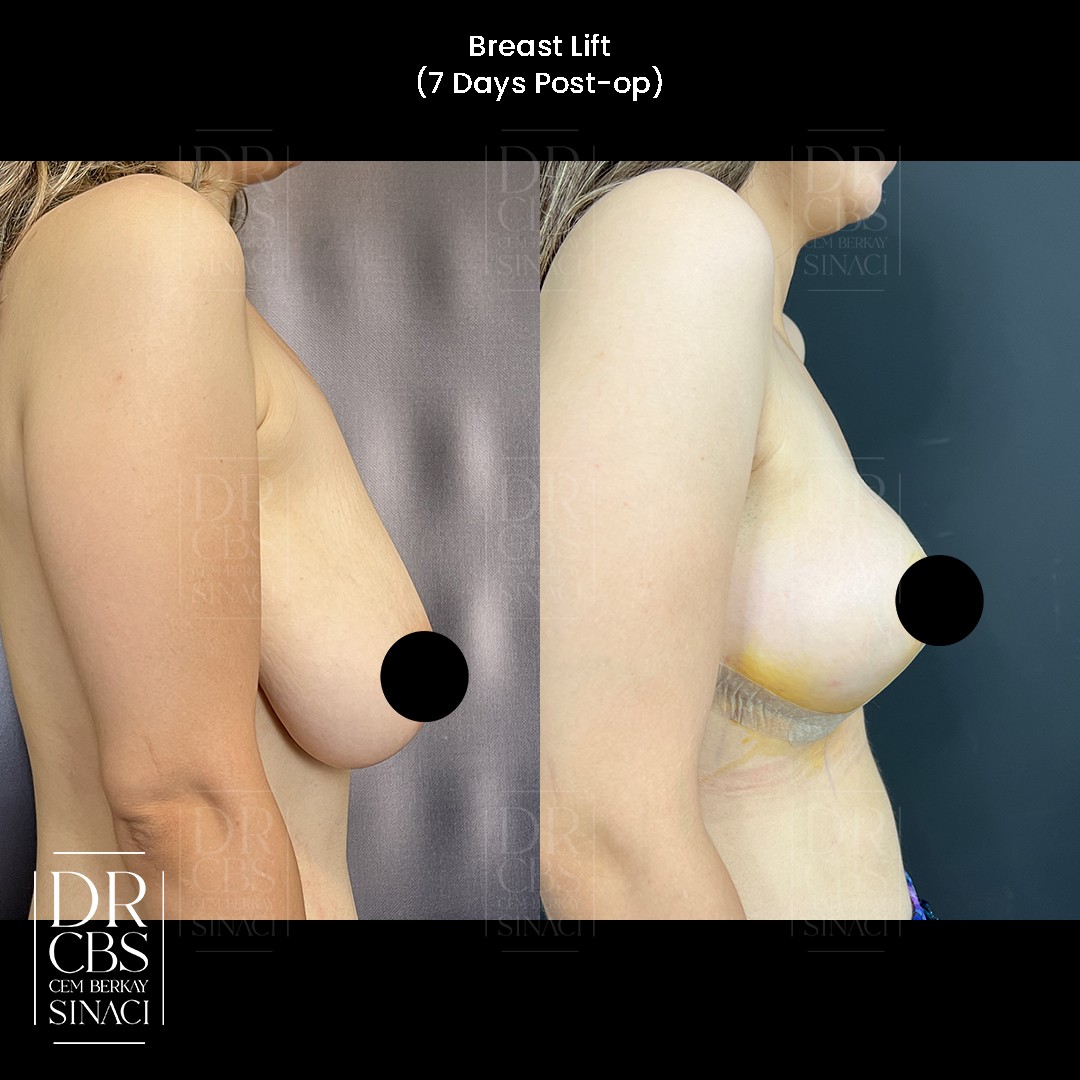
Breast lift with auto-augmentation at 7 days. No implant used, volume created from own tissue redistribution. Dr. Cem Berkay Sinaci, Istanbul.


Patient Overview
Patient: Mine
Gender: Female
Age: 28 years
Procedures: Breast lift (mastopexy) with auto-augmentation technique (no implant)
After photos taken at: 7 days post-surgery
Case Description
Mine underwent a breast lift with auto-augmentation at our clinic in Istanbul — a procedure that lifts, reshapes, and creates the appearance of fuller breasts using only the patient's own tissue, with no implant placed. Her after photographs at seven days capture the point where the first week of recovery ends and the early settling begins — a stage that is particularly informative for this specific procedure because the breast shape at one week already hints at the final contour in a way that implant-based cases at the same stage do not.
Why the No-Implant Result Looks Different at Day 7
In our implant-based mastopexy cases, the day-seven breast looks high, firm, and boxy because the implant has not yet settled into the lower pole. Weeks to months of "drop and fluff" are needed before the final shape emerges. With auto-augmentation and no implant, this settling dynamic does not exist. There is no implant waiting to descend. The breast tissue has already been placed in its final configuration during surgery — reshaped, concentrated, and secured into a projected mound with the internal support structure holding it in position.
What does change between day seven and the final result is swelling resolution and tissue softening. The breast at one week is still edematous, which adds temporary volume and firmness. As this swelling clears over the following four to six weeks, the breast will become slightly smaller and noticeably softer. But the shape — the contour, the projection, the position on the chest wall — will remain largely unchanged. This is a meaningful advantage of the no-implant approach from a recovery experience standpoint: what you see early on is much closer to what you get.
Auto-Augmentation as a Standalone Technique
Our gallery now includes auto-augmentation combined with the internal bra technique and with fat injection. Mine's case demonstrates auto-augmentation in its simplest form — tissue redistribution and a standard mastopexy, without the internal bra flap and without fat grafting. This stripped-down version of the technique is appropriate when the patient has adequate tissue volume, reasonable skin quality, and modest enhancement goals.
The technique works by mobilizing breast tissue from the lower and lateral portions of the breast — areas where tissue contributes to width and ptosis but not to projection — and rotating it into the central and upper pole. The tissue is secured with internal sutures in its new, concentrated configuration. The result is a breast that appears fuller and more projected than before, even though no volume has been added. It is an architectural change, not a volumetric one — the same material arranged in a more effective shape.
The degree of enhancement achievable with auto-augmentation alone depends entirely on how much tissue the patient starts with. A patient with generous breast tissue that has simply descended and spread out will see a dramatic improvement in projection and upper pole fullness. A patient with very little tissue to begin with will see a more modest change. Mine had sufficient tissue to produce a result that looked naturally full — not augmented, but shapely and proportionate.
The One-Week Recovery Without Implants
Mine's recovery experience differs from implant-based cases in several practical ways. The absence of an implant eliminates the deep chest tightness that implant patients describe in the first week — that sensation of pressure behind the breast from the implant stretching its pocket. Mine's discomfort was primarily at the skin surface — soreness along the incision lines and sensitivity in the reshaped tissue — rather than deep within the chest wall.
At day seven, she had returned to all normal daily activities. Walking, light housework, desk work, and driving were comfortable. The surgical support bra was still in place and would remain for another three to five weeks. Upper body exercise remained restricted, but the functional limitation was less pronounced than in implant cases because there was no pocket healing to protect.
This lighter recovery profile is one of the practical advantages of the no-implant approach. Patients who are drawn to the idea of avoiding implants often discover that the recovery benefits reinforce their decision — less internal discomfort, fewer restrictions, and a faster return to physical normalcy.
Who Is a Candidate for Auto-Augmentation Without Implants?
The ideal candidate has several characteristics. Adequate existing breast tissue is the most important — there must be enough volume to redistribute meaningfully. Ptosis is actually an advantage in this context, because the descended tissue that creates the sagging is the same tissue that will be mobilized and reshaped into the new, projected mound. A patient with significant ptosis and adequate volume is the best candidate, because the auto-augmentation converts the problem (descended tissue) into the solution (projected fullness).
Patients with very small breasts and minimal ptosis are generally not good candidates. There is simply not enough tissue to redistribute, and the result would be a well-lifted but still small breast. For these patients, implants or fat injection remain the most reliable methods for achieving meaningful volume enhancement.
Realistic expectations are essential. Auto-augmentation produces a natural-looking breast with improved projection and upper pole fullness — but it does not produce the dramatic size increase that implants provide. Patients who want to go from an A cup to a D cup need implants. Patients who want to go from a ptotic B cup to a lifted, shapely B-to-C cup through tissue reshaping alone are excellent auto-augmentation candidates.
Surgeon's Note
Mine's case demonstrates auto-augmentation in its purest form — no internal bra, no fat injection, no implant. Just the patient's own breast tissue, surgically reshaped and lifted. The seven-day result already shows a breast that is compact, projected, and well-positioned on the chest wall. Because there is no implant settling process, the shape will evolve only through swelling resolution and tissue softening rather than through the dramatic positional changes that characterize implant-based recoveries.
I find this approach particularly satisfying in patients like Mine whose tissue lends itself to redistribution. The procedure converts what the patient perceives as a problem — excess, descended breast tissue — into the source of her improvement. Nothing is added and nothing is wasted. The same tissue that was creating the ptotic, deflated appearance is rearranged into a shape that looks naturally full and youthful. It is plastic surgery in its most literal sense: reshaping what is already there.