
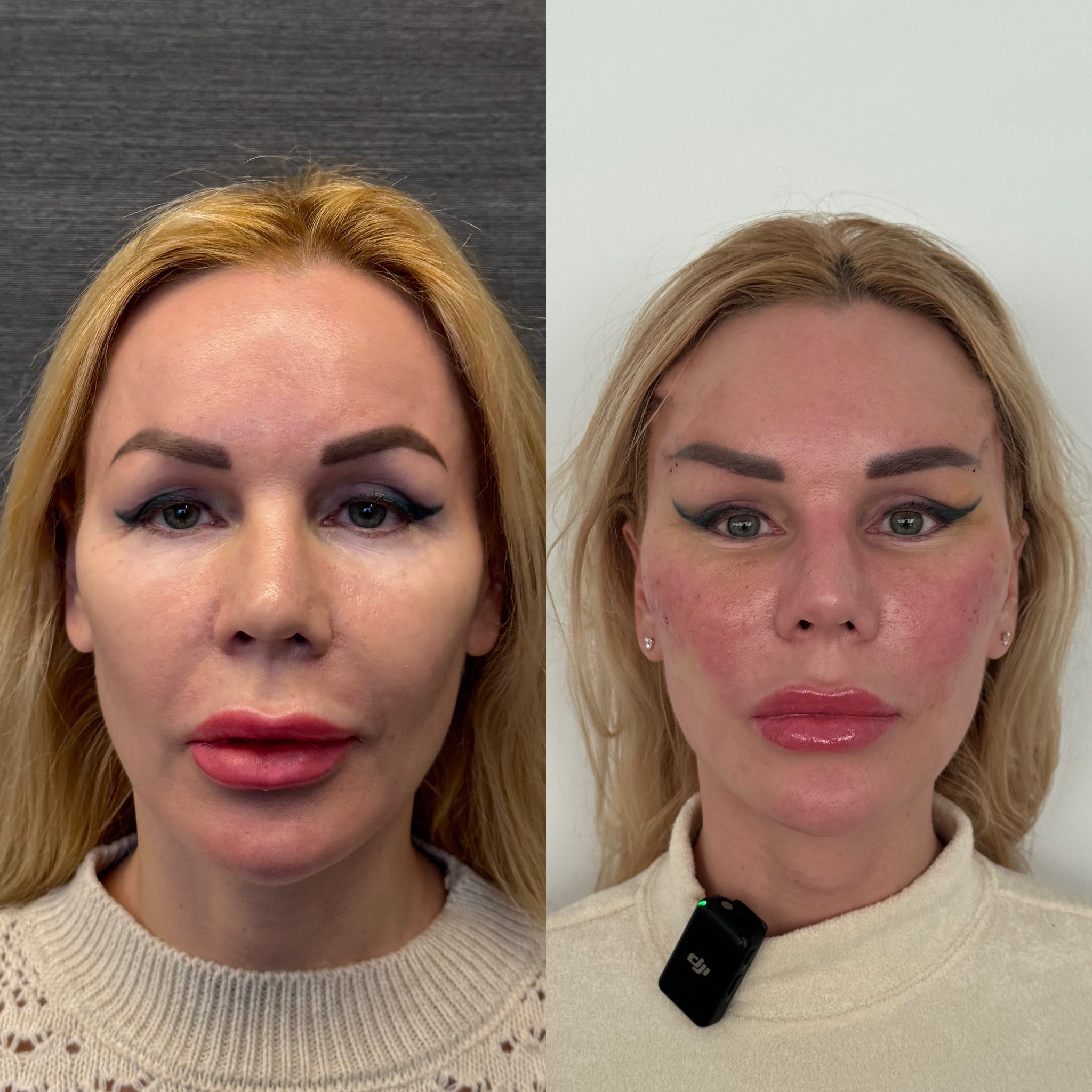
Temporal Browlift Before After Results | 6 Days Post-Op
See 6-day temporal browlift before after photos by board-certified plastic surgeon Dr. Cem Berkay Sinaci in Istanbul, Turkey. Natural brow repositioning results


Patient Overview
Patient: Marina
Age: 42 years old
Gender: Female
Procedures: Temporal face and browlift
After photos taken at: 6 days post-surgery
Origin: United Kingdom
Lifting the Upper Face Without Changing the Identity
When patients research facelifts, the conversation almost always begins with the jawline and neck. But for many women, the earliest and most bothersome signs of facial aging appear higher — in the heaviness of the brow, the hooding of the upper eyelids, and the subtle descent of the temples that gradually transforms a bright, open expression into one that looks perpetually tired. Marina, a 42-year-old patient from the United Kingdom, recognized this pattern in her own face and traveled to Istanbul specifically to address the upper third before the lower face required attention.
Her six-day post-operative photos show the early results of a temporal face and browlift — a procedure that targets the area most responsible for how rested, alert, and youthful the eyes appear within the overall facial frame.
Why the Brow Descends Before Everything Else
Facial aging does not happen uniformly. The forehead and brow region are among the first areas to show gravitational descent because the soft tissue attachments in this zone are relatively sparse compared to the midface. The brow fat pad, the superficial temporal fascia, and the skin of the lateral forehead gradually slide downward and inward over the years, driven by gravity and the progressive weakening of the fascial ligaments that once held everything in position.
This descent has a cascading effect. As the brow drops, it pushes excess tissue onto the upper eyelid, creating a heaviness or hooding that can make the eyes appear smaller and more enclosed. The lateral brow — the tail end near the temples — typically falls first, which is why many patients notice that their eyes look increasingly downturned or sad at the outer corners even when their mood is perfectly fine.
For Marina, this lateral brow descent was the primary concern. At 42, her lower face and jawline still maintained good definition, but the upper face had begun to lose the open, elevated quality that characterized her younger appearance. The temporal browlift was selected specifically to restore lift where it was needed most without altering the areas that did not yet require intervention.
The Temporal Approach: Precision Over Breadth
A temporal browlift differs from a full coronal browlift in both scope and incision placement. Rather than an incision stretching from ear to ear across the top of the scalp, the temporal approach uses shorter incisions hidden within the hairline at the temples. Through these incisions, the surgeon accesses the deep temporal fascia and releases the ligamentous attachments that are tethering the lateral brow in its descended position.
Once these attachments are released, the brow tissue is repositioned superiorly and laterally — upward and slightly outward — restoring the natural arch that gravity has flattened. The tissue is then secured in its new position, and the incisions are closed within the hair-bearing scalp where they become virtually undetectable once healed.
The advantage of this targeted approach is twofold. First, it addresses the specific area of descent — the lateral brow and temple — without unnecessarily manipulating the central forehead, which in many patients has not yet fallen significantly. Second, the recovery is considerably shorter than a full coronal lift because the surgical dissection is more limited. For international patients like Marina who need to travel home within a reasonable timeframe, this focused recovery profile is a practical benefit.
Combining Temporal Lift with Facial Rejuvenation
Marina's procedure included both the temporal browlift and a facelift component addressing the lateral face. This combination allows the surgeon to create a harmonious rejuvenation across the upper and middle thirds of the face in a single session rather than staging separate procedures months apart.
The facelift component in this case targeted the lateral cheek and the junction between the midface and the lower face. By addressing both the descended brow above and the early midface laxity below through coordinated tissue repositioning, the result achieves a balanced, natural-looking lift that avoids the common pitfall of treating one facial zone in isolation.
When only the brow is lifted without addressing adjacent areas, the result can appear segmented — a fresh upper face sitting above an untreated middle zone that still shows its age. Conversely, lifting the midface without correcting the brow leaves the patient looking rejuvenated from the cheekbones down but still heavy and tired around the eyes. Marina's combined approach ensures that the entire upper two-thirds of the face ages — or rather, un-ages — as a cohesive unit.
Reading Day-Six Results on the Face
Interpreting early facial surgery results requires a different framework than evaluating body contouring photos. The face has an extraordinarily rich blood supply, which means two things simultaneously: it heals remarkably fast compared to the trunk and extremities, but it also swells more dramatically in the acute phase.
At six days after a temporal browlift and facelift, residual swelling is still present, particularly around the eyes and temples. Mild bruising may be visible, though it is typically transitioning from purple to yellow-green at this stage as the body reabsorbs the extravasated blood. The incision lines within the hairline are still fresh and slightly pink.
What is already visible at day six, despite these temporary findings, is the structural change. The brow position has been elevated. The lateral hooding over the eyes has been reduced. The overall expression of the upper face has shifted from heavy and fatigued to open and refreshed. These positional changes are permanent — they are the result of tissue repositioning and fixation, not swelling or temporary post-operative fullness.
Over the next four to six weeks, the residual swelling will resolve progressively. The final soft tissue settling typically completes by three months, at which point the result has fully matured. But the architectural improvement — the actual lift — is established from the day of surgery. Everything that follows is refinement, not transformation.
International Patients and the Istanbul Experience
Marina's journey from the United Kingdom to Istanbul for facial surgery reflects a pattern we see frequently at our clinic. British patients researching face rejuvenation options often find that the combination of board-certified surgical expertise, advanced facility standards, and direct accessibility makes Istanbul a compelling choice for procedures that demand precision and artistry.
The pre-operative consultation for Marina was conducted with particular attention to her specific anatomy and goals. Facial proportions, skin thickness, brow position at rest and during animation, the degree of lateral hooding, and the relationship between the brow and the upper eyelid were all assessed and documented. These measurements informed the surgical plan — specifically, how much lift was needed, at what vector, and whether the central brow required any adjustment or could be left untouched.
This individualized planning is essential because no two faces age identically. The temporal browlift that produces a beautiful result for a 42-year-old with isolated lateral descent would be entirely wrong for a 55-year-old with global brow ptosis and deep forehead rhytids. Each surgical plan must be designed for the face in front of the surgeon, not adapted from a template.
The Understated Art of Upper Facial Rejuvenation
As a Fellow of the European Board of Plastic, Reconstructive and Aesthetic Surgery with specialized training in facial procedures — including cadaver-based surgical courses and international fellowship experience — I consider upper facial surgery among the most nuanced work in aesthetic plastic surgery. The margins between a natural result and an overdone one are measured in millimeters. An over-elevated brow creates a permanently surprised expression. An asymmetric lift is immediately noticeable because the human brain is exquisitely sensitive to differences between the left and right eye region.
Marina's day-six photos demonstrate the goal of every temporal browlift we perform at our clinic: a visible but natural elevation that restores the youthful relationship between the brow, the upper eyelid, and the temple — without any suggestion that surgery was involved. The face looks rested, not altered. Refreshed, not redesigned. And that distinction is what separates technically competent surgery from surgery that truly serves the patient.