
Facelift Incision Placement and Day-Four Swelling Guide
Day 4 deep plane facelift and temporal browlift photos showing incision and post-op swelling. Honest early recovery guide from plastic surgeon in Istanbul

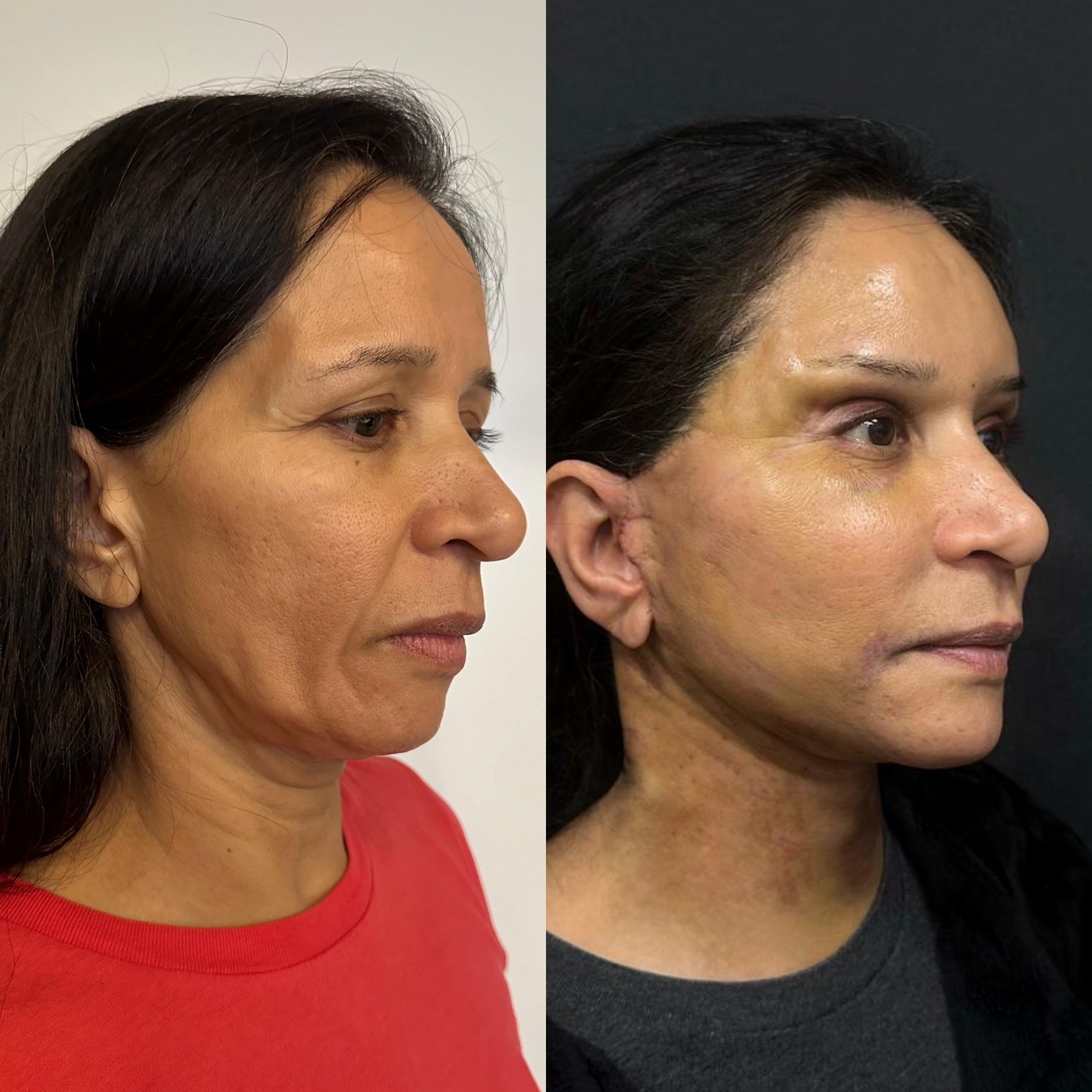
Patient Overview
Patient: Maher
Age: 55
Gender: Female
Procedures: Deep plane facelift, temporal browlift
After photos taken at: 4 days post-op (educational: incision placement and swelling)
Origin: United States (Iranian heritage)
Location: Istanbul, Turkey
Why We Show Day-Four Photos
The vast majority of facelift galleries present results at their most polished — months after surgery, when healing is complete and the outcome speaks for itself. These photographs serve a different purpose entirely. Maher's four-day images are published not to showcase a finished result but to answer the questions that prospective patients most urgently want answered: Where exactly are the incisions? How much swelling is normal? What does the face actually look like in the first days after a deep plane facelift?
Dr. Cem Berkay Sinaci, a fellow of the European Board of Plastic Reconstructive and Aesthetic Surgery (FEBOPRAS) and member of ISAPS and ASPS, believes that informed patients make better decisions. Showing only final results creates an incomplete picture. The early postoperative period — with its swelling, bruising, and visible incision lines — is the reality that every facelift patient will experience, and understanding it beforehand reduces anxiety and sets realistic expectations for recovery.
Where the Deep Plane Facelift Incisions Are Placed
The deep plane facelift incision follows a carefully planned path designed to be concealed within natural anatomical landmarks once healed. It begins in the temporal hairline above the ear, descends along the natural crease where the ear meets the face (the preauricular sulcus), curves beneath the earlobe, and continues behind the ear into the postauricular crease before returning into the occipital hairline.
At four days, these incision lines are visible — they are fresh surgical wounds in the process of early healing. What Maher's photographs demonstrate is the precision of their placement. Each segment of the incision sits within a fold, crease, or hair-bearing area that will conceal it once healing is complete. The preauricular incision follows the tragal edge or the natural skin crease in front of the ear. The postauricular portion sits in the groove behind the ear. The hairline components are placed within hair-bearing scalp where regrowth will cover them entirely.
Having refined his incision design through fellowship training with Raul Gonzalez in Brazil and cadaver dissection courses in Bangkok, Dr. Sinaci tailors the exact path to each patient's anatomy — accounting for hairline position, ear shape, and skin quality to ensure the most inconspicuous possible scar trajectory.
Temporal Browlift Incision Placement
The temporal browlift incisions are separate from the facelift incisions, placed within the temporal hairline above and slightly behind the temples. These small incisions — typically two to three centimetres each — provide access to the lateral brow tissues, allowing the outer brow to be elevated and secured in a more youthful position. At four days, these incision lines are visible within the hairline. As healing progresses and hair regrowth fills in around them, they become virtually undetectable. By three months, even parting the hair directly over the incision site typically reveals only a fine line that is difficult to identify.
Understanding Normal Swelling at Day Four
The swelling visible in Maher's photographs is entirely expected and normal at four days after a deep plane facelift. Postoperative oedema peaks between day two and day four, meaning these images capture the face at or near its maximum swelling point. Understanding this is important: the face will look progressively less swollen from this point forward, with noticeable daily improvement.
The swelling distribution follows predictable patterns. The cheeks and jawline show the most volume increase because this is where the deepest tissue manipulation occurred. The area in front of the ears, where the skin flap was elevated, may appear fuller than the rest of the face. The neck typically swells less dramatically but may show firmness along the jawline. Some asymmetry in swelling between the two sides is common and does not indicate an asymmetric result — it simply reflects slightly different rates of fluid accumulation and drainage between the left and right sides.
By one week, the swelling will have reduced noticeably. By two weeks, it will have diminished enough that most patients feel comfortable in social settings. By one month, the major swelling is resolved. Subtle residual oedema — often only perceptible to the patient — may persist for two to three months before fully resolving.
Bruising: What to Expect
Although the degree varies between patients, bruising after a deep plane facelift typically appears within the first twenty-four to forty-eight hours and peaks around day three to five. It follows gravity, meaning bruising that begins in the cheek may track downward to the jawline and neck over the first week. The colour progression is predictable: dark purple or blue initially, transitioning to green and then yellow as the haemoglobin is reabsorbed. Most visible bruising resolves by ten to fourteen days. Residual yellow discolouration, easily concealed with light makeup, may persist slightly longer.
What These Early Photos Tell Us About the Final Result
Even at four days, with maximum swelling and fresh incision lines, certain elements of the facelift result are already apparent. The jawline, though swollen, already shows improved definition compared to the preoperative contour. The neck, despite oedema, is already cleaner in its transition from chin to cervical area. The brow sits in its elevated position. These structural changes — achieved through deep tissue repositioning — are visible even through the acute postoperative swelling because they represent the new anatomical position of the underlying SMAS and facial tissues.
As the swelling resolves over the coming weeks and months, these early indicators will be progressively refined and revealed. The final result, typically assessed at six to twelve months, will bear little resemblance to the four-day photographs in terms of surface appearance — the swelling and bruising will be distant memories — but the structural foundation visible here is exactly what that final result will be built upon.
The Recovery Timeline Ahead
For patients researching deep plane facelift recovery, Maher's four-day photographs represent the starting point of a healing arc that follows a well-established trajectory. Most sutures are removed between five and seven days. Social presentability — the point at which the patient feels comfortable being seen in public — typically arrives between ten and fourteen days, though some patients are comfortable earlier. Return to non-strenuous work is usually possible by two weeks. Exercise and vigorous activity are gradually reintroduced after four to six weeks. The result continues to refine subtly for six to twelve months.
Honest Documentation for Informed Decisions
Maher, a 55-year-old patient of Iranian heritage living in the United States, chose to have her facelift in Istanbul after thorough research. By consenting to share her four-day photographs, she contributes to a more honest representation of what facial surgery involves. For international patients considering a deep plane facelift, these early recovery images provide the kind of transparent, unedited documentation that polished final results alone cannot offer — the full picture of the journey from operating table to settled, natural rejuvenation.