
Male Revision Facelift with Lower Blepharoplasty
Before and after revision facelift, lower blepharoplasty and lip lift in a 62-year-old male patient. 6-day results combining three facial procedures in Istanbul
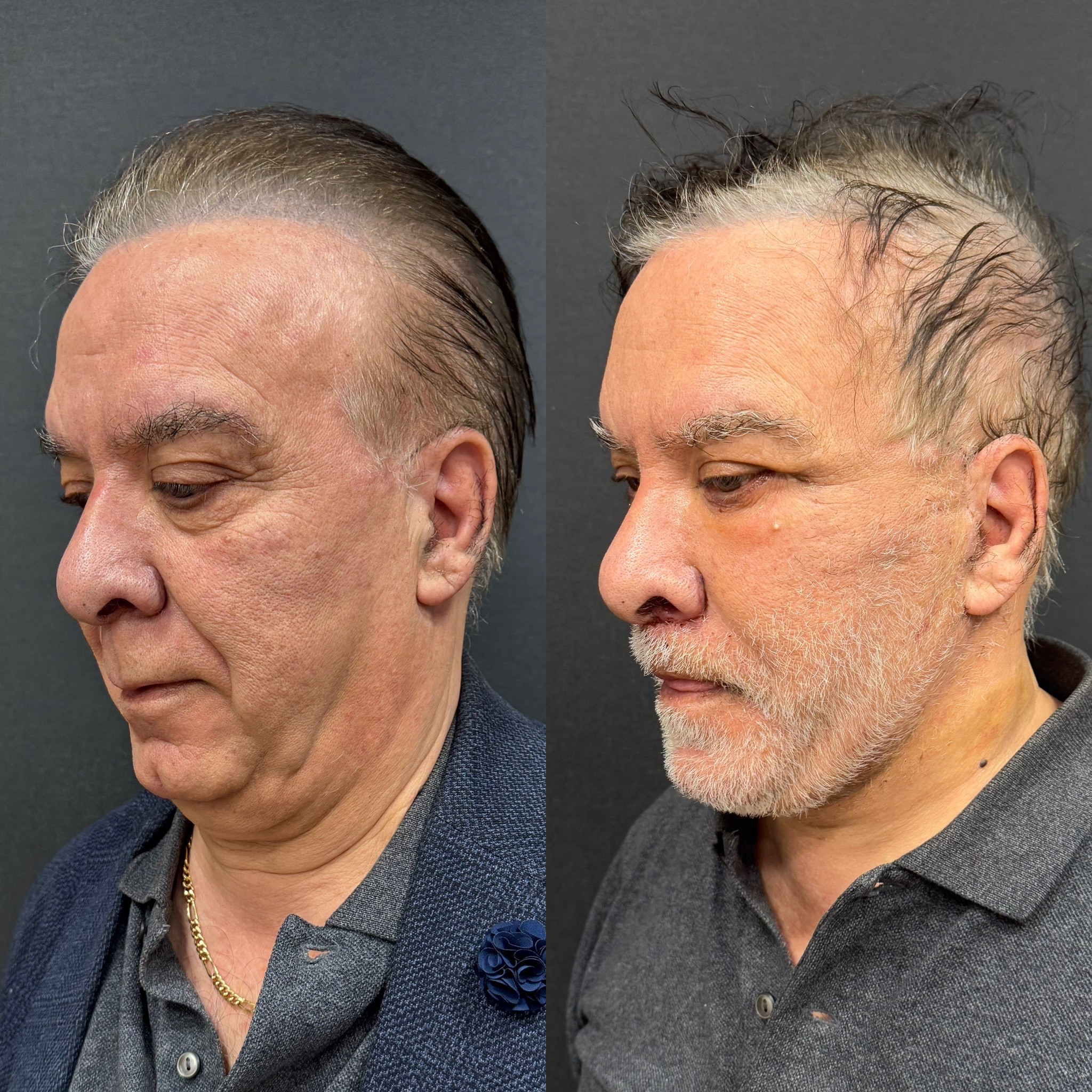


Patient Overview
Patient: Jalaleddin
Age: 62
Gender: Male
Procedures: Revision face and neck lift, lower blepharoplasty, lip lift
After photos taken at: 6 days post-op
Origin: United States (Persian heritage)
Location: Istanbul, Turkey
Three Procedures, One Cohesive Male Facial Rejuvenation
Revision facelift surgery on its own is among the most technically demanding operations in facial plastic surgery. Combining it with lower blepharoplasty and a lip lift in a single session adds further complexity — but also the opportunity to address the entire face comprehensively rather than in stages. Jalaleddin, a 62-year-old male patient of Persian heritage living in the United States, had undergone a previous face and neck lift that left him unsatisfied with the result. Rather than simply revising the prior work, he sought a surgeon who could correct the existing issues while simultaneously rejuvenating the periorbital region and restoring upper lip proportion — concerns that his original surgery had not addressed.
Dr. Cem Berkay Sinaci, a fellow of the European Board of Plastic Reconstructive and Aesthetic Surgery (FEBOPRAS) and member of ISAPS and ASPS, planned a three-component approach: revision face and neck lift to correct the lower face and cervical contour, lower blepharoplasty to address under-eye puffiness and skin excess, and a bullhorn lip lift to shorten the elongated philtrum and restore upper lip vermilion show.
The Revision Face and Neck Lift
Operating through tissue that has been previously dissected is fundamentally different from performing a primary facelift. The normal anatomical planes — the layers that a surgeon separates and works within — have been disrupted by the first surgery and replaced by scar tissue. The SMAS layer may have been plicated, folded, or partially excised. The skin flaps may have reduced blood supply due to the previous dissection. The facial nerve branches, which run through these same tissue planes, must be identified and protected in an environment where the usual anatomical landmarks may have shifted.
For Jalaleddin, Dr. Sinaci carefully re-entered the previously operated planes, releasing scar tissue to re-establish the correct dissection layer, and performed a revision lift that addressed the residual laxity and contour irregularities left by the first procedure. The jawline was redefined, the jowl tissue was repositioned, and the neck was tightened with attention to the platysma muscle and cervical skin envelope. Having trained in advanced facial rejuvenation through fellowship with Raul Gonzalez in Brazil and cadaver dissection courses in Bangkok, Dr. Sinaci approaches revision cases with the understanding that no two are alike — each reflects the specific technique used by the previous surgeon and how the individual patient healed.
For a deeper understanding of why the neck is central to facial rejuvenation, Dr. Sinaci has published a detailed guide: The Secret to a Youthful Face: Why Your Neck Holds the Key.
Male Facial Surgery: A Different Aesthetic Framework
Facial rejuvenation in male patients demands a fundamentally different approach than in female patients, and this difference extends across all three of Jalaleddin's procedures. The male face is characterised by stronger skeletal prominences, thicker skin with a denser vascular network from the beard follicles, a different hairline pattern affecting incision placement, and aesthetic ideals that favour angularity and strength over softness and curvature.
In the revision facelift, this meant preserving a masculine jawline contour and avoiding any over-tightening that could create a feminised or pulled appearance. In the lower blepharoplasty, it meant conservative tissue removal to maintain the natural fullness that suits a male eye rather than creating the wider, brighter look that might be appropriate for a female patient. In the lip lift, it meant a subtle shortening of the philtrum that restores proportion without creating an exaggerated or overly defined upper lip.
For more on the specific considerations of male facial surgery, read: Male Facelift: Understanding the Unique Aspects for Men.
Lower Blepharoplasty: Addressing the Under-Eye Area
Jalaleddin's lower eyelids showed herniated fat pads creating visible bags and lower lid skin laxity contributing to a fatigued appearance. The lower blepharoplasty was performed through a subciliary incision placed just beneath the lash line, providing access to the fat compartments and the skin envelope. The excess fat was reduced conservatively — enough to eliminate the visible puffiness without creating hollowness — and redundant skin was trimmed to smooth the lower lid surface.
Non-dissolvable sutures were used for the lower blepharoplasty closure. In the delicate lower eyelid skin, these sutures produce minimal inflammatory reaction compared to dissolvable alternatives and are removed at four to six days, consistently yielding finer, less conspicuous scars.
The Lip Lift Component
The distance between the base of the nose and the upper lip vermilion border — the philtrum — elongates with age in both men and women. This lengthening thins the visible upper lip, reduces vermilion show, and alters the proportion between the nose and mouth in a way that contributes significantly to an aged appearance. In Jalaleddin's case, the elongated philtrum was further emphasising the ageing of his lower face.
Dr. Sinaci performed a bullhorn lip lift — the only lip lift technique he uses — which removes a precisely measured strip of skin beneath the nose in a shape that follows the natural contour of the nasal base. The incision is closed with non-dissolvable sutures, which are removed at five to seven days. Internal suturing technique recreates the philtral columns — the vertical ridges that frame the central upper lip — adding structural definition to the result. The bullhorn approach shortens the philtrum while preserving the natural masculine lip shape, avoiding the exaggerated or feminised appearance that an overly aggressive lift could create in a male patient.
Six Days: Reading the Earliest Combined Result
Jalaleddin's before and after photographs at six days post-surgery capture all three procedures at their most raw. This is the stage where sutures have recently been removed, residual bruising may still be visible, and the tissues are in the acute phase of healing. Sharing a result this early requires confidence in the surgical execution because there is nowhere for imprecision to hide.
At six days, the structural changes from the revision facelift are already apparent — the jawline is more defined, the jowling is corrected, and the neck contour is markedly improved. The lower eyelids show the fat bags eliminated, though mild swelling in the lower lid area is normal at this stage. The lip lift has shortened the philtrum and increased the upper lip vermilion show, though the incision line beneath the nose is still in its earliest healing phase and will take several months to fade fully.
Every element of this result will continue to improve. Swelling will resolve over four to eight weeks. Bruising will clear within two weeks. The facelift and blepharoplasty scars will mature over three to twelve months. The lip lift scar, which sits in the well-vascularised skin of the nasal base, will transition from a visible pink line to a fine mark that blends with the natural crease at the nose-lip junction.
Why Combined Procedures Make Sense in Revision Cases
For a patient like Jalaleddin who is already undergoing the recovery from a revision facelift, adding lower blepharoplasty and a lip lift to the same session offers clear advantages. A single anaesthesia, a single recovery period, and a result where all three zones heal and settle simultaneously. Staging these as separate operations would mean three separate recoveries, three separate periods of visible healing, and the risk of a mismatched result where one area appears rejuvenated while the others still show signs of ageing. The combined approach produces a unified transformation that reads as natural and balanced rather than piecemeal.
Choosing a Revision Facelift Surgeon in Istanbul
Jalaleddin's journey from the United States to Istanbul for his revision surgery reflects the thorough research that revision patients typically undertake. Having experienced a result that did not meet expectations, these patients approach the selection of their revision surgeon with particular care — seeking board certification, specific experience with revision cases, and an aesthetic philosophy aligned with their goals. For male patients especially, finding a surgeon who understands the distinct requirements of male facial anatomy is essential.