
Face & Neck Aesthetics
Breast & Body Aesthetics
Nose Job
Non-surgical
Patient Resources

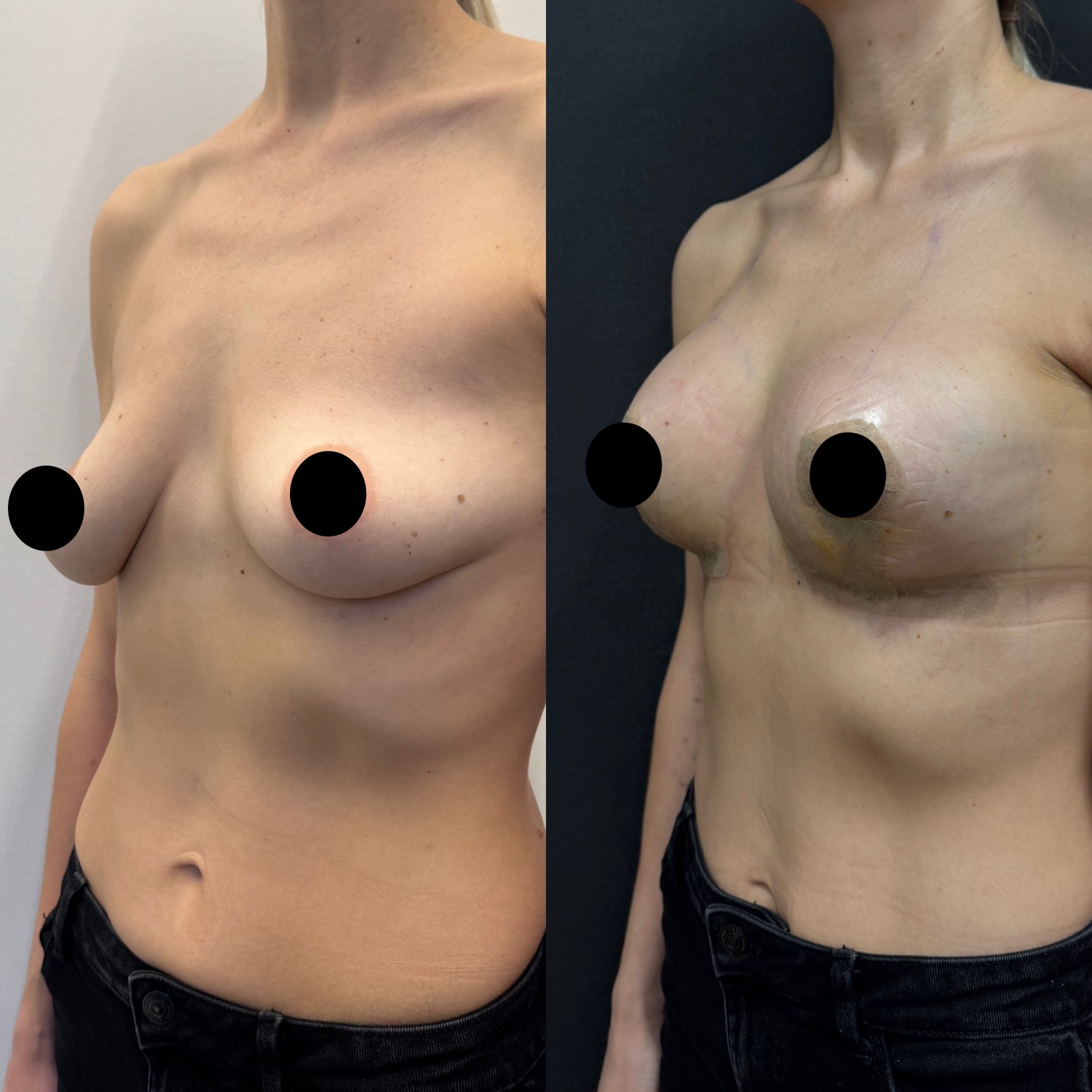
Breast Lift with Implants for Asymmetry | Day 5, Age 41
Breast lift with implants correcting breast asymmetry at 5 days. Mastopexy-augmentation before and after by Dr. Cem Berkay Sinaci, Istanbul, Turkey.


Patient Overview
Patient: Irina
Age: 41 years old
Gender: Female
Procedures: Breast lift (mastopexy) with implant augmentation, correction of breast asymmetry
After photos taken at: 5 days post-surgery
Case Description
Irina came to our clinic in Istanbul with a concern that she had been hesitant to discuss for years: her breasts were noticeably different from each other. One was larger and sat lower, the other was smaller with a different nipple position. Clothing, particularly swimwear and fitted tops, required constant adjustments. Bras never fit correctly because each side needed a different cup size. What might sound like a minor inconvenience had become a daily source of self-consciousness that affected how she dressed, how she carried herself, and how she felt about her body.
Breast asymmetry is far more common than most women realize. Virtually all women have some degree of difference between their breasts, but when the asymmetry becomes visually obvious — a full cup size or more of difference, noticeably different nipple positions, or distinctly different breast shapes — it moves from a normal anatomical variation into a condition that meaningfully affects quality of life.
How Asymmetry Changes the Surgical Plan
In a standard mastopexy-augmentation, the surgeon performs essentially the same procedure on both sides — same implant, same lift pattern, same skin excision. The goal is enhancement of two breasts that start from a similar baseline. In asymmetry correction, each breast is treated as an independent surgical problem with its own solution, and the goal is to make two different starting points converge on a single, symmetrical result.
For Irina, this meant evaluating each breast separately across multiple dimensions. The volume difference required either different implant sizes on each side, or the same implant with different degrees of tissue rearrangement to equalize the apparent volume. The nipple position difference required different amounts of lift on each side — more skin excision on the breast with the lower nipple, less on the other. The shape difference required different approaches to the skin envelope management to produce matching contours.
Every decision made on one side was cross-referenced against the other. The procedure alternated between the two breasts throughout, with the surgeon sitting the patient up at multiple points during the operation to compare the sides in an upright position — because symmetry can only be accurately assessed when gravity is acting on the tissue as it will in everyday life.
The Challenge of Achieving Symmetry
Perfect symmetry is not achievable in any breast surgery, and this is a conversation that every asymmetry patient must have before the procedure. The chest wall itself is often asymmetric — ribs may be more prominent on one side, the inframammary fold may sit at a slightly different height, and the pectoralis muscle may have a different shape or thickness on each side. These skeletal and muscular differences are fixed landmarks that the breast sits upon, and they influence how the breast appears even after surgical correction.
The realistic goal — and the one Irina and I agreed upon — is the best achievable symmetry: breasts that match closely enough in size, shape, and nipple position that the difference is imperceptible in clothing and minimal when unclothed. Moving from obviously asymmetric to subtly asymmetric is a dramatic improvement in the patient's daily experience, even if mathematical perfection is not possible.
This honest framing before surgery is critical. Patients who expect identical breasts will find imperfections to focus on no matter how successful the correction. Patients who understand the realistic goal appreciate how much has changed and are consistently satisfied with the outcome.
What Day 5 Shows in an Asymmetry Case
Evaluating symmetry at day five is unreliable, and this is important for patients to understand early in their recovery. Swelling does not develop symmetrically. One breast may swell more than the other based on the extent of the work performed on each side, individual tissue response, and even sleeping position during the first few nights. The implants are both still elevated and have not begun settling. And the lift closure is at its tightest, which may create slightly different tension patterns on each side depending on how much skin was removed.
In Irina's day-five photographs, both breasts show the expected elevated, firm postoperative appearance. Comparing the two sides at this stage may reveal apparent differences that are entirely attributable to asymmetric swelling rather than the surgical result. These differences resolve as the swelling clears and the implants settle over the following weeks.
The true symmetry assessment happens at three months, when the swelling is completely resolved, the implants have reached their final position, and the tissues have adapted to their new configuration. Patients who judge their asymmetry correction at day five are evaluating a work in progress, not a finished result.
Surgeon's Note
Asymmetry correction is one of the most intellectually demanding procedures in breast surgery because every decision is relative rather than absolute. There is no single correct implant size — there is only the correct size for each breast relative to the other. There is no single correct nipple height — there is only the correct height that brings both nipples into alignment. The entire procedure is an exercise in bilateral calibration.
Irina's case required different approaches on each side, tailored to the specific characteristics of each breast. The intraoperative assessment involved multiple upright evaluations to compare the sides under the influence of gravity, and adjustments were made until the closest possible match was achieved. At day five, the foundation for symmetry is in place. The settling process over the next three months will determine the final bilateral comparison.
What I always tell asymmetry patients at their first postoperative visit — and what I want prospective patients reading this to understand — is that the two breasts will heal at slightly different rates and look slightly different at every stage of recovery until the settling is complete. This is not a sign that the correction has failed. It is a sign that two different starting points are following two slightly different paths toward the same destination.
Frequently Asked Questions
Is breast asymmetry normal?
Yes. The majority of women have some degree of asymmetry between their breasts. Studies suggest that measurable differences in volume, shape, or nipple position exist in over 90 percent of women. In most cases the difference is minor and not visually noticeable. When asymmetry is significant enough to affect clothing fit, bra sizing, or self-confidence, surgical correction becomes a reasonable option.
Will my breasts look uneven during recovery?
Yes, and this is expected. Swelling develops at different rates on each side, and the two implants settle on their own individual timelines. Asymmetric swelling during the first six to eight weeks does not predict the final result. The true symmetry comparison becomes reliable at approximately three months post-surgery, once all swelling has resolved and both implants have reached their final position.
Do asymmetric breasts require different-sized implants?
Sometimes. The approach depends on the nature of the asymmetry. If the primary difference is volume, different implant sizes may be used. If the difference is primarily shape or nipple position, the same implant may be used with different lift techniques on each side. In some cases, a combination approach is needed — different implant sizes paired with different degrees of skin excision and tissue rearrangement. The specific plan is determined during the consultation based on clinical measurements.
Can breast asymmetry come back after correction?
The surgical correction is permanent in the sense that the structural changes made — implant placement, tissue repositioning, skin excision — do not reverse. However, the two breasts may age at slightly different rates over the decades, and weight fluctuations may affect each side differently. Significant asymmetry recurrence is uncommon, but subtle differences may re-emerge over many years as part of the natural aging process.
Patient Overview
Patient: Irina
Age: 41 years old
Gender: Female
Procedures: Breast lift (mastopexy) with implant augmentation, correction of breast asymmetry
After photos taken at: 5 days post-surgery
Case Description
Irina came to our clinic in Istanbul with a concern that she had been hesitant to discuss for years: her breasts were noticeably different from each other. One was larger and sat lower, the other was smaller with a different nipple position. Clothing, particularly swimwear and fitted tops, required constant adjustments. Bras never fit correctly because each side needed a different cup size. What might sound like a minor inconvenience had become a daily source of self-consciousness that affected how she dressed, how she carried herself, and how she felt about her body.
Breast asymmetry is far more common than most women realize. Virtually all women have some degree of difference between their breasts, but when the asymmetry becomes visually obvious — a full cup size or more of difference, noticeably different nipple positions, or distinctly different breast shapes — it moves from a normal anatomical variation into a condition that meaningfully affects quality of life.
How Asymmetry Changes the Surgical Plan
In a standard mastopexy-augmentation, the surgeon performs essentially the same procedure on both sides — same implant, same lift pattern, same skin excision. The goal is enhancement of two breasts that start from a similar baseline. In asymmetry correction, each breast is treated as an independent surgical problem with its own solution, and the goal is to make two different starting points converge on a single, symmetrical result.
For Irina, this meant evaluating each breast separately across multiple dimensions. The volume difference required either different implant sizes on each side, or the same implant with different degrees of tissue rearrangement to equalize the apparent volume. The nipple position difference required different amounts of lift on each side — more skin excision on the breast with the lower nipple, less on the other. The shape difference required different approaches to the skin envelope management to produce matching contours.
Every decision made on one side was cross-referenced against the other. The procedure alternated between the two breasts throughout, with the surgeon sitting the patient up at multiple points during the operation to compare the sides in an upright position — because symmetry can only be accurately assessed when gravity is acting on the tissue as it will in everyday life.
The Challenge of Achieving Symmetry
Perfect symmetry is not achievable in any breast surgery, and this is a conversation that every asymmetry patient must have before the procedure. The chest wall itself is often asymmetric — ribs may be more prominent on one side, the inframammary fold may sit at a slightly different height, and the pectoralis muscle may have a different shape or thickness on each side. These skeletal and muscular differences are fixed landmarks that the breast sits upon, and they influence how the breast appears even after surgical correction.
The realistic goal — and the one Irina and I agreed upon — is the best achievable symmetry: breasts that match closely enough in size, shape, and nipple position that the difference is imperceptible in clothing and minimal when unclothed. Moving from obviously asymmetric to subtly asymmetric is a dramatic improvement in the patient's daily experience, even if mathematical perfection is not possible.
This honest framing before surgery is critical. Patients who expect identical breasts will find imperfections to focus on no matter how successful the correction. Patients who understand the realistic goal appreciate how much has changed and are consistently satisfied with the outcome.
What Day 5 Shows in an Asymmetry Case
Evaluating symmetry at day five is unreliable, and this is important for patients to understand early in their recovery. Swelling does not develop symmetrically. One breast may swell more than the other based on the extent of the work performed on each side, individual tissue response, and even sleeping position during the first few nights. The implants are both still elevated and have not begun settling. And the lift closure is at its tightest, which may create slightly different tension patterns on each side depending on how much skin was removed.
In Irina's day-five photographs, both breasts show the expected elevated, firm postoperative appearance. Comparing the two sides at this stage may reveal apparent differences that are entirely attributable to asymmetric swelling rather than the surgical result. These differences resolve as the swelling clears and the implants settle over the following weeks.
The true symmetry assessment happens at three months, when the swelling is completely resolved, the implants have reached their final position, and the tissues have adapted to their new configuration. Patients who judge their asymmetry correction at day five are evaluating a work in progress, not a finished result.
Surgeon's Note
Asymmetry correction is one of the most intellectually demanding procedures in breast surgery because every decision is relative rather than absolute. There is no single correct implant size — there is only the correct size for each breast relative to the other. There is no single correct nipple height — there is only the correct height that brings both nipples into alignment. The entire procedure is an exercise in bilateral calibration.
Irina's case required different approaches on each side, tailored to the specific characteristics of each breast. The intraoperative assessment involved multiple upright evaluations to compare the sides under the influence of gravity, and adjustments were made until the closest possible match was achieved. At day five, the foundation for symmetry is in place. The settling process over the next three months will determine the final bilateral comparison.
What I always tell asymmetry patients at their first postoperative visit — and what I want prospective patients reading this to understand — is that the two breasts will heal at slightly different rates and look slightly different at every stage of recovery until the settling is complete. This is not a sign that the correction has failed. It is a sign that two different starting points are following two slightly different paths toward the same destination.
Frequently Asked Questions
Is breast asymmetry normal?
Yes. The majority of women have some degree of asymmetry between their breasts. Studies suggest that measurable differences in volume, shape, or nipple position exist in over 90 percent of women. In most cases the difference is minor and not visually noticeable. When asymmetry is significant enough to affect clothing fit, bra sizing, or self-confidence, surgical correction becomes a reasonable option.
Will my breasts look uneven during recovery?
Yes, and this is expected. Swelling develops at different rates on each side, and the two implants settle on their own individual timelines. Asymmetric swelling during the first six to eight weeks does not predict the final result. The true symmetry comparison becomes reliable at approximately three months post-surgery, once all swelling has resolved and both implants have reached their final position.
Do asymmetric breasts require different-sized implants?
Sometimes. The approach depends on the nature of the asymmetry. If the primary difference is volume, different implant sizes may be used. If the difference is primarily shape or nipple position, the same implant may be used with different lift techniques on each side. In some cases, a combination approach is needed — different implant sizes paired with different degrees of skin excision and tissue rearrangement. The specific plan is determined during the consultation based on clinical measurements.
Can breast asymmetry come back after correction?
The surgical correction is permanent in the sense that the structural changes made — implant placement, tissue repositioning, skin excision — do not reverse. However, the two breasts may age at slightly different rates over the decades, and weight fluctuations may affect each side differently. Significant asymmetry recurrence is uncommon, but subtle differences may re-emerge over many years as part of the natural aging process.
For International Patients
You can read our details who will come from abroad

For International Patients
You can read our details who will come from abroad
For International Patients
You can read our details who will come from abroad
Schedule Your Consultation
Begin your journey to a more confident you.
Schedule Your Consultation
Begin your journey to a more confident you.
Schedule Your Consultation
Begin your journey to a more confident you.
Dr. CBS, European and Turkish Board-certified plastic, reconstructive, and aesthetic surgeon in Istanbul
Face & Neck
Breast & Body
Non-surgical
Copyright © 2026 Dr. Cem Berkay Sınacı. All Rights Reserved
Dr. CBS, European and Turkish Board-certified plastic, reconstructive, and aesthetic surgeon in Istanbul
Face & Neck
Breast & Body
Non-surgical
Copyright © 2026 Dr. Cem Berkay Sınacı. All Rights Reserved
Dr. CBS, European and Turkish Board-certified plastic, reconstructive, and aesthetic surgeon in Istanbul
Face & Neck
Breast & Body
Non-surgical
Copyright © 2026 Dr. Cem Berkay Sınacı. All Rights Reserved