
Buccal Fat Removal and Chin Lipo for Defined Jawline
Before and after buccal fat removal and chin liposuction for a defined jawline at 10 months. Dr. CBS facial slimming and V-shape contouring in Istanbul.
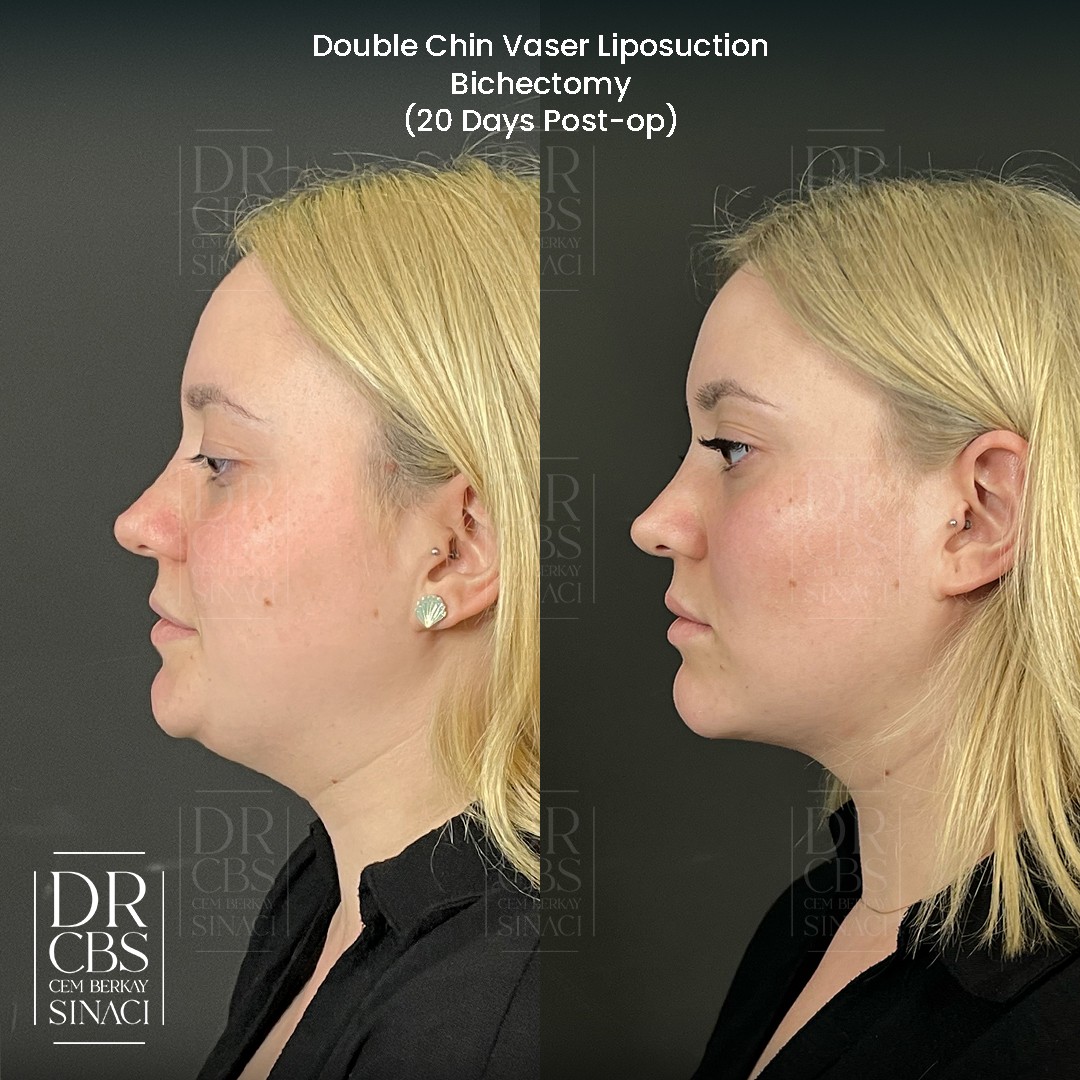
Patient Overview
Patient: Ilayda
Age: 24 years old
Gender: Female
Procedures: Buccal fat removal (cheek reduction), chin liposuction
After photos taken at: 10 months post-surgery
Location: Istanbul, Turkey
How to Get a Defined Jawline Without Touching the Jaw
The most searched question in facial aesthetics — how to get a defined jawline — carries an assumption that the jaw itself needs to change. Implants, fillers, bone shaving — the solutions that dominate search results all focus on modifying the jawbone or adding material to it. But for many patients, the jawline they want is already there. It is simply buried beneath volume that obscures it. Removing what hides the jaw can be more effective than altering the jaw itself.
Ilayda, a twenty-four-year-old patient of Dr. Cem Berkay Sinaci, had a well-structured jawline that was invisible beneath two layers of concealing volume: buccal fat pads that widened her lower cheeks, and submental fat that softened the transition from jaw to neck. Dr. Sinaci, a European board-certified plastic surgeon (FEBOPRAS) and member of ISAPS and ASPS, recognised that her facial contouring goal did not require building or augmenting anything — it required strategic subtraction. Buccal fat removal and chin liposuction together uncovered the defined jawline that her bone structure had always possessed.
Why Diet and Exercise Cannot Create Facial Definition
This is the frustration that drives most cheek reduction and face slimming consultations. The patient is at a healthy weight — sometimes even lean — yet her face retains a round, full appearance that does not match her body. She has tried caloric restriction, increased cardiovascular exercise, and every facial massage technique social media recommends. Nothing changes because the volume she is trying to eliminate is not responsive to these interventions.
Buccal fat is a deep, encapsulated fat deposit with its own blood supply and structural role. It does not participate in the body's general fat metabolism the way subcutaneous body fat does. A patient can reach her lowest healthy body weight and her buccal fat pads will remain essentially unchanged — maintaining the chubby cheeks and round lower face that make her feel her appearance does not reflect her fitness level.
Submental fat beneath the chin is somewhat more responsive to weight loss than buccal fat, but in many patients — particularly younger women with genetic predisposition — it persists stubbornly even at low body fat percentages. The combination of resistant buccal fullness and persistent chin fat creates a facial contour that no lifestyle modification can reshape.
For Ilayda at twenty-four, this disconnect between her body composition and her facial fullness was the core of her concern. Her body was lean. Her face was round. Surgery addressed the anatomy that diet could not.
Buccal Fat Removal at 24: Is It Too Young?
The question of age appropriateness for buccal fat removal generates significant debate online, and Ilayda's case addresses it directly. The concern is that buccal fat naturally diminishes with age, and removing it from a young patient might produce an overly gaunt or hollow appearance as she enters her forties and fifties.
This concern is valid in principle but overstated in practice when the procedure is performed conservatively on the right candidate. The key word is selection. Not every patient with round cheeks is a candidate for buccal fat removal, and not every candidate should have the same amount removed.
Dr. Sinaci evaluates buccal fat removal candidacy based on the size of the fat pad relative to the facial skeleton, the patient's overall facial fat distribution, and the skeletal structure beneath the soft tissue. Patients with strong cheekbone projection and a well-defined facial skeleton — like Ilayda — tolerate buccal fat reduction well because the bone structure provides permanent architectural support that prevents the hollowed appearance that concerns critics of the procedure.
Patients with flat cheekbones, minimal skeletal projection, and overall thin faces are poor candidates at any age because removing buccal fat from an already under-supported mid-face accelerates the appearance of volume loss. The procedure is not inherently too aggressive for young patients — it is too aggressive for the wrong facial anatomy, regardless of age.
What Buccal Fat Removal Actually Involves
The procedure is remarkably straightforward despite its dramatic effect. A small incision — approximately one centimetre — is made inside the mouth, on the inner surface of each cheek. Through this intraoral approach, the buccal fat pad is identified, gently separated from surrounding tissue, and partially or fully excised depending on the degree of reduction planned.
The entire procedure takes roughly thirty to forty minutes for both sides. There are no external incisions, no visible scars, and no sutures that require removal — the intraoral incisions heal rapidly in the moist oral environment. Post-operative discomfort is mild, managed with standard analgesics, and most patients return to normal activities within two to three days.
The most important technical detail is how much fat to remove. Complete excision of the entire buccal fat pad produces maximum cheek reduction but carries a higher risk of future hollowness. Partial excision — removing a precisely calculated portion — creates a meaningful slimming effect while preserving a volume reserve that maintains mid-face fullness as the patient ages. Dr. Sinaci calibrates the excision volume to each patient's anatomy, erring toward preservation in younger patients like Ilayda.
Chin Liposuction: Completing the V-Shape
Buccal fat removal slims the cheeks, but the defined jawline that patients search for requires definition along the entire jaw-to-neck transition. This is where chin liposuction completes the facial contouring equation.
Through one or two puncture-sized incisions hidden beneath the chin, a fine cannula removes the submental fat that blunts the cervicomental angle — the sharp transition between jawline and neck that defines a sculpted lower face. Once this fat layer is removed, the mandibular border becomes visible as a clean, continuous line from ear to chin. The jawline does not need to be larger or more projected — it simply needs to be revealed.
For Ilayda, the combination of cheek reduction above the jaw and fat removal below it created a defined jawline visible from every angle. The front view shows narrower cheeks and a V-shape facial taper. The profile view shows a sharp jaw-to-neck angle. The three-quarter view — the angle most commonly seen in daily life — shows the full effect of both procedures working together.
The Ten-Month Final Result
At ten months, both procedures have reached their permanent outcome. The buccal fat removal result, which emerges gradually over three to six months as surgical swelling resolves and tissue settles, has fully matured. The cheek contour at ten months is the cheek contour Ilayda will have at thirty, forty, and beyond — modified only by the natural, gradual facial volume changes that ageing produces in everyone.
The chin liposuction result has similarly stabilised. The skin has fully retracted around the reduced submental volume, the jawline definition is complete, and the fat that was removed will not regenerate. The defined jawline visible at ten months is a permanent structural change.
What Ilayda's ten-month photographs show is a face that has transformed from round to sculpted through subtraction alone. No implants were placed. No fillers were injected. No bone was modified. The facial skeleton that was always present has simply been revealed by removing the soft tissue volume that was concealing it.
Face Slimming Surgery in Istanbul
Ilayda's ten-month before and after demonstrates the power of strategic volume reduction for facial contouring. Buccal fat removal and chin liposuction together create a defined jawline, V-shape facial taper, and sculpted cheek-to-jaw transition that no non-surgical treatment can replicate permanently. For patients searching for face slimming surgery or cheek reduction in Istanbul, her case shows that the most natural-looking facial definition often comes not from adding structure but from uncovering the structure that already exists beneath the surface.