
Upper Eyelid Surgery Under Local Anaesthesia Result
Before and after upper eyelid blepharoplasty eye lift at four days under local anaesthesia. Dr. CBS performs natural upper eyelid rejuvenation in Istanbul.


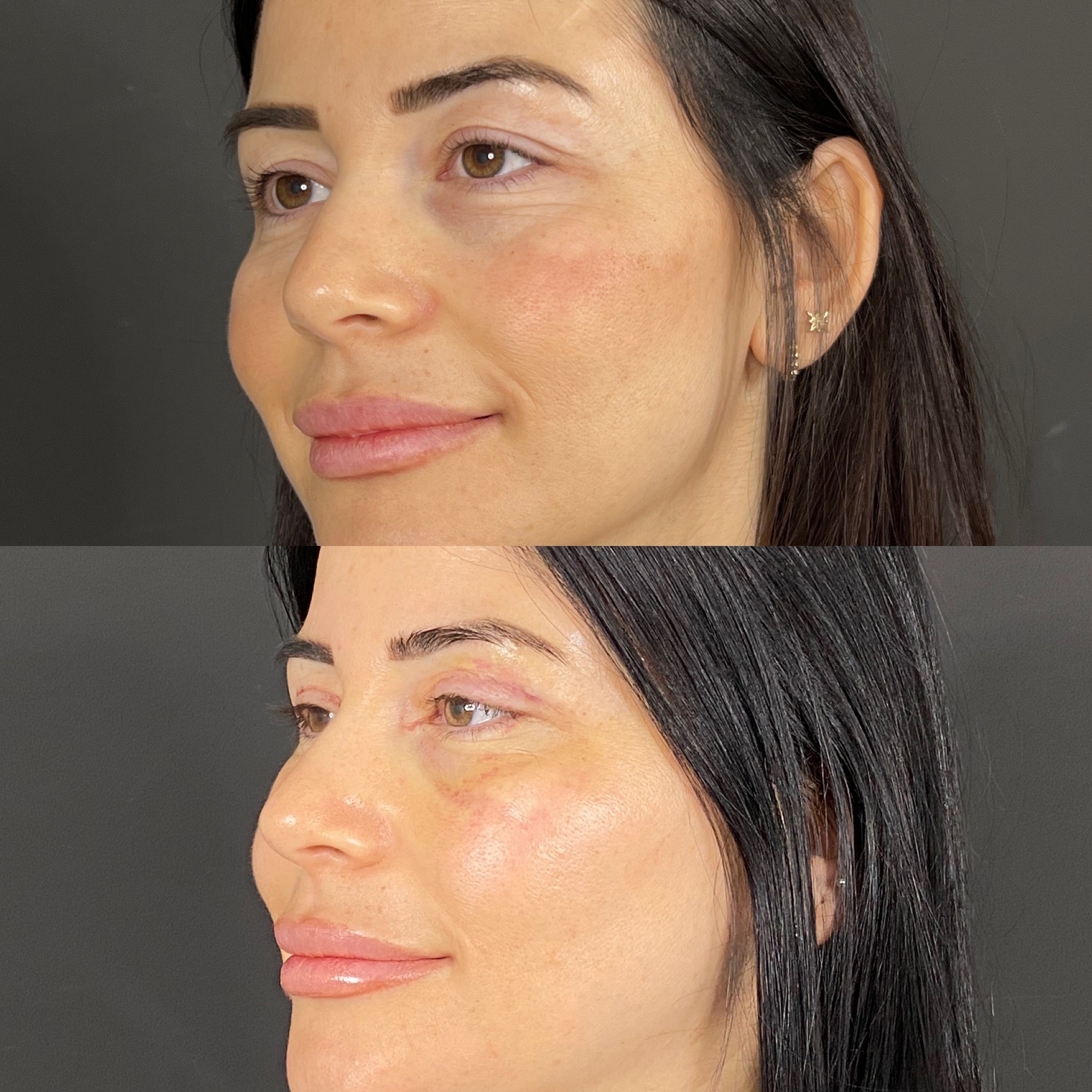
Patient Overview
Patient: Funda
Age: 36 years old
Gender: Female
Procedures: Upper eyelid surgery (upper blepharoplasty) under local anaesthesia
After photos taken at: 4 days post-surgery
Location: Istanbul, Turkey
The Eye Lift That Takes Thirty Minutes and Changes Everything
Of all the procedures in facial aesthetics, upper eyelid surgery delivers the most visible transformation relative to its simplicity. No bone work. No implants. No deep tissue dissection. A precise excision of excess skin from the upper eyelid crease, performed under local anaesthesia in approximately thirty minutes, produces a change in facial appearance that patients and their families describe as dramatic — yet no one can pinpoint exactly what is different. The eyes simply look more open, more alert, and more youthful. Funda's four-day before and after photographs demonstrate this effect at the earliest visible stage of recovery.
At thirty-six, Funda underwent upper blepharoplasty with Dr. Cem Berkay Sinaci, a European board-certified plastic surgeon (FEBOPRAS) and member of ISAPS and ASPS. Her case illustrates a point that many patients do not realise: upper eyelid surgery is not exclusively for patients in their fifties and sixties. Excess upper eyelid skin can be genetic, present from the twenties onward, and its correction is driven by anatomy rather than age.
Why Upper Eyelids Change Before Anything Else
The skin of the upper eyelid is the thinnest on the entire body — less than one millimetre in many individuals. This extraordinary thinness is what allows the eyelid to fold, stretch, and move with the speed and precision that blinking and expression require. But it also makes the upper eyelid the first area of the face to show the effects of skin redundancy.
Whether from genetic predisposition, early elasticity loss, or a combination of both, the upper eyelid skin can develop excess that drapes over the eyelid crease, hooding the eye and reducing the visible platform between lash line and brow. This hooding narrows the eye opening, creates a tired or heavy appearance, and can eventually interfere with peripheral vision if the skin descends far enough over the lash line.
Funda's upper eyelid redundancy at thirty-six was primarily genetic. Her skin quality remained youthful — no significant wrinkles, no sun damage, no loss of deep facial volume. The excess was confined specifically to the upper eyelid skin, which had always been fuller than she wanted. This anatomical specificity made upper blepharoplasty the ideal solution: a targeted correction of the one feature that was affecting her facial appearance.
The Local Anaesthesia Advantage
Dr. Sinaci performs upper eyelid surgery under local anaesthesia — the eyelids are numbed with a small injection of anaesthetic, and the patient remains awake and comfortable throughout the procedure. This approach offers several advantages over general anaesthesia that matter both clinically and practically.
The patient can open and close her eyes on command during surgery. This allows Dr. Sinaci to assess the symmetry of the skin excision in real time, comparing the two eyelids dynamically rather than estimating the result from a static, closed-eye position. The ability to check symmetry with the patient actively participating reduces the already small risk of asymmetric correction.
Recovery from local anaesthesia is immediate. There is no post-anaesthetic grogginess, no nausea, no hours spent in a recovery ward waiting for sedation to wear off. Funda left the clinic fully alert and independent, with clear post-operative instructions and the ability to care for herself from the moment she walked out.
The safety profile of local anaesthesia is inherently superior to general anaesthesia for a procedure of this scope. The risks associated with intubation, pharmacological unconsciousness, and systemic anaesthetic agents are eliminated entirely. For a procedure that takes thirty minutes and involves superficial tissue only, general anaesthesia adds risk without adding benefit.
What Four Days After an Eye Lift Looks Like
Funda's four-day photographs capture the upper blepharoplasty at a stage where the correction is visible but the healing signatures are still present. The excess skin that previously hooded her eyelids has been removed, and the difference in eye opening is immediately apparent. The eyes appear wider, more open, and more defined — the eyelid platform between lash line and crease is visible in a way it was not before surgery.
At four days, the expected post-operative signs include mild swelling along the incision line, faint bruising that may extend to the inner corner of the eye or the upper cheek, and a suture line visible within the eyelid crease. These signs are temporary and resolve on a predictable timeline.
The bruising, if present, typically transitions from purple-blue to yellow-green during the first week and clears completely by ten to fourteen days. Most patients find that bruising at this stage is easily concealed with sunglasses in social settings — the single most effective recovery accessory for any eye procedure.
The suture line sits within the natural eyelid crease — the fold that forms when the eye is open. This placement means the scar is hidden in the crease itself, invisible when the eye is open and visible only when the eye is closed and examined from very close range. As the scar matures over three to six months, it fades to a fine line that becomes virtually undetectable even on close inspection.
How Much Skin to Remove: The Critical Calculation
The artistry of upper blepharoplasty lies in the excision calculation. The surgeon must remove enough skin to eliminate the hooding and open the eye, but not so much that the eyelid cannot close fully or the brow is pulled downward by the tightened skin.
Dr. Sinaci marks the planned excision with the patient sitting upright before surgery, using calipers and a surgical marker to outline the precise amount of skin to be removed. The lower border of the excision follows the natural eyelid crease. The upper border is determined by a pinch test — gently grasping the excess skin with forceps until the eyelid just begins to separate from the underlying tissue, identifying the maximum safe excision.
This conservative approach, refined through Dr. Sinaci's fellowship with the internationally renowned plastic surgeon Raul Gonzalez in Brazil and cadaver training in Bangkok, prioritises natural results over maximum correction. An over-resected upper eyelid creates a hollow, skeletonised appearance that looks surgical and aged rather than refreshed. The goal is to remove exactly the amount of skin that restores a natural, rested eyelid contour — no more.
The Ripple Effect on the Entire Face
Upper blepharoplasty is an eye procedure, but its effect extends beyond the eyelids. When the hooded skin is removed and the eyes open more fully, the entire upper face appears lighter, more alert, and more energised. The brow often appears to sit slightly higher — not because it was lifted, but because the visual weight of the hooding skin is no longer pulling the eye area downward.
The overall facial expression changes at rest. A hooded upper eyelid creates a default expression that reads as tired, stern, or disengaged. An open, defined upper eyelid creates a default expression that reads as alert, approachable, and rested. This change in resting expression is one of the most appreciated outcomes of upper blepharoplasty — the patient looks the way she feels, rather than looking tired when she is perfectly awake.
For Funda at thirty-six, this expressive improvement means that the eye lift does not simply correct a cosmetic concern — it changes how her face communicates in every interaction, photograph, and video call.
Upper Eyelid Surgery in Istanbul
Funda's four-day before and after result shows what upper blepharoplasty achieves at its earliest visible stage — more open eyes, a refreshed upper face, and a natural result that does not look operated. For patients considering an eye lift in Istanbul, her case demonstrates that the procedure is brief, performed comfortably under local anaesthesia, and produces a visible improvement from the first days of recovery that continues to refine as healing progresses over the following weeks.