
Breast Lift with Implants 6 Month Natural Result
Breast lift with implants before and after at 6 months. Natural-looking mastopexy-augmentation long-term result by Dr. Cem Berkay Sinaci, Istanbul.


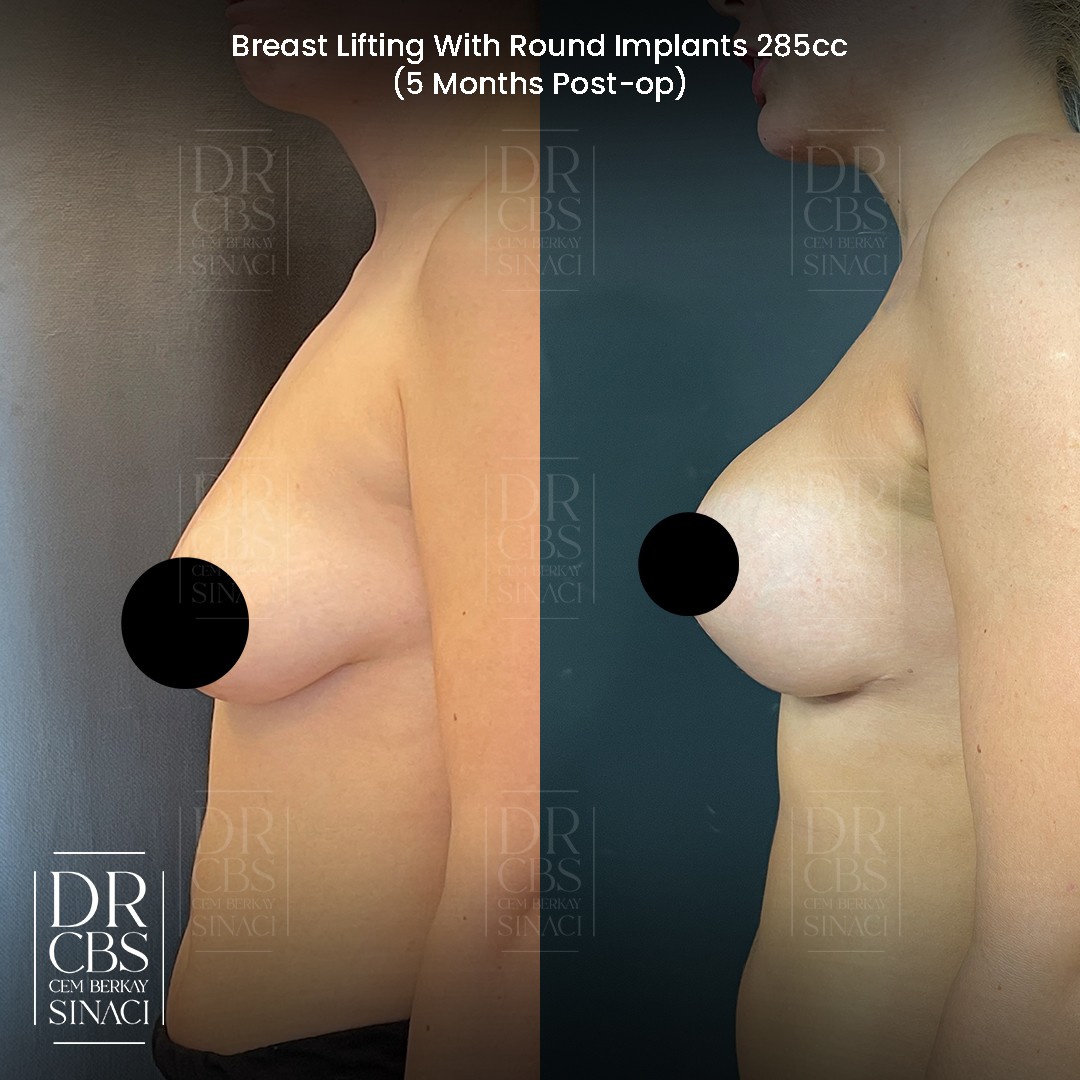
Patient Overview
Patient: Deniz
Gender: Female
Age: 32 years old
Procedures: Breast lift (mastopexy) with implant augmentation
After photos taken at: 6 months post-surgery
Case Description
Deniz's six-month result represents the point that most plastic surgeons consider the definitive outcome — the moment when every variable in the healing equation has been resolved and what the patient sees is what she will continue to see. While Zahra's 10-month case showed that subtle scar improvements continue beyond this point, the breast shape, position, softness, and overall aesthetic at six months are final. Nothing is still settling. Nothing is still swelling. The breast is finished.
Together, Zahra at 10 months and Deniz at 6 months give our gallery two long-term anchors that validate everything the earlier cases promise during their respective recoveries. They are the proof that the process works.
The Anatomy of a Natural-Looking Result
What makes a mastopexy-augmentation look natural rather than surgical? This is a question patients ask frequently but struggle to articulate precisely. They know it when they see it, but defining it is harder. Deniz's six-month result provides an opportunity to identify the specific characteristics that distinguish a natural outcome from an obviously augmented one.
The upper pole slope is gradual rather than convex. In the early postoperative weeks, the upper pole is rounded and prominent — the hallmark of a freshly augmented breast. At six months, that roundness has given way to a gentle, concave-to-straight slope from the collarbone down to the nipple. This is how a naturally full breast transitions from chest wall to projection point. The implant provides the volume, but the settled tissue drapes over it in a way that conceals the implant's presence.
The lower pole has a natural, teardrop curve. The fullest point of the breast sits at or slightly below the nipple level, with a smooth, convex curve from the nipple down to the inframammary fold. This curve is what gives the breast its feminine, soft appearance. It only emerges fully once the implant has completely settled and the tissue has relaxed around it — which is why the early postoperative shape, with its flat lower pole, looks so different from the final result.
The breast moves naturally with the body. At six months, the tissue has adapted completely to the implant. When Deniz leans forward, the breast falls naturally. When she lies down, it spreads laterally the way a natural breast does. When she moves her arms, the breast responds fluidly rather than remaining rigidly in place. This dynamic quality is impossible to achieve at two weeks or even two months — it requires the full maturation of the tissue-implant relationship.
The transition zones are invisible. The edges of the implant — where it ends and the natural chest wall begins — are completely concealed by the overlying tissue. There is no visible step-off, no palpable rim, no contour break. The breast blends seamlessly into the chest wall above, the cleavage medially, and the lateral chest toward the axilla. This invisibility of the transition is what allows the breast to pass as natural from any angle.
Why "Natural" Requires Surgical Restraint
Achieving a natural result is, paradoxically, harder than achieving a dramatic one. A dramatic result is a matter of volume — larger implants, more projection, more upper pole fullness. A natural result is a matter of proportion, balance, and knowing when to stop.
The implant must be sized to what the tissue can conceal, not to what the patient's imagination desires. An implant that exceeds the tissue's covering capacity will be visible and palpable, no matter how skilled the surgical technique. The breast envelope must be tightened enough to support the implant but not so much that it restricts natural movement. The nipple must be positioned at the point of maximum projection — too high and the breast looks artificially perky, too low and the lift appears insufficient.
Each of these decisions involves restraint — choosing the option that serves the long-term natural appearance over the one that maximizes immediate visual impact. Deniz's result at six months reflects that calibration. Her breasts are full, lifted, and beautifully shaped — but they do not announce themselves as augmented. They look like breasts she could have been born with, which is exactly what she wanted.
The Complete Mastopexy-Augmentation Timeline
With Deniz's six-month result, our gallery now documents mastopexy-augmentation across the full healing arc. The complete timeline that prospective patients can follow is: day 3, day 4, day 5, day 6, 13 days, 15 days, 1 month, 11 weeks, 6 months, and 10 months. Each case shows a different patient with different anatomy at a different stage — and together they construct a visual narrative of the settling process that no single before-and-after pair can provide.
The message of this timeline is consistent at every stage: the early result does not represent the final result, and the final result is worth waiting for. Deniz's six-month photographs are the most compelling evidence of that message — breasts that are soft, natural, proportionate, and settled in a way that makes the day-three and day-five cases look like they belong to a different procedure entirely. They do not. They belong to the same procedure. Only time separates them.
Surgeon's Note
Deniz's case is one I am particularly proud of because the result achieves what I consider the highest standard in mastopexy-augmentation: invisibility. Not invisibility of the breast — but invisibility of the surgery. Nothing about Deniz's six-month result announces that a procedure was performed. The shape is natural. The proportions are harmonious with her frame. The scars have faded into the breast's natural contours. The implant is undetectable.
This is the result I show during consultations when patients tell me they want to look natural. Not every patient wants this — some prefer a more obviously augmented appearance, and that is an equally valid choice. But for patients who want enhancement that integrates seamlessly with their body, Deniz demonstrates that it is achievable. It requires careful implant selection, precise surgical technique, and — above all — the patience to let the settling process run its full course.
At six months, there is nothing left for time to improve. This is the result. And I believe it speaks for itself.