
Deep Plane Facelift at 63: One-Month Early Photos
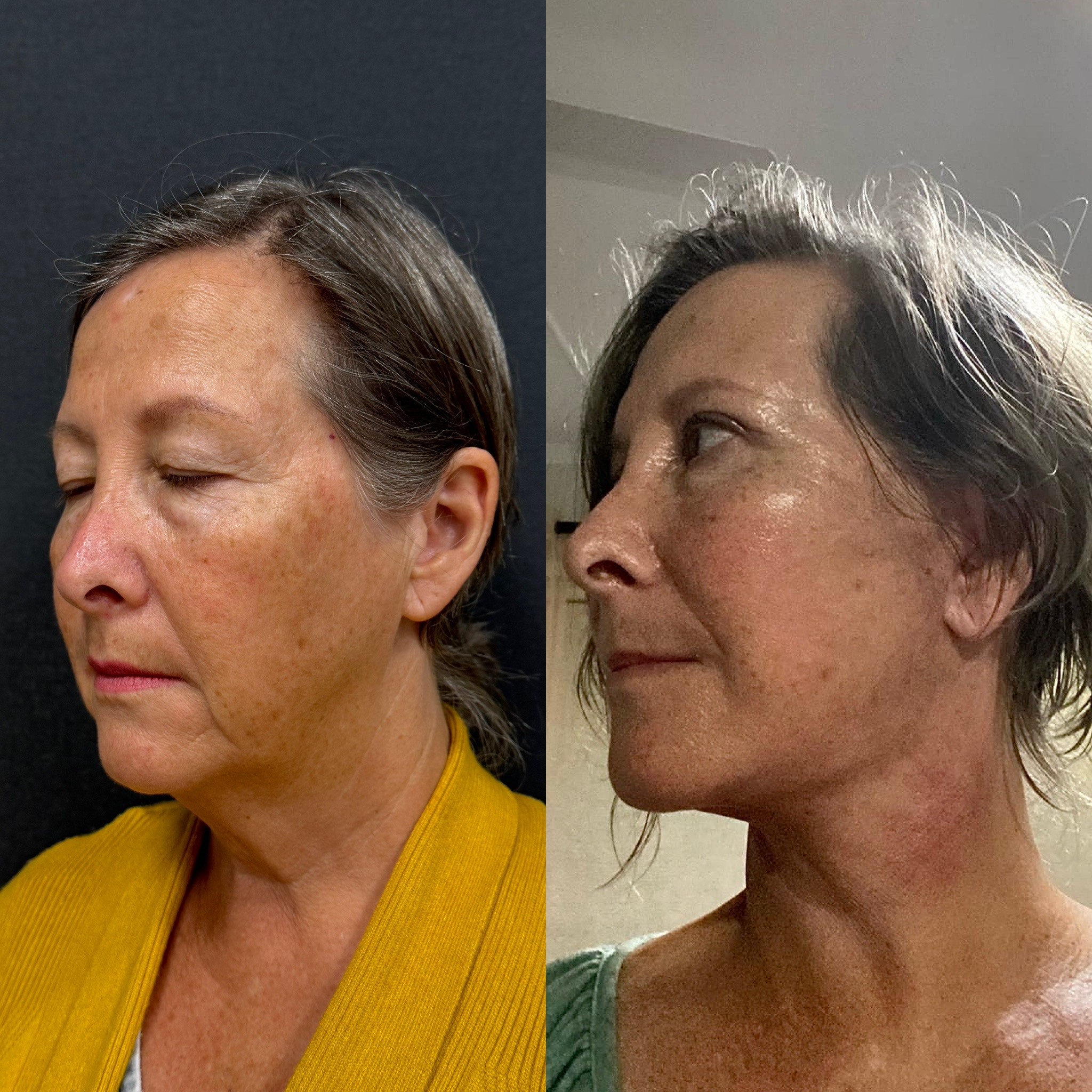
Before and after deep plane facelift, neck lift and upper blepharoplasty at 1 month in a 63-year-old Australian. Early results from plastic surgeon in Istanbul


Patient Overview
Patient: Cindyta
Age: 63
Gender: Female
Procedures: Deep plane facelift, neck lift, upper blepharoplasty
After photos taken at: 1 month post-op (still healing, residual swelling)
Origin: Australia
Location: Istanbul, Turkey
When Your Daughter's Result Brings You to the Same Surgeon
Cindyta's journey to Istanbul began not with her own research but with her daughter's face. Zoey, her 42-year-old daughter, had undergone a short scar deep plane facelift with submandibular gland removal and browlift with Dr. Sinaci earlier that year. Cindyta watched her daughter heal, saw the result mature, and observed firsthand the quality of care throughout the process — from the preoperative consultation through recovery and follow-up. That direct, daily observation of her daughter's experience led Cindyta to make the same journey from Australia to Istanbul for her own facial rejuvenation.
A mother choosing the same surgeon who operated on her daughter is among the most meaningful endorsements a practice can receive. It reflects not just confidence in the aesthetic result but trust in the surgical safety, the postoperative care, and the overall integrity of the experience.
Facial Rejuvenation at 63: Adapted Technique, Same Principles
At 63, Cindyta's facial ageing was more advanced than her daughter's — more pronounced jowling, greater skin redundancy, deeper cervical laxity, and more significant upper eyelid hooding. The deep plane principles remain identical regardless of age, but the technical execution adapts to the tissue reality. Skin elasticity at 63 is reduced compared to 42, which means the surgeon must account for different redraping characteristics. The deeper structures may require more extensive ligament release to achieve adequate mobilisation. The amount of skin ultimately removed is typically greater than in a younger patient.
Dr. Cem Berkay Sinaci, a fellow of the European Board of Plastic Reconstructive and Aesthetic Surgery (FEBOPRAS) and member of ISAPS and ASPS, planned a deep plane facelift with neck lift and upper blepharoplasty — addressing the lower face, neck, and eyes as a unified rejuvenation. Having trained in advanced facial rejuvenation through fellowship with Raul Gonzalez in Brazil and cadaver dissection courses in Bangkok, Dr. Sinaci applies the same deep plane philosophy across all ages while calibrating the execution to the specific tissue quality and degree of correction required in each individual case.
The Deep Plane Facelift and Neck Lift
The deep plane technique works beneath the SMAS layer, releasing retaining ligaments and elevating the descended midface, jowl, and cheek tissue as a single composite flap. For Cindyta, this meant repositioning tissue that had descended significantly over more than six decades — restoring the jowl volume above the mandibular border, recreating midface projection, and redefining the jawline contour.
The neck lift addressed platysmal laxity, skin excess, and the loss of the cervicomental angle that had progressively blurred the transition between chin and neck. The platysma was tightened, the cervical skin was redraped, and the excess was removed. At one month, the improvement in neck contour and jawline definition is already apparent despite the residual swelling that is normal at this stage of healing.
Upper Blepharoplasty
Cindyta's upper eyelids showed significant skin redundancy — excess tissue that had progressed beyond hooding into functional territory, encroaching on the superior visual field. The upper blepharoplasty removed this excess through an incision within the natural eyelid crease, restoring a defined lid platform and eliminating the heavy, curtained appearance that was making her eyes look smaller and more fatigued.
Non-dissolvable sutures were used for the closure. In the thin eyelid skin, these sutures produce minimal inflammatory reaction and yield finer scars than dissolvable alternatives. They were removed at four to six days. At one month, the eyelid incisions are already settling into the crease and will continue to fade over the coming months.
Honest One-Month Photographs: Still Healing
Cindyta's photographs at one month are presented with full transparency about what they represent: a patient still in the active healing phase. Residual swelling is visible, particularly along the jawline, in the preauricular area, and in the midface. This oedema is entirely normal at four weeks after a deep plane facelift and represents the body's ongoing healing response to the deeper tissue manipulation.
What is important to understand when viewing one-month photographs is the distinction between what will change and what will not. The structural repositioning — the corrected jowls, the redefined jawline, the improved neck contour, the open eyelids — is permanent. These elements are visible even through the swelling. What will change is the surface refinement: the swelling will resolve completely over the next two to three months, the tissues will soften from their current firmness, any mild asymmetry between the two sides will equalise, and the scars will continue to fade.
By three months, the swelling will have resolved and the result will closely approximate its final appearance. By six months, the tissues will be fully settled. The result Cindyta sees at that point will be the version she carries forward — a naturally rejuvenated face that ages gradually from its new, restored baseline.
Recovery at 63 Compared to Younger Patients
Recovery after deep plane facelift follows the same general timeline regardless of age, but patients in their sixties may notice that certain aspects take modestly longer than they would in a younger patient. Bruising may persist slightly longer due to changes in capillary fragility. Tissue firmness may take an additional few weeks to fully soften. Swelling resolution follows a similar trajectory but may lag behind the timeline of a patient in her forties or fifties by one to two weeks.
These differences are subtle and do not represent complications — they are the normal variation in healing biology across different decades of life. The final result is not compromised by the slightly extended timeline. It simply requires the patience to allow the tissues the additional time they need to complete their healing.
A Family's Trust Across Continents
The story of Cindyta and Zoey — mother and daughter, both travelling from Australia to Istanbul, both entrusting their facial rejuvenation to the same surgeon — illustrates a pattern of care that extends beyond individual procedures. When a family places its collective trust in a practice, it reflects confidence built on direct observation of results, honest communication about what surgery can and cannot achieve, and the kind of aftercare that makes international patients feel supported throughout their journey.
For Australian patients considering facial rejuvenation in Istanbul, Cindyta's case demonstrates that comprehensive deep plane facelift surgery is both safe and effective in the seventh decade of life when performed by a board-certified plastic surgeon with the experience to adapt technique to the specific demands of each patient's anatomy and age.