
Lower Face Neck Lift 6 Month Final Result Before After
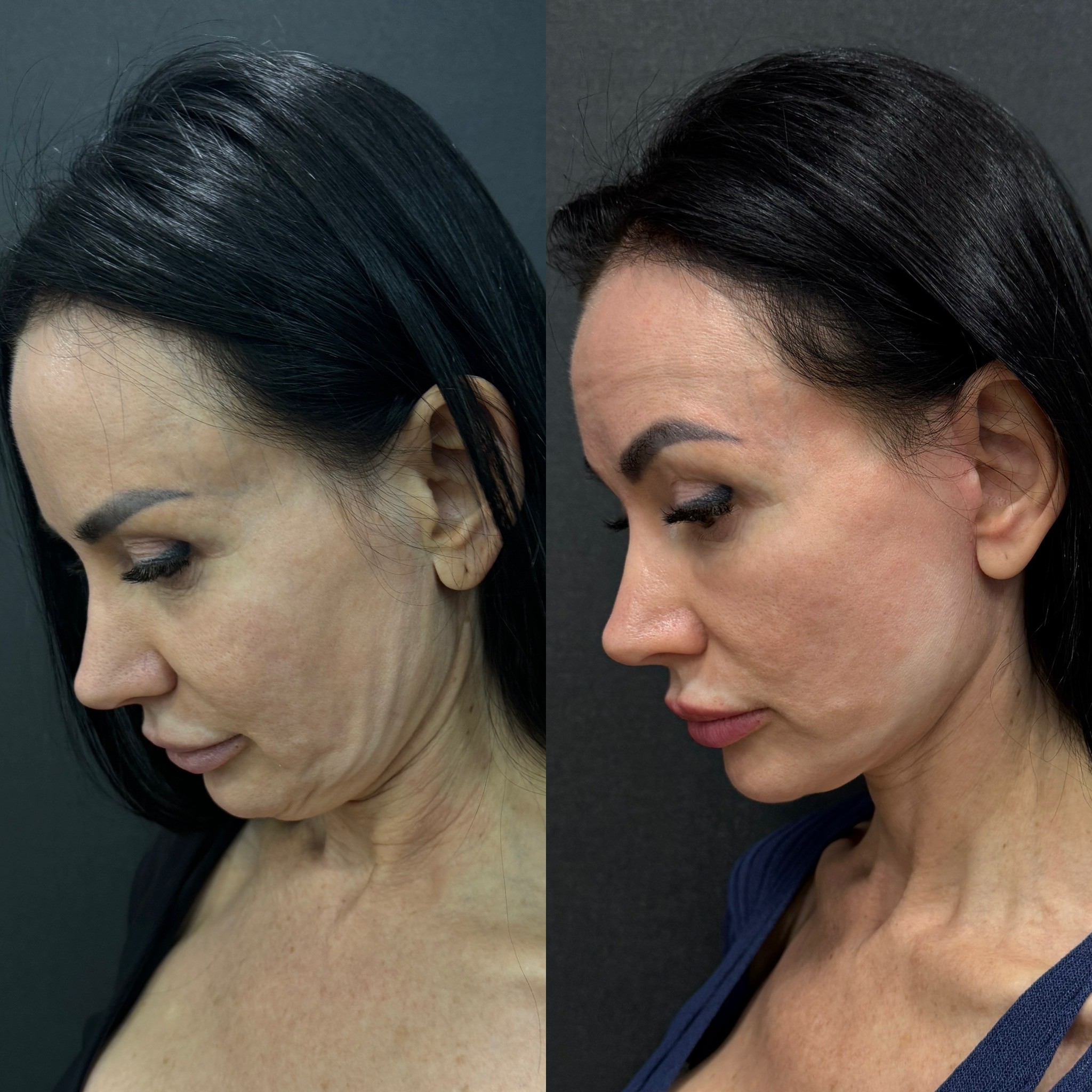
6-month final result before after of lower face and neck lift for 50-year-old female from USA by board-certified plastic surgeon Dr. Sinaci in Istanbul, Turkey


Patient Overview
Patient: Chloey
Age: 50 years old
Gender: Female
Procedures: Lower face and neck lift
After photos taken at: 6 months post-surgery
Origin: United States of America
Location: Istanbul, Turkey
What a Face and Neck Lift Looks Like at Six Months — The Settled Result
Six months after surgery is the milestone that plastic surgeons consider the point of maturation for a lower face and neck lift. By this stage, every layer of the surgical correction has fully healed. The repositioned tissues have integrated into their new location, the swelling that masked fine details during the first three months has completely resolved, and the skin has finished adapting to its redraped contour. What you see at six months is the result. For Chloey, a 50-year-old woman from the United States, her six-month photographs represent the definitive outcome of her lower face and neck lift performed in Istanbul by Dr. Cem Berkay Sinaci, a Fellow of the European Board of Plastic Reconstructive and Aesthetic Surgery (FEBOPRAS) and active member of ISAPS and ASPS. Unlike early postoperative images that require caveats about ongoing healing, these photographs show the stable, lasting transformation that Chloey will carry forward for years.
Why Fifty Is a Strategic Age for Lower Face and Neck Lift Surgery
The decision of when to have a facelift is as important as the decision of which technique to choose. At 50, Chloey's timing was strategically ideal. Her skin retained enough elasticity to redrape smoothly over the repositioned deeper structures, yet the degree of descent in her lower face and neck had progressed sufficiently to benefit meaningfully from surgical correction. This balance between tissue quality and degree of ageing is what makes the late forties to early fifties a particularly effective window for facelift surgery.
Patients who wait too long face a different set of challenges. Skin that has lost the majority of its elasticity does not contract as readily over a tightened foundation, which can limit the smoothness of the final contour. Patients who seek surgery too early, before meaningful descent has occurred, may find that the improvement is subtle to the point of being difficult to appreciate. At 50, Chloey had reached the point where the jowling along her jawline, the deepening nasolabial folds, and the laxity developing in her neck were all clearly present and correctable, while her skin quality was still excellent enough to produce a beautifully smooth result.
Restoring Jawline Definition Through Lower Facelift Surgery
The jawline is one of the defining features of a youthful face. In youth, a clean, continuous line runs from the chin along the mandible to the angle of the jaw beneath the ear. This line provides structural definition that separates the face from the neck and gives the lower third of the face its shape. As the deep tissues descend with age, fat and soft tissue accumulate along and below this line, creating jowls that break the smooth contour and make the lower face appear heavy and square.
Chloey's lower facelift addressed the jowling by lifting the descended tissue away from the jawline and repositioning it back to its original location higher on the cheek and lateral face. Dr. Sinaci released the retaining ligaments that were anchoring the tissue in its descended position and elevated the entire soft tissue layer as a unit, restoring the clean mandibular border that had been obscured. At six months, Chloey's jawline is sharply defined from chin to ear, with no residual heaviness or tissue accumulation along the border. The jowls that previously dominated her lower face profile are gone.
Neck Contouring and the Cervicomental Angle
The neck component of Chloey's procedure focused on restoring the cervicomental angle, the angle formed where the chin meets the neck when viewed from the side. A youthful cervicomental angle is sharp and well-defined, typically between 105 and 120 degrees. As the neck ages, this angle becomes obtuse as skin loosens, the platysma muscle weakens and separates, and fat accumulates beneath the chin. The result is a blunted, undefined transition between face and neck that adds years to the appearance.
Dr. Sinaci's neck lift corrected each of these contributing factors. The platysma was tightened to restore the muscular support that maintains neck definition. Submental fat was removed to clean the space beneath the chin. The excess skin was redraped over the newly tightened foundation and trimmed to eliminate redundancy. At six months, Chloey's cervicomental angle has been restored to a youthful degree of sharpness, and the smooth transition from chin through neck to collarbone is one of the most striking elements of her result.
The Difference Between Early Results and the Six-Month Maturation
Patients who have followed this gallery know that earlier postoperative photographs — at five days, two weeks, or even one month — show results that are impressive but still evolving. Comparing those early stages to a six-month result like Chloey's reveals the degree of refinement that occurs during the months of tissue settling and swelling resolution.
At one week, the structural improvement is visible but masked by significant swelling and bruising. At one month, the bruising has resolved and the improvement is clearly apparent, but residual deep tissue fullness still softens the contour. At three months, the result is close to final but subtle firmness and minor asymmetries may still be present. At six months, everything has settled. The tissues are soft, the contour is smooth, and the result has reached its permanent state.
For prospective patients evaluating before and after galleries, understanding this timeline is critical. Early photographs show what the first weeks of recovery look like. Six-month photographs show what you will actually live with. Chloey's images represent this permanent outcome, the face and neck contour that she will see in the mirror every day and that will age gracefully from this improved baseline over the coming decades.
How Long a Lower Face and Neck Lift Result Lasts
One of the most frequently asked questions about facelift surgery is how long the result will last. The answer depends on the technique used, the patient's tissue quality, and their lifestyle and genetic ageing pattern. A well-performed lower face and neck lift does not stop ageing, but it resets the clock. Chloey's face and neck will continue to age from the day of surgery forward, but they will age from the improved position that the surgery established. This means that at 60, she will look like a well-rested 60-year-old rather than carrying the degree of descent and laxity she would have had without intervention.
Most patients enjoy the primary benefits of a lower face and neck lift for approximately 10 to 15 years before gravitational descent and continued ageing bring the tissues back to the pre-surgical level of laxity. Some patients choose a secondary procedure at that point, while others are satisfied with the decade-plus of improvement and allow natural ageing to continue. Because Chloey had her procedure at 50, she can reasonably expect the core benefits to remain visible well into her early to mid-sixties, with some patients maintaining noticeable improvement for even longer depending on their skin quality and lifestyle factors such as sun exposure, smoking status, and weight stability.
Why American Patients Choose Istanbul for Face and Neck Lift Surgery
Chloey joins a growing cohort of patients from the United States who select Istanbul for their facial rejuvenation surgery. The city has earned its reputation as a global centre for plastic surgery through a combination of high surgical volume, rigorous training standards, and modern clinical infrastructure. For American patients specifically, the factors driving the decision include access to advanced techniques, comprehensive international patient coordination, and the ability to combine their surgical journey with recovery in a culturally rich environment.
Dr. Sinaci's qualifications align with the standards that informed American patients seek when choosing a surgeon abroad. European board certification through FEBOPRAS, active membership in both ISAPS and ASPS, fellowship training with world-renowned surgeon Raul Gonzalez in Brazil, and cadaver-based facial anatomy training in Bangkok together provide the verified, international-calibre expertise that makes travelling across the Atlantic for surgery a confident decision. Chloey's six-month result speaks for itself — a natural, lasting transformation achieved with surgical precision and an understanding of facial anatomy that transcends borders.