
Lip Lift Suture Technique: Why Stitch Type Matters
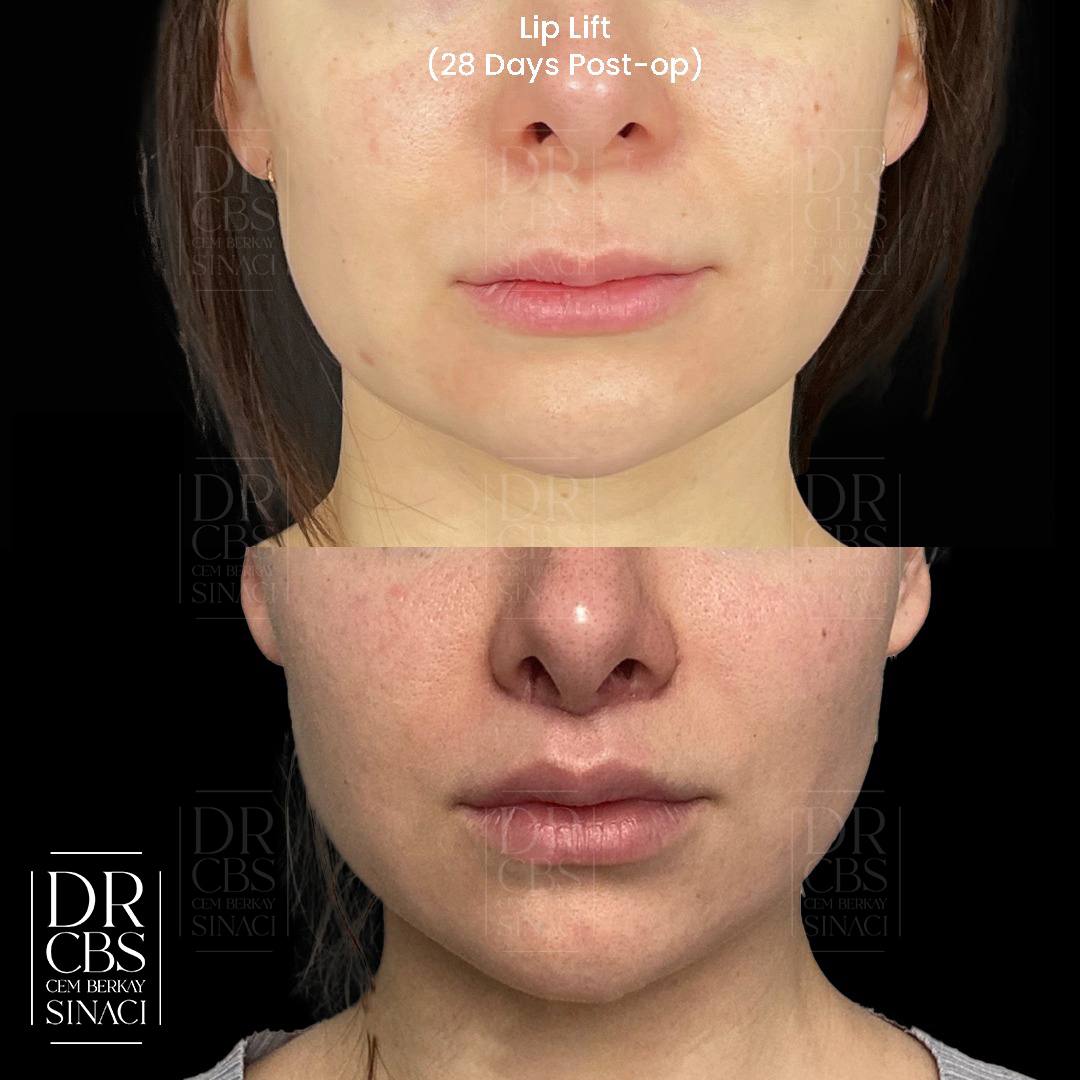
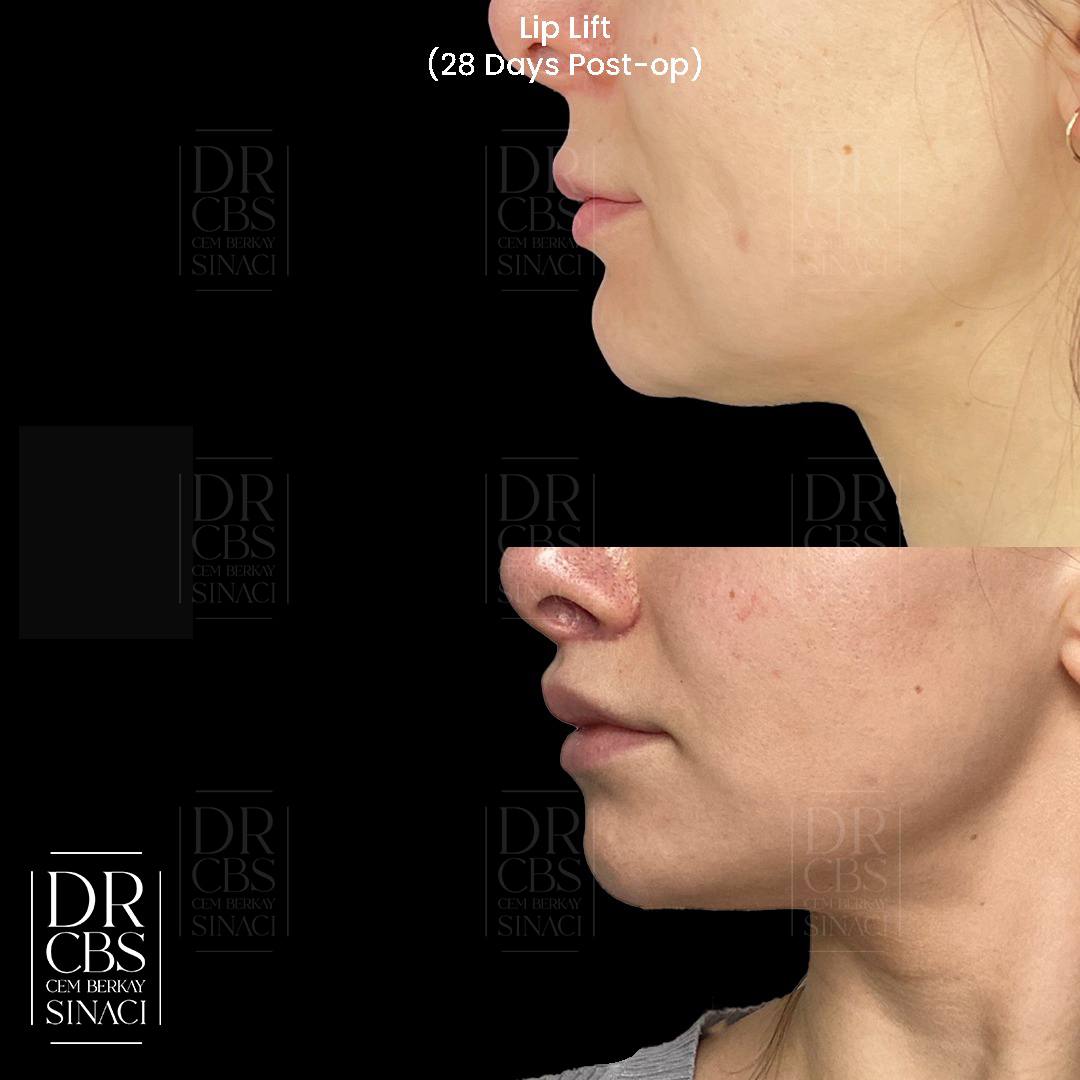
Before and after bullhorn lip lift at one month with faded scars. Dr. CBS explains why non-dissolvable sutures produce better lip lift scars in Istanbul.

Patient Overview
Patient: Angela
Age: 28 years old
Gender: Female
Procedures: Bullhorn lip lift
After photos taken at: 1 month post-surgery
Location: Istanbul, Turkey
The Detail That Affects Every Lip Lift Scar
Patients researching lip lift surgery compare surgeons, techniques, and before-and-after galleries — but almost nobody asks about suture material. It seems like a minor technical detail, the kind of decision best left entirely to the surgeon. Yet the choice between dissolvable and non-dissolvable stitches has a direct, measurable impact on the quality of the scar that every lip lift patient will carry permanently. It is one of those invisible decisions that produces very visible consequences.
Angela, a twenty-eight-year-old patient of Dr. Cem Berkay Sinaci, demonstrates what meticulous suture technique contributes to a lip lift outcome. At one month, her scar has already faded to a point where it is not noticeable during normal interaction — a result that reflects both her individual healing biology and the specific surgical choices Dr. Sinaci made during her procedure. Dr. Sinaci, a European board-certified plastic surgeon (FEBOPRAS) and member of ISAPS and ASPS, uses non-dissolvable suture material in every lip lift and removes the stitches between days five and seven. This is a deliberate clinical decision, not a matter of convenience, and the reasoning is rooted in scar biology.
Why Non-Dissolvable Sutures Produce Better Scars
Dissolvable sutures are designed to break down within the body through an inflammatory process called hydrolysis or enzymatic degradation. The body recognises the suture material as foreign, mounts an inflammatory response to break it down, and gradually absorbs the fragments over weeks to months. This process is convenient — no suture removal appointment is needed — but it comes at a cost that matters enormously in a visible facial scar.
The inflammatory reaction required to dissolve the suture material does not limit itself precisely to the suture thread. It radiates into the surrounding tissue, producing a zone of prolonged inflammation along the entire incision line. This extended inflammatory phase stimulates more aggressive collagen deposition — the body's repair cells, activated by the ongoing foreign body response, produce thicker, more disorganised scar tissue than they would in the absence of that inflammatory stimulus.
The result is a scar that is wider, more raised, and slower to fade than it would have been with a material that does not provoke an ongoing tissue reaction.
Non-dissolvable sutures sit inertly within the tissue. They hold the wound edges together with precision, but they do not trigger a sustained inflammatory response because the body is not attempting to break them down. When these sutures are removed at five to seven days — once the wound edges have bonded sufficiently to maintain their approximation independently — they leave behind tissue that has healed under minimal inflammatory provocation. The resulting scar is thinner, flatter, and progresses through its maturation phases faster.
For a scar that sits on the face, directly beneath the nose, in a location that the patient sees in every mirror and every photograph for the rest of her life, this difference in scar quality is not trivial. It is the reason Dr. Sinaci chooses non-dissolvable material for every lip lift patient despite the minor inconvenience of a suture removal appointment.
The Five-to-Seven-Day Removal Window
The timing of suture removal is as important as the material choice. Stitches left in too long — beyond seven to ten days in facial skin — can produce "railroad track" marks: small permanent dots or lines perpendicular to the incision where the suture entry and exit points scarred from prolonged pressure on the skin surface. Stitches removed too early — before day five — risk wound edge separation because the tissue has not yet developed enough tensile strength to hold itself together.
The five-to-seven-day window represents the optimal balance. By day five, the wound edges have bonded through early collagen crosslinking with sufficient strength to maintain their approximation without external support. By day seven, the maximum benefit of suture support has been achieved, and any additional time adds risk of suture marks without meaningful gain in wound strength.
Dr. Sinaci schedules suture removal within this window for all lip lift patients. The removal itself is quick and minimally uncomfortable — the non-dissolvable stitches slide out cleanly, and the incision line, now self-supporting, continues its healing without interruption.
Practical Advice for International Patients
Many of Dr. Sinaci's lip lift patients travel to Istanbul from abroad, and their stay in Turkey may be shorter than the five-to-seven-day suture removal window requires. For patients who plan to stay fewer than five days, Dr. Sinaci recommends having the sutures removed after returning home by a qualified health professional — a plastic surgeon, dermatologist, or trained nurse who can perform the simple removal procedure.
This recommendation ensures that patients are not pressured into extending their travel plans unnecessarily, while also ensuring that the non-dissolvable suture protocol — and its scar quality benefits — are not compromised by substituting dissolvable materials for the sake of convenience. The suture removal is a straightforward procedure that any medical professional can perform with basic instruments. Dr. Sinaci provides written post-operative instructions that the patient can share with her local healthcare provider, specifying the removal timing and technique.
The priority is always scar quality over scheduling convenience. A patient who uses dissolvable sutures to avoid a removal appointment saves one brief medical visit but potentially lives with a less favourable scar permanently. A patient who arranges local suture removal invests a few minutes of professional time and gains the long-term benefit of a scar that healed under optimal conditions.
Angela's One-Month Result
At four weeks, Angela's lip lift result has settled into its near-final form. The upper lip proportion is corrected — shorter, more defined, with increased vermilion show that enhances her natural lip shape. The tissue has fully softened, lip mobility is completely natural, and the correction has integrated seamlessly into her facial anatomy.
Her scar at one month has faded to a degree that exceeds the average timeline. It is not noticeable during conversation, does not require concealment with makeup in most settings, and sits within the nasal base crease where natural shadow further minimises its presence. This is an excellent result — but Dr. Sinaci is careful to note that it is not a guarantee for every patient. Individual genetics, skin type, and healing biology all influence scar maturation speed. Some patients reach Angela's level of scar fading at one month; others require three to six months to achieve the same degree of invisibility.
This honest framing is important. Using Angela's result as a universal promise would be misleading. Using it as an example of what is achievable under favourable conditions — the right genetics, precise surgical technique, non-dissolvable sutures, and diligent aftercare — is both accurate and informative for prospective patients.
What Angela's Scar Will Look Like at Six and Twelve Months
The scar that is already difficult to detect at one month will continue its maturation over the coming year. Between months one and six, the remaining faint pigmentation will fade further, and the collagen within the scar will reorganise into a flatter, more uniform configuration. Between months six and twelve, the final subtle refinements occur — the scar reaches its ultimate colour match with surrounding skin and its texture becomes virtually indistinguishable from the adjacent nasal base tissue.
By one year, Angela's scar will require deliberate, close-range inspection to identify. Under normal lighting and at normal social distances, it will be invisible — a permanent outcome that reflects the cumulative effect of non-dissolvable suture technique, appropriate removal timing, favourable genetics, and consistent scar care.
Lip Lift Suture Choice in Istanbul
Angela's one-month before and after result demonstrates how a technical decision that patients rarely think to ask about — suture material — contributes to the scar quality that patients care about most. For anyone researching bullhorn lip lift in Istanbul, understanding that non-dissolvable sutures removed at five to seven days produce less tissue reaction and better long-term scarring than dissolvable alternatives provides a concrete question to ask during consultation — and a meaningful way to evaluate the attention to detail that a surgeon brings to every aspect of the procedure.